In short:
- Measure the top of your dog’s shoulder blade while they stand naturally.
- Set the bowl rim at about two-thirds of that shoulder height.
- Watch your dog eat and adjust from there, since that’s the real test.
- Senior dogs, flat-faced breeds, and fast eaters may need tweaks to this rule.
- Dogs who eat lying down do best with the bowl at floor level or just slightly raised.
- Re-measure as your dog grows, ages, or slows down — the right height isn’t a one-time decision.
Why Bowl Height Matters More Than You Think
You’ve probably never given it much thought. You put the bowl on the floor, the dog eats, everyone’s happy. But watch an older dog with a stiff neck, or a tall breed hunched awkwardly over a bowl that sits too low, and you start to notice something: the height of that bowl actually matters.
Getting it right isn’t about buying fancy equipment. It’s about matching the bowl to your dog’s body so mealtime is comfortable, not a daily strain. Too low, and your dog stretches and gulps air. Too high, and they struggle to reach or eat in an unnatural position. The sweet spot is surprisingly simple to find once you know what to measure.
In this guide, we’ll walk you through exactly how to measure the correct height for your dog’s food bowl, using nothing more than a tape measure, your dog, and a couple of minutes.
Start With the Right Landmark: The Shoulder, Not the Head
Here’s where most people go wrong. They eyeball the bowl against the dog’s legs or guess based on the dog’s overall size. That’s a recipe for a bowl that’s either too low or too high.
The single most reliable reference point is the top of your dog’s shoulder blade — the highest point of the shoulder, right where the neck meets the back. That’s your anchor.
Why the shoulder? Because it reflects your dog’s natural standing posture. When a dog eats, the front legs stay planted and the neck extends downward. The shoulder height tells you where the neck movement starts, and that’s what determines a comfortable reach.
How to find the shoulder point
- Have your dog stand naturally on a flat surface — not sitting, not lying down.
- Run your fingers along the spine from the neck toward the tail until you feel the first prominent bony ridge. That’s the withers, just behind the neck.
- The top of the shoulder blade sits right around there. Mark that spot mentally.
- Measure straight down from that point to the floor with a tape measure.
Real example: A Labrador standing calmly measures about 55–60 cm at the shoulder. A Chihuahua might measure 15–20 cm. Those numbers matter, but they’re only the starting point — the actual bowl height will be a fraction of that.
The Simple Rule: Bowl Height Is Roughly Two-Thirds of Shoulder Height
Once you have your dog’s shoulder height, the math is easy. For most dogs, the rim of the bowl should sit at around two-thirds of the shoulder height. This puts the food at a level where the neck stays in a relaxed, slightly downward curve — no craning, no hunching.
Let’s put that into practice:
| Dog size | Approx. shoulder height | Suggested bowl rim height |
|---|---|---|
| Small (e.g., terrier) | 25–35 cm | 15–23 cm |
| Medium (e.g., border collie) | 45–55 cm | 30–37 cm |
| Large (e.g., German shepherd) | 60–70 cm | 40–47 cm |
| Giant (e.g., Great Dane) | 75–90 cm | 50–60 cm |
These are starting points, not gospel. Every dog is built differently. A deep-chested dog may need the bowl slightly lower to avoid swallowing air, while a dog with a long, straight neck might do better a touch higher.
Watch your dog eat — the real test
Numbers get you close. Observation gets you the rest of the way. Fill the bowl and watch.
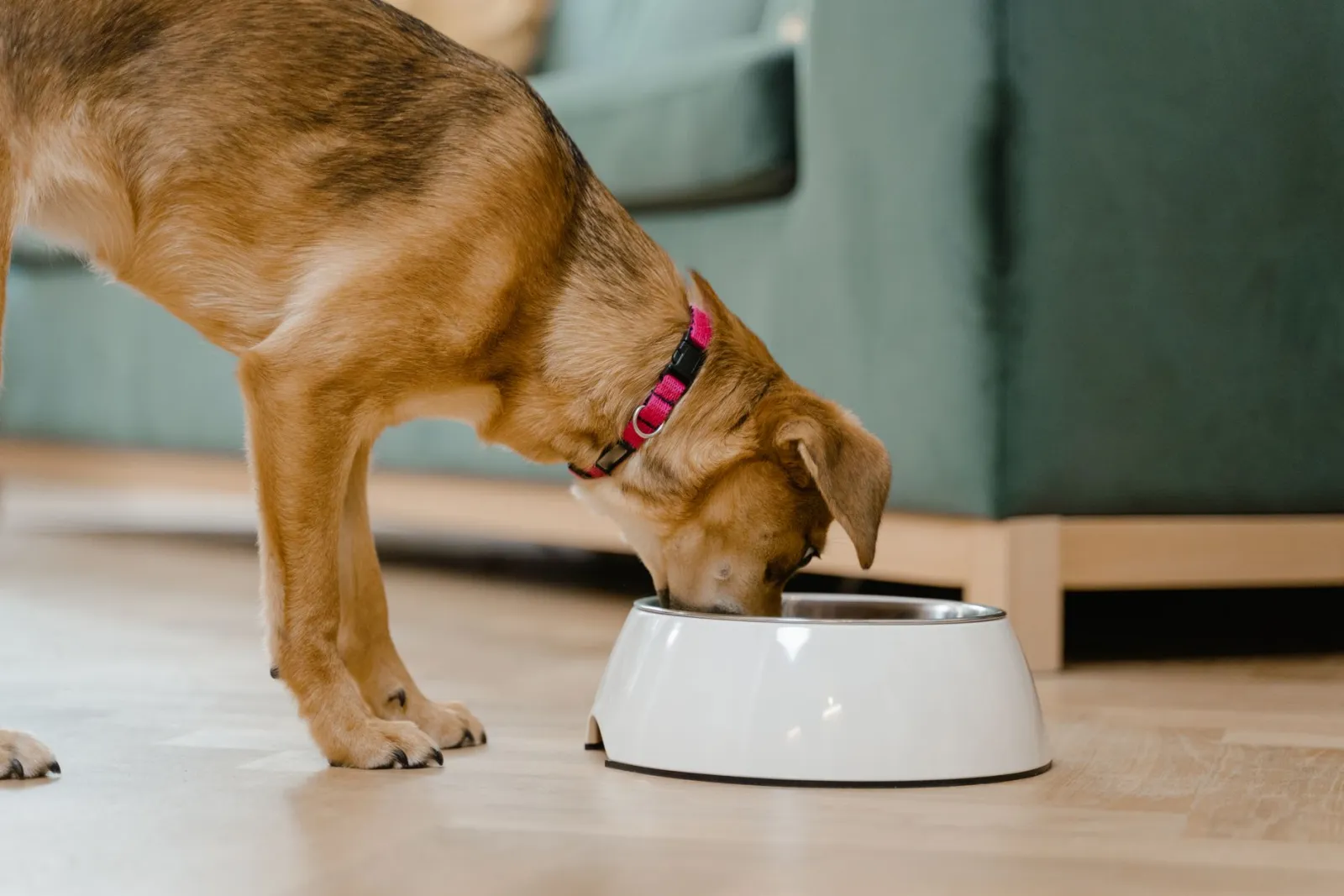
- Good sign: The neck slopes gently down, the back stays level, and the dog eats without shifting its paws.
- Too low: The front legs splay, the elbows lock, and the dog’s throat looks compressed. You might hear gulping or see air swallowing.
- Too high: The dog lifts its head unnaturally, backs away, or scoops food out onto the floor because it can’t reach the bottom comfortably.
Real example: A friend’s senior golden retriever had started leaving food behind. The bowl was on the floor. Raising it to about 40 cm — roughly two-thirds of the dog’s shoulder height — had the dog finishing every meal within two days. The issue wasn’t appetite. It was neck pain.
Adjust for Age, Health, and Eating Style
The two-thirds rule is a baseline. Several factors should push you to adjust up or down.
Senior dogs and dogs with joint issues
A dog that once ate happily from the floor may now find it painful to lower its head. For these dogs, raising the bowl slightly above the standard measurement often helps. The goal is to minimise neck flexion, not eliminate it.
If your dog has been diagnosed with a specific condition — cervical disc disease, for instance — ask your vet for a target height. They can tell you exactly how much neck movement to allow.
Flat-faced breeds
Dogs with short muzzles, like pugs or French bulldogs, can’t scoop food from a deep bowl. For them, a shallow bowl at a moderate height works better than a deep one raised high. The rim height stays roughly the same, but the bowl’s depth matters just as much.
Fast eaters and gulpers
Some dogs inhale their food. Raising the bowl too high can actually make gulping worse because gravity helps the food slide down faster. For these dogs, keep the bowl closer to the lower end of the range and consider a slow-feeder design — but that’s a separate topic.
Real example: A boxer would gulp and then vomit after every meal. Lowering the bowl from 45 cm to 35 cm and switching to a wider, shallower dish stopped the vomiting within a week. Height alone wasn’t the fix — but it was part of it.
What You’ll Need (and What You Don’t)
This is a low-equipment job. You don’t need a workshop, and you don’t need to spend anything to get the measurement right.
- A tape measure. A soft tailor’s tape works best because it follows the body. A rigid builder’s tape works too, as long as you keep it vertical.
- A flat surface. Hard flooring is ideal. Carpet can add a centimetre or two of squish that throws off the reading.
- A helper (optional). A second pair of hands keeps the dog standing square while you measure. If you’re on your own, a treat held at nose level keeps most dogs still.
- A temporary riser. A stack of books, a sturdy box, or a low step lets you test heights before committing to anything permanent.
- The bowl itself. Use the bowl your dog actually eats from. A deep bowl and a shallow one at the same rim height feel very different to a dog.
What you don’t need: a special measuring tool, a professional assessment, or a new bowl before you’ve confirmed the height. Test first, then decide whether your current setup already works.
Common Mistakes to Avoid
Most height problems come from a handful of predictable errors. Here’s what to watch for.
- Measuring a sitting or lying dog. Posture changes everything. A sitting dog’s shoulder height reads lower than it actually is, which leads to a bowl that’s too low.
- Using the head or eye level as a reference. Head height varies wildly with mood and alertness. The shoulder is stable; the head is not.
- Setting the bowl rim at full shoulder height. This is the most common overcorrection. Two-thirds is the target for most dogs, not the full measurement.
- Ignoring the bowl’s depth. A tall rim on a deep bowl can still force a dog to crane. If the food sits at the bottom of a deep dish, the effective height is lower than the rim suggests.
- Filling the bowl to the brim. A full bowl changes the eating angle. Judge the height with a normal portion, not an overflowing one.
- Setting it once and forgetting it. Puppies grow, seniors slow down, and injuries happen. The right height today may be wrong in six months.
- Raising the bowl for a gulper. Higher isn’t automatically better. For dogs that swallow air, a lower bowl often reduces the problem rather than worsening it.
Care, Lifespan, and When to Replace Your Setup
A raised feeding setup isn’t a permanent fixture. It takes daily wear, and the parts that matter most — the stand, the riser, the bowl itself — all have a working life. Knowing when to adjust or replace saves you from a slow drift back into discomfort.
Everyday care
The routine is simple, but it’s the routine that keeps the height correct. Wipe the rim and the outside of the bowl after every meal, especially with wet food, which leaves a film that attracts bacteria and can make the bowl slippery in a stand. Wash the bowl itself daily in warm soapy water, and give it a deeper clean weekly.
If you use a raised stand, check the joints and the base every week or so. A stand that wobbles slightly at first will wobble more over time, and a shifting bowl changes the effective height with every meal. Tighten anything that’s meant to be tightened, and check that rubber feet or grips are still doing their job on your floor type. On tile or hardwood, worn grips mean the whole setup slides forward as your dog eats — which quietly turns a correctly measured height into an inconsistent one.
For the measurement itself, keep a note of your dog’s shoulder height and the bowl rim height somewhere handy. It takes ten seconds to re-check against a wall or a doorframe, and it stops you from second-guessing yourself every time your dog’s eating habits change.
Expected lifespan of the setup
How long a feeding setup lasts depends far more on use than on any fixed number. A few factors drive it:
- Material and weight. Heavier, thicker bowls hold their shape and resist tipping. Thin, lightweight bowls dent, warp, or crack sooner, especially if they get knocked around.
- How many dogs and how many meals. Two large dogs eating twice a day put far more stress on a stand than one small dog eating once. More cycles means faster wear on joints, grips, and coatings.
- Cleaning habits. Frequent hot washing and dishwashing cycles wear down finishes and can weaken some plastics over time. Hand-washing gently tends to extend the life of anything with a coating or a printed surface.
- Floor surface. Dragging a stand across rough stone or concrete chews through feet and bases quickly. Lifting it instead of sliding it makes a real difference.
- Chewing and pawing. Some dogs push, paw, or mouth their bowl. That behaviour shortens the life of any setup, no matter how well made.
Signs it’s time to replace or adjust
You don’t need a calendar for this. The setup tells you when it’s done. Replace or reconfigure when you notice any of the following:
- The stand no longer holds its height. If it sags, slips, or needs constant re-tightening, the height you measured is no longer the height your dog is eating at.
- Cracks, chips, or deep scratches in the bowl. These trap food and bacteria, and a cracked bowl can split without warning.
- A wobbly or unstable base. If the bowl rocks while your dog eats, they’ll compensate by shifting position — which defeats the purpose of measuring in the first place.
- Worn grips or missing feet. Small replacement parts are often all that’s needed, but if they’re not available, the stand has reached the end of its useful life.
- Your dog’s posture has changed. Slowing down, stiffness after rest, hesitation before lowering the head, or a new diagnosis all mean it’s time to re-measure and possibly raise the bowl.
- Your dog has grown. Puppies can outgrow a height in weeks. If the bowl now sits below two-thirds of the shoulder, it’s too low.
- Mealtime behaviour has shifted. Leaving food, eating faster, coughing, or scooping food onto the floor are all signals to re-check the height before assuming anything else is wrong.
A useful habit: re-measure at the same time you’d normally review your dog’s routine — after a vet visit, at the start of a new season, or whenever you notice a change in how they move. The measurement takes a minute; the payoff is a dog that eats comfortably every day.
A Day in the Life: Putting It All Together
Here’s how the advice plays out in a realistic household, start to finish.
Picture a medium-sized mixed breed — part collie, part something sturdier — around eight years old. He’s always eaten from a bowl on the floor. Lately, he’s been leaving a few kibbles behind at every meal, and he takes a moment before lowering his head. Nothing dramatic, just a small hesitation that wasn’t there a year ago.
Step one: measure. He’s stood on the kitchen tile, square and calm, with a treat held at nose level. The tape runs from the top of his shoulder blade straight down to the floor. He measures about 52 cm.
Step two: do the math. Two-thirds of 52 cm is roughly 35 cm. That’s the target for the bowl rim — noticeably higher than the floor, but well below his shoulder.
Step three: test with what’s on hand. Rather than buying anything, a sturdy box and a couple of books bring the existing bowl up to about 35 cm. The bowl is deep, so the food sits lower than the rim suggests. It’s close, but not quite right.
Step four: watch and adjust. At mealtime, the dog approaches, lowers his head, and eats — but he still has to dip his muzzle deep into the bowl to reach the last of the food. The rim height is correct; the bowl depth is the problem. Swapping to a wider, shallower dish at the same 35 cm fixes it. Now his neck stays in a gentle downward curve from the first bite to the last.
Step five: check the details. The box is stable, the bowl doesn’t slide on the tile, and the food sits at a consistent level with a normal portion. Nothing wobbles. Nothing shifts.
Step six: re-check in a few weeks. Two weeks later, the food is gone at every meal and the hesitation before eating has disappeared. A month after that, a slight stiffness shows up after long walks. The bowl gets raised by a couple of centimetres — still within the comfortable range — and mealtime stays easy.
The whole process used a tape measure, a box, some books, and a shallower bowl that was already in the cupboard. No special equipment, no guesswork, and a clear reason for every adjustment. That’s the pattern to follow: measure once, test with what you have, watch your dog, and re-check whenever something changes.
FAQ
Can I just guess the height by looking at my dog?
You can, and many people do. But guessing is unreliable, especially for medium and large breeds where a few centimetres make a real difference. A tape measure takes thirty seconds and removes the doubt. Measure once, then adjust based on what you see at mealtime.
Does the bowl height change as my puppy grows?
Absolutely. A puppy’s shoulder height can increase dramatically in the first year. Re-measure every few weeks during growth spurts. What worked at four months may be far too low by eight months. Adjustable stands make this easier, but you can also use a stack of books or a sturdy box as a temporary riser while you figure out the right height.
What if my dog eats lying down?
Some dogs, especially seniors or those with mobility issues, prefer to eat lying down. In that case, the bowl should sit at floor level or just slightly raised — enough to keep the food contained but not so high that the dog has to lift its head. Watch for signs of discomfort and adjust accordingly.
Should I measure both the food bowl and the water bowl the same way?
The same shoulder-height reference works for both, but water bowls are often better set slightly lower than food bowls. Dogs drink in short, quick laps rather than holding a downward position, so a bowl that’s a touch lower usually feels more natural. If your dog is a messy drinker, a slightly wider bowl at the same height reduces splashing without changing the angle.
How often should I re-measure?
Any time something changes: a growth spurt, a new diagnosis, a noticeable slowdown, or a shift in eating behaviour. Outside of that, a quick re-check every few months is plenty. The measurement itself takes under a minute, and it’s the cheapest way to catch a problem before it becomes a habit.
The Bottom Line
Measuring the correct height for your dog’s food bowl comes down to one measurement and one rule: find the top of the shoulder, then set the bowl rim at about two-thirds of that height. Watch your dog eat, and fine-tune from there. It’s a five-minute job that pays off at every single meal.
Keep the setup clean, check it for wobbles and wear, and re-measure whenever your dog’s body or behaviour changes. The height that’s right today won’t necessarily be right forever — and adjusting it is far easier than watching your dog struggle through mealtime.
If you’re ready to put the measurement to use, our guide to choosing an elevated dog bowl setup walks through what to look for once you know your target height.
To choose the right model : Best material for dog water bowl
Sources
- American Kennel Club (AKC) — breed standard measurements and general dog care guidance.
- Royal Society for the Prevention of Cruelty to Animals (RSPCA) — companion animal welfare and feeding guidance.
- American Veterinary Medical Association (AVMA) — general pet health and husbandry resources.
Full guide :Pets
More from this guide :
Was this guide helpful?
Share your experience with the WiseHomeGuides community.