Short answer : A catio is an outdoor enclosure that lets your cat experience fresh air and natural sights while staying safely contained, protecting both the cat and local wildlife. Building one starts with choosing a location against a house wall or as a freestanding structure, then framing a sturdy wooden or metal frame and enclosing it with secure wire mesh. Plan the layout around enrichment: shelves, ramps, and climbing platforms give cats vertical space, while a covered section offers shade and shelter from rain. Access can come through a window insert or a cat door, so the cat moves between house and catio freely. Before building, check local regulations on outdoor structures and confirm the mesh gauge is strong enough to resist claws and chewing.
In short
- Choose a sheltered wall or freestanding spot with level ground and easy access from a window or door.
- Frame with pressure-treated lumber or metal posts, then cover with galvanized wire mesh sized to prevent escapes.
- Add shelves, ramps, and platforms at varied heights so cats can climb, perch, and observe from above.
- Include a roofed or shaded section and raise the structure slightly off damp ground for durability.
- Secure all edges, corners, and the door with latches and buried or weighted mesh to block digging out.
What a Catio Is and Why Cats Need One

A catio is an enclosed outdoor space built for cats—a patio, balcony, window box, or freestanding structure that lets a cat experience fresh air, sunlight, and outdoor sights and smells while staying safely contained. Unlike a simple open window with a screen, a catio is a deliberate enclosure designed around the cat’s needs: room to move, vertical surfaces to climb, places to perch and watch, and secure boundaries that prevent escape. Catios range from small window-mounted boxes that hold a single cat comfortably to large walk-in structures with shelves, ramps, and planted areas where several cats can share the space. The common thread is containment: every catio is built so the cat stays in and hazards stay out.
The core reason cats need a catio is that the outdoors offers stimulation an indoor environment rarely matches. Moving leaves, birds, insects, shifting light, and changing scents give a cat a constant stream of things to watch and investigate. This kind of sensory variety supports natural behaviors like stalking, climbing, and scanning from a high vantage point—behaviors indoor cats often express through restless pacing, over-grooming, or persistent meowing at doors and windows. A catio channels that energy into appropriate outlets instead of frustration.
Safety is the other half of the case. Free-roaming outdoor cats face traffic, predators, hostile people, and exposure to weather and unfamiliar animals. A catio removes those risks while preserving the benefits of being outside. It also protects local wildlife, since a contained cat cannot hunt birds or small mammals. For households that would otherwise keep a cat strictly indoors, a catio is a middle path: outdoor access without the dangers of free roaming.
Different living situations call for different catio approaches. Apartment dwellers with a balcony or a single window often use a compact window or balcony enclosure, which suits one or two cats and fits limited space. Homeowners with a yard can build larger freestanding or attached structures, sometimes walk-in size, that allow people to join the cat outside. Multi-cat households benefit from more square footage and multiple levels so cats can spread out and avoid conflict. Even a modest enclosure gives a cat meaningful outdoor time.
When planning, think in terms of the cat’s daily experience rather than the structure’s size alone. A catio with a few vertical levels, a sheltered corner for shade and rain protection, and a clear view of activity will be used far more than a larger but empty box. Access matters too: a secure tunnel, window insert, or cat door connecting the home to the enclosure lets the cat move in and out on its own schedule. The goal is a space the cat chooses to use, not one it is placed in.
Choosing Between DIY Kits and Custom Catios
The first real decision in any catio project is whether to assemble a ready-made kit or design something built around your specific space. Kits appeal because they arrive with panels, connectors, and instructions already matched to one another, so the main work is assembly rather than design. Custom builds cost more in planning time but let you wrap an enclosure around an awkward corner, a window, or a slope that no standard kit accounts for. Neither is inherently better; the right answer depends on your yard, your skills, and how long you intend to stay put.
Choose a kit when your site is straightforward and your priority is speed and predictability. A flat patio, a level lawn edge, or a straight run along a wall suits modular panels well, because the manufacturer has already solved the structural questions of bracing and joint strength. Kits also make sense if you rent, since a freestanding kit can often be dismantled and moved. The trade-off is fit: a kit sized for a generic rectangle may leave gaps against your house or fence that you then have to close with mesh or framing, and those improvised seams are where security tends to weaken.
Go custom when the location is irregular or the enclosure needs to connect tightly to a building. A catio that seals against a window or a door frame, or that follows an L-shaped fence line, is usually easier to build from scratch than to force from a kit. Custom work also lets you match the height, footprint, and roof style to how your cat actually uses outdoor space—a low, wide run for a cat that likes to patrol, or a taller structure with shelves for a climber. The cost is in carpentry skill and time: you are designing load paths, choosing fasteners, and sourcing mesh yourself.
A practical middle path is a kit frame with custom infill. Many people buy a basic panel system for the structure and then adapt the mesh, roof, or connection to the house themselves, which keeps the hard structural work simple while solving the fit problems a kit leaves open. This hybrid approach suits someone comfortable with basic tools but unwilling to engineer a full frame from raw lumber.
Weigh three factors before deciding: how square and level your site is, how confident you are with measuring and cutting, and whether the catio needs to attach to the house. A level site plus moderate DIY confidence points to a kit; an irregular site or a house-attached design points to custom. Whichever you choose, plan the door and the human-access point first, since retrofitting a workable entrance into a finished enclosure is the most common source of frustration.
Key Materials for a Durable Catio
The frame is the skeleton of your catio, and the choice of material determines how long the structure will hold up under weather, weight, and the occasional determined cat. Pressure-treated lumber is the workhorse choice for the base and posts because it resists rot and insect damage in ground contact, while cedar and other naturally rot-resistant woods offer a lighter, more attractive option for the visible frame. For a permanent ground-level build, treated dimensional lumber sized for structural load is the sensible default; for a lightweight window or balcony unit, thinner cedar or even sturdy composite framing can keep the assembly manageable. Whatever you choose, the frame should feel rigid when you push against it, with no flex at the joints.
The mesh is where safety and durability meet. Welded wire mesh with small openings is the standard for cat enclosures because it resists being stretched or bitten through, unlike chicken wire, which is too flimsy for a cat that climbs and pushes. Gauge matters: a heavier gauge wire holds its shape and resists rust far better than a thin one, especially in humid or coastal climates. Look for galvanized or vinyl-coated mesh if the catio will be exposed to rain year-round, since bare steel will corrode at cut edges and weld points over time. For the roof and any horizontal surfaces, a slightly heavier mesh or a solid polycarbonate panel reduces sagging and keeps rain out.
Fasteners and connectors are the quiet failure points. Use exterior-rated screws and galvanized or stainless hardware, because interior screws will rust and loosen within a season or two outdoors. Corner brackets, joist hangers, and structural connectors add rigidity far beyond what screws alone provide, particularly on taller frames that catch wind. Stainless staples or specialized mesh fasteners hold wire far more securely than ordinary staples, which pull out when a cat climbs the mesh.
For the floor and footing, gravel, pavers, or a poured concrete pad keep the base dry and prevent digging out. A solid roof, whether polycarbonate or corrugated metal, extends the life of the entire structure by keeping rain off the frame and mesh. Consider how each material behaves in your local climate: freeze-thaw cycles stress joints, salt air accelerates corrosion, and intense sun degrades some plastics. Matching materials to your conditions is what separates a catio that lasts a decade from one that needs rebuilding in two years.
How to Size a Catio for Your Cats
Sizing a catio starts with the cats themselves rather than with the footprint of your yard. A single cat needs enough floor area to walk a few body lengths, turn around comfortably, and lie stretched out in a sun patch. Two cats that coexist peacefully can often share a similar footprint, but they need vertical separation so one can retreat above the other. A household with three or more cats, or with cats that are not closely bonded, should plan for multiple distinct zones rather than one open box, because a crowded single level invites guarding and tension.
Think in terms of usable volume, not just square footage. Cats use the third dimension heavily: shelves, ramps, and perches at different heights effectively multiply the space available. A narrow catio that runs along a wall can work well for one cat precisely because it stacks climbing routes above a modest floor. Conversely, a wide, low enclosure with a single flat floor wastes space that cats would otherwise use. As a rough guide, prioritize height and staggered resting spots over raw ground area when you are constrained.
Match the size to how the catio will be used. A short supervised outing through a window box or a small balcony enclosure suits a cat that mainly wants to sniff the air and nap. A full outdoor room intended for hours of unsupervised access needs room to move, a litter area kept away from resting spots, and a covered retreat the cat can use in rain or strong sun. Multi-cat households benefit from a layout with more than one route between levels, so a cat is never trapped at a dead end.
Access and maintenance also shape the right size. You need a door or panel wide enough to reach in for cleaning, to set down food and water, and to lift a cat out if needed. A catio that is too deep to reach the far corner will be harder to keep clean, and accumulated debris undermines the point of giving cats outdoor time. Leave clearance around the structure for sweeping and for inspecting joints and mesh.
Finally, size against your actual space and budget rather than an ideal. Measure the wall, balcony, or window you intend to use, confirm what local rules allow, and build the largest enclosure that fits those limits while keeping the features that matter most: height, shade, a dry retreat, and a secure door. A modest, well-planned catio that cats can climb and hide in will serve them better than a large, empty one.
Placement Options: Window, Yard, or Freestanding
The right placement depends less on aesthetics than on how your cat will actually use the enclosure and how much structural work you can take on. A window-mounted catio is the most compact option and the easiest to integrate into an existing home. It typically projects outward from a window frame and relies on the window opening as the access point, so the cat moves between indoors and outdoors without a door cut into a wall. This suits apartments, rented homes, and households that want a contained footprint that stays close to the building. The trade-offs are size and load: a window unit is shallow compared with a yard structure, and it must be anchored so its weight is carried by the frame and wall rather than the window sash alone. Check that the chosen window opens in a way the cat can pass through and that the unit can be secured without damaging the exterior.
A yard or ground-level catio gives you the most room and the most natural enrichment. Because it sits on the ground, it can be larger, include climbing structures, shelves, and shaded resting spots, and let the cat move at ground level rather than on a raised platform. The main requirements are a level base, a design that resists digging out from below and climbing over from above, and a clear route back into the house, usually through a pet door or a dedicated wall opening. Ground placement also means thinking about drainage, so the surface does not turn into mud, and about how the structure meets the ground so it stays stable over time.
Freestanding catios are the most flexible for households that cannot or will not attach anything to the building. They stand independently in a garden or on a patio and can be repositioned, which helps when you want to move the enclosure with the sun or relocate it seasonally. The catch is that a freestanding unit depends entirely on its own frame and anchoring, so wind exposure and stability matter more than with a wall-supported design. They work well for renters, for homes where the exterior walls are unsuitable for mounting, and for anyone who wants an enclosure that can be taken down and moved.
Use the cat’s temperament and your routine to choose between them. A confident climber benefits from the vertical space and varied surfaces a yard or freestanding catio allows, while a cautious cat may settle more readily in a smaller window unit that keeps familiar indoor space within sight. Consider how often you want to supervise: a window catio close to a room you use is easy to keep an eye on, whereas a larger yard structure rewards a design with good sightlines from the house. Whichever you pick, plan the access route first, confirm the structure can be anchored safely, and match the size to how much time the cat will realistically spend outside.
Weatherproofing and Shade for Year-Round Use
Weatherproofing starts with the roof, because it is the single element that decides whether a catio stays usable through rain and snow or turns into a soggy, abandoned box. A solid roof—polycarbonate panels, corrugated plastic, or shingles over plywood—sheds water and blocks the worst of the sun, while an open mesh top leaves bedding, ramps, and resting shelves soaked after every storm. If you want the catio to remain a genuine year-round space, treat the roof as non-negotiable and slope it slightly so water runs off rather than pooling. For a simpler seasonal build, a removable shade sail or tarp stretched over the top can work in summer, but it will not protect the structure through winter.
Wind and rain exposure depend heavily on orientation and placement. A catio tucked against a house wall or fence line on the leeward side stays dramatically drier and calmer than one standing free in an open yard, where driving rain reaches every surface and gusts rattle loose panels. When siting the enclosure, watch where prevailing weather comes from across the seasons and use the building or a solid fence as a natural windbreak. On the exposed sides, consider solid lower panels or a partial wall rather than full mesh; this blocks rain splash and gives cats a dry zone to retreat to, while keeping the upper section open for airflow and viewing.
Shade is the other half of comfort, and it matters most on hot, still afternoons when a mesh enclosure can heat up quickly. A solid roof alone provides overhead shade, but adding a shade cloth, sail, or planted screen on the sun-facing side cuts glare and lowers the temperature inside. Deciduous planting near the catio is a practical ally: dense leafy cover in summer, then bare branches in winter that let light and warmth through when you want it. Position resting shelves and hide boxes in the shaded half of the enclosure so cats have a cool retreat without leaving the structure.
Ventilation and drainage complete the picture. A catio sealed too tightly traps humidity and stale air, so keep upper sections open or add mesh vents opposite each other to encourage cross-flow, and make sure the floor drains—gravel, slatted decking, or a slight slope toward open ground—so puddles do not linger. In cold climates, block the windiest faces with removable panels in winter and take them down in spring, and keep bedding dry by raising sleeping platforms off the floor. The goal is a structure that stays dry underfoot, shaded in heat, sheltered from wind, and easy to adjust as the seasons change, so the catio earns its place as an all-year extension of your cat’s territory rather than a fair-weather novelty.
Safe Access and Escape-Proof Door Design
Safe access is where many catio designs quietly fail: the enclosure itself may be sturdy, but the connection point between house and outdoor space becomes the weak link. The goal is a transition that a cat cannot slip through, unlatch, or push open, while still being convenient enough for you to use every day. Treat the door as a small piece of engineering rather than an afterthought, and the rest of the build becomes far more forgiving.
The most reliable pattern is a two-door airlock, often called a vestibule or staging area. Instead of a single opening straight from the house to the outdoors, you create a small intermediate chamber with an interior door and an exterior door. The rule is simple: one door is closed before the other opens. This matters most for cats that bolt, and it also prevents accidental escapes when you carry in food bowls, litter, or cleaning supplies. Even a modest vestibule, sized so you can stand and turn around, gives you a buffer zone that a single door cannot.
Door hardware deserves more attention than most builders give it. A simple hook-and-eye or a magnetic catch is not enough for a determined cat; use a positive latch that requires a deliberate motion, such as a sliding bolt or a lockable turn latch, ideally positioned high enough that a cat cannot reach it from a climbing frame or shelf. Self-closing hinges or a spring-loaded closer reduce the chance of a door being left ajar. For the exterior door, consider a latch that engages automatically on closing so that a gust of wind or a nudge from a cat does not leave it swinging.
Escape-proofing also means closing the gaps around the door, not just the door itself. Cats are far more flexible than their body width suggests, and a gap that looks trivial to you can be a route out. Check the clearance at the bottom of the door, the sides, and the top, and use weatherstripping, brush seals, or a threshold sweep to close them. The same logic applies to the frame: a door that fits loosely in its opening will rattle, warp, and eventually fail. A snug, well-hung door with a solid frame is both more secure and more pleasant to use.
Think about how the door will be used in practice. If the catio is accessed from a sliding glass door, a purpose-made insert panel with a built-in cat door can preserve the existing door while adding a controlled opening; if access is through a wall or window, a framed hatch with a locking flap works well. For multi-cat households or cats that are new to the setup, a flap that can be locked open or closed lets you control access while the cat learns the routine. Whatever the configuration, test it from the cat’s perspective: can it reach the latch, squeeze a paw under the edge, or push the door open with its shoulder? A few minutes of scrutiny at the design stage saves a great deal of worry later.
Enrichment Features Cats Actually Enjoy
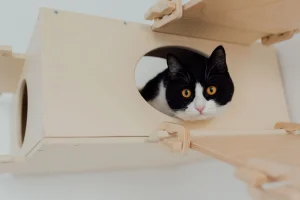
The enrichment that matters most in a catio is the kind that lets a cat perform natural behaviors rather than simply occupy space. Vertical variation is the single most valuable feature: cats are drawn to height for surveillance and security, so staggered shelves, ramps, and platforms at different levels turn a flat run into territory. A useful rule of thumb is that a catio should offer at least two or three distinct elevations, with perches wide enough for a cat to lie down fully rather than just sit. Shelves placed near a wall give a sense of backing, which most cats prefer over exposed ledges.
Sightlines and hiding spots work as a pair. Cats want to watch the world from cover, so position perches where they can see movement—garden borders, feeders, a fence line—while leaving a shaded box or draped corner nearby to retreat into. A catio that is all open mesh and no concealment feels exposed; one that is all shelter and no view feels like a cage. The balance is roughly a mix where a cat can move from a high, open lookout to a low, enclosed nook within a few steps.
Scratching and climbing surfaces belong inside the enclosure, not just outside it. Sisal-wrapped posts, rough bark logs, or a section of untreated wood give cats something to sink claws into, and horizontal logs double as balance beams. Climbing structures should be anchored firmly, since a wobbling shelf undermines confidence and cats will avoid it. Ramps with a gentle slope and a textured surface let older or less agile cats reach upper levels without jumping.
Sensory variety keeps a catio interesting across seasons. Plant-safe grasses and cat-friendly herbs in sturdy containers invite sniffing and nibbling, while a shallow tray of sand or loose soil supports digging and rolling. Moving elements—a hanging toy on a short cord, dried leaves that drift in, a water feature with a gentle ripple—add stimulation without clutter. Rotate toys and reposition lightweight furniture periodically so the space does not become stale.
Finally, match enrichment to the individual cat. A confident climber will use every high shelf, while a cautious cat may prefer ground-level tunnels and covered beds until it settles in. Provide multiple resources—perches, hiding spots, scratching surfaces—spread apart so one cat cannot monopolize them in a multi-cat household. The goal is a space where the cat chooses its own activity: watching, climbing, scratching, resting, or digging, each available on demand.
Routine Cleaning and Maintenance Checklist
A catio stays safe and pleasant only if it is maintained on a regular rhythm. Build your cleaning schedule around three tiers: a quick daily pass, a weekly deeper clean, and a seasonal structural check. The daily pass takes only a few minutes. Scoop or empty litter stations placed inside the enclosure, remove any food remnants before they attract insects or wildlife, and glance at the latches and gate closures to confirm they are fully engaged. Fresh water should replace standing water daily, especially in warm weather, because outdoor bowls collect debris quickly.
Once a week, do a more thorough clean. Hose down or wipe the flooring, ramps, and shelves to remove accumulated dirt, and scrub feeding and water bowls with a pet-safe cleaner. Inspect bedding and any fabric hammocks for dampness or wear, and replace or launder them as needed. This is also the moment to check the mesh or netting for small tears, loose staples, or sagging sections, and to confirm that all connectors, hinges, and screws remain tight. A cat that leans or paws at the mesh can gradually work a fastener loose, so a weekly tightening pass catches problems while they are still minor.
Seasonally, treat the catio as a structure and inspect it the way you would a fence. Look for rust on metal frames, rot or splintering on wood, and wear on roofing or shade covers. Clear gutters, drainage paths, and corners where leaves and debris collect, since standing moisture accelerates decay and creates hiding spots for pests. In colder months, check that the enclosure still offers dry, sheltered spots and that any heated or insulated areas remain clean and free of damp bedding. In hot months, verify that shade and ventilation are unobstructed.
Match the intensity of maintenance to how the catio is used. A small balcony enclosure with one cat and a litter box needs less scrubbing than a large ground-level catio with multiple cats, planted areas, and heavy foot traffic. High-use enclosures benefit from more frequent floor cleaning and quicker bedding changes. If the catio sits under trees, expect more debris on the roof and in the mesh and plan to clear it more often.
Keep a simple written checklist posted near the catio door so nothing gets skipped, and note the date of each deep clean and inspection. Replace worn latches, torn mesh, or damaged hinges promptly rather than waiting for a scheduled check, and remove any loose wire, sharp edges, or splintered wood as soon as you spot them. Consistent, unhurried maintenance is what keeps the enclosure secure and comfortable season after season.
Common Catio Mistakes to Avoid
The most frequent catio mistake is treating the mesh as an afterthought. Chicken wire and other lightweight netting feel adequate during planning, but a determined cat can stretch, pry, or tear thin gauge over time, and the resulting gap is exactly the kind of opening a cat will exploit. Choose welded wire or a rigid mesh with small openings, and check that the fasteners holding it to the frame are as sturdy as the mesh itself. Staples alone tend to pull free; screws with washers or a framed panel hold far better.
The second common error is underestimating the top. Many builders focus on walls and forget that cats climb and launch upward. An open-topped enclosure, or one with a loose or sagging roof, invites escape over the rim. A solid roof covering, or a securely tensioned overhead mesh anchored at every edge, closes that route. The same logic applies to the base: a catio resting on bare ground with gaps at the bottom lets a cat dig out or a predator dig in, so a buried apron or a solid floor matters.
Flimsy framing is another recurring problem. Light timber that flexes under wind load, or posts set too shallow, will loosen over a season and distort the mesh. Build for the worst weather the site sees rather than the average day, and brace corners and long spans so the structure stays rigid. A catio that wobbles is one that will eventually fail at a joint.
Access design is frequently overlooked. A catio with no proper door, or a door that opens inward into the run, makes cleaning awkward and turns every entry into an escape risk. Plan a human door large enough to move a litter box and reach the far corners, and consider a small transfer hatch or tunnel connecting to the house so the cat moves between indoors and out without being carried through an open door.
Finally, avoid furnishing the catio as an empty box. Cats need vertical space, scratching surfaces, a sheltered dry spot, and something to watch. A bare enclosure gets ignored, which defeats the purpose. Add climbing shelves at varied heights, a weatherproof hide, and a perch facing the view. Also skip the temptation to cram it against a fence or under low branches that give a cat a launch point onto the roof. Leave clearance on all sides, and check the perimeter for climbable objects that turn the catio into a stepping stone rather than a destination.
Frequently asked questions
What is a catio and how does it work?
A catio is an enclosed outdoor space that lets a cat experience fresh air, sunlight, and outdoor sights while staying contained. It typically consists of a frame covered in sturdy mesh, with a roof and a secure door. Some catios attach to a window or wall, while others are freestanding structures in a yard. The enclosure gives the cat room to climb, perch, and watch wildlife without the risks of roaming free, such as traffic, predators, or getting lost.
Do I need a permit to build a catio?
Permit rules vary widely by location, so check with your local building or planning department before you start. A small window-mounted catio may need no approval, while a large freestanding structure could count as an accessory building subject to zoning, setback, and height limits. If you rent, get written permission from your landlord. Homeowner association rules may also apply. Asking first avoids fines or having to take the structure down later.
Can I build a catio myself or buy a kit?
Both options work, and the right choice depends on your skills, time, and how custom the space needs to be. Building it yourself lets you fit the catio to an odd window, wall, or yard shape and choose every material. Kits are faster and come with pre-cut parts and instructions, but they come in fixed sizes. If you build, plan the frame, mesh, roof, and door carefully and use hardware that will not rust.
How much does a basic catio usually cost?
Costs depend heavily on size, materials, and whether you build or buy. A small do-it-yourself window box using wood and wire mesh is the least expensive route, while a large custom-built or prefabricated walk-in catio costs considerably more. Shipping, tools you do not already own, and extras like shelves or a roof add to the total. Getting quotes on materials or kits for your specific plan is the best way to budget accurately.
What materials are best for building a catio?
Choose materials that resist weather and hold up to a cat’s claws. Pressure-treated or rot-resistant wood is common for frames, and galvanized or vinyl-coated wire mesh is stronger than thin netting. Stainless steel hardware resists rust. For the roof, use solid panels or mesh to block rain and keep predators out. Avoid sharp edges, loose wire ends, and treated wood surfaces the cat will chew. Sand rough spots and check that all fasteners are secure.
How do I keep my cat safe inside a catio?
Make the enclosure escape-proof by checking mesh, seams, and the door latch regularly and using a double-door or safety vestibule if possible. Provide shade and shelter so the cat can escape heat and rain, plus fresh water. Add climbing shelves, perches, and a litter area for comfort. Remove toxic plants and standing water. Ensure the structure is anchored against wind and cannot be tipped or dug under. Supervise initially until you are confident the cat is secure.
Can a catio be attached to a window?
Yes, window-mounted catios are a popular option for apartments and homes without yard space. They typically fit into an open window and are supported by brackets or a frame, with the window closing against the unit. This gives the cat outdoor access without altering the yard. Check that the unit is securely anchored, that the window can be locked or secured, and that the design suits your window type and size.
How do I clean and maintain a catio?
Scoop litter and remove food debris daily, and hose or wipe down surfaces regularly. Clean mesh and shelves to prevent dirt and mold buildup, especially in damp weather. Inspect the frame, mesh, hinges, and latches for wear, rust, or loose fasteners, and repair anything that could let the cat escape. Refresh bedding and shelters, check for insect nests, and clear fallen leaves or snow from the roof. Regular checks keep the catio safe and pleasant.
Put it into practice : How do I choose the best cat tree for large cats?
Work out your own case in 30 seconds:
Methodology
This calculator produces an indicative estimate based on the parameters you enter. The ranges used reflect typical market tiers in the pets space and are neither a commercial offer nor a guarantee. Prices and availability may vary.
Full guide :Pets
More from this guide :
Was this guide helpful?
Share your experience with the WiseHomeGuides community.