In short:
\n
- \n
- Hold the lead in the hand opposite the side your dog walks on.
- That one switch stops most tangling because the lead sweeps across your body instead of wrapping your legs.
- Teach your dog a consistent side and pick a lead length that matches your walking style.
- When your dog stops to sniff or circles you, stay still and let the lead go slack instead of pulling.
- Start with the hand switch on your very next walk.
\n
\n
\n
\n
\n
\n
\n\n
You’re walking down the pavement, your dog is happily sniffing a lamp post, and then it happens. The lead wraps around your calf, tightens just above the knee, and suddenly you’re doing a clumsy one-legged hop while your dog looks up at you with complete innocence. If this scene feels familiar, you’re not alone. It’s one of the most common frustrations owners mention, and it has almost nothing to do with bad luck. A lead that tangles is usually a lead that’s too long, held in the wrong hand, or attached to a dog who’s learned that circling pays off. The good news? A few small adjustments can fix this in a single walk.
\n\n
Below, I’ll walk you through the practical changes that worked for me after years of walking a strong labrador who treated every stroll like a slalom course. No gimmicks, no expensive gear — just technique, habit, and a bit of observation.
\n\n
Start With Your Hand Position (This Fixes Half the Problem)
\n
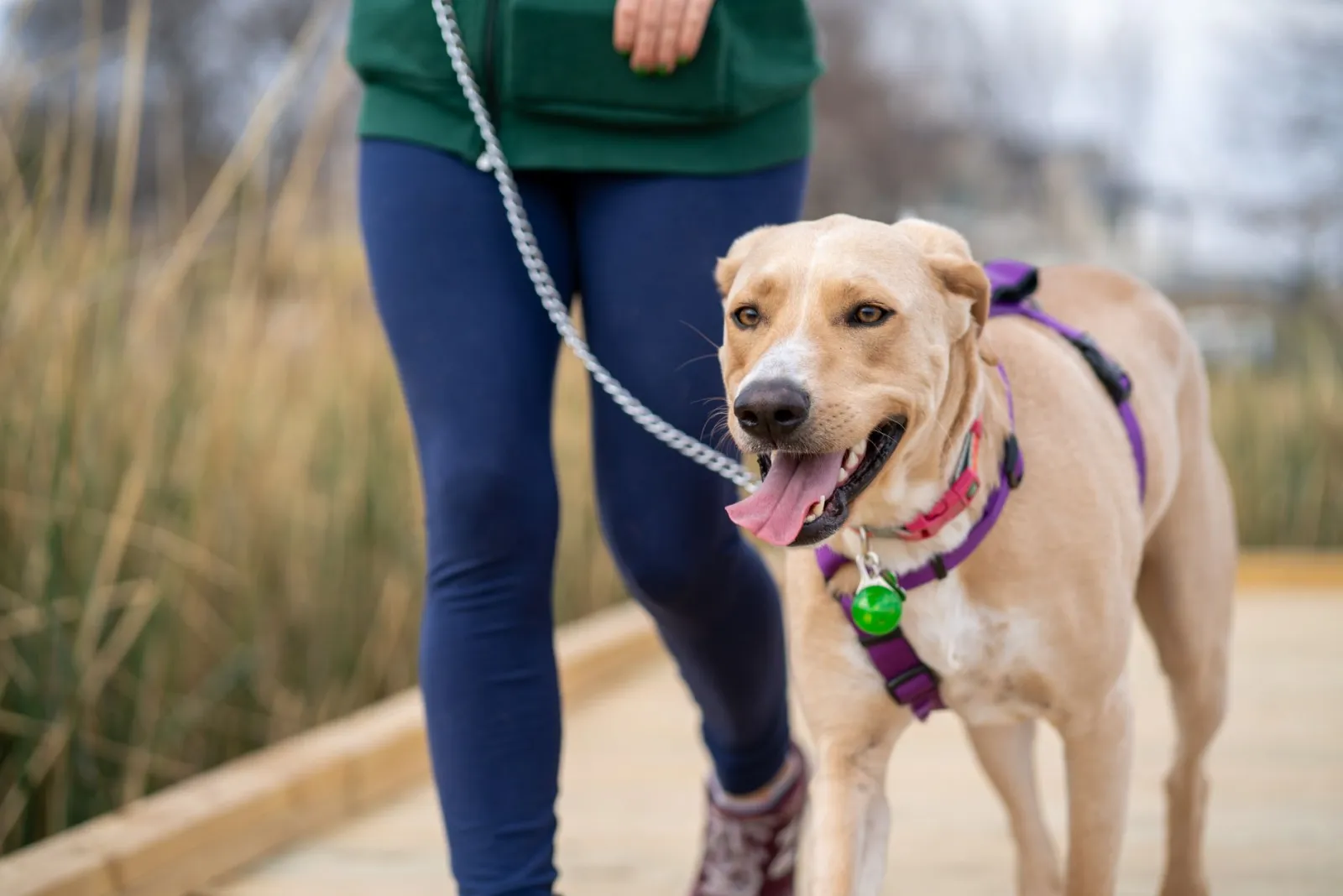
Most tangling starts at the handle. If you hold the loop loosely with your palm facing forward and your arm relaxed, the lead has nowhere to go but around your body the moment your dog changes direction. Here’s a better way: hold the handle in the hand opposite the side your dog walks on. If your dog stays on your left, hold the lead in your right hand.
\n
Why does this matter? Because when your dog drifts or circles, the lead naturally sweeps across your front rather than wrapping your legs. Your body becomes a barrier instead of a target.
\n
Real example: A friend of mine walked her spaniel with the lead in her left hand while the dog walked on her left. Every time the dog crossed in front of her, the lead cinched around her shins.
\n
Two more hand habits worth building:
\n
- \n
- Keep your arm still. A swinging arm feeds slack into the lead and invites loops. Let your dog feel a calm, steady line.
- Gather the excess. If you’re using a longer lead, fold the extra into loose loops in your free hand — never wrap it around your wrist or fingers. That’s a safety issue, not just a comfort one.
\n
\n
\n\n
Teach the “Side” Rule and Stick to It
\n
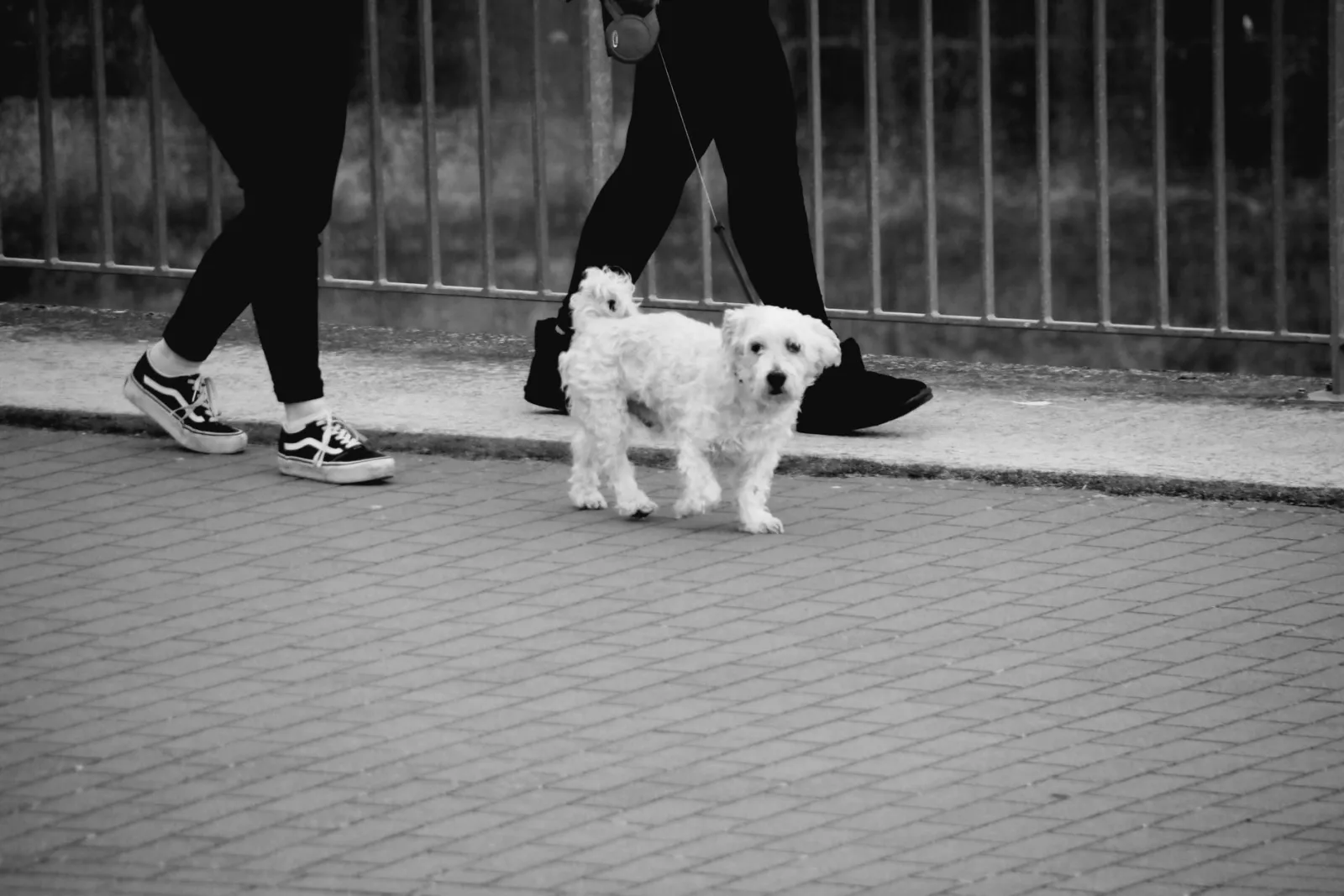
Dogs tangle leads because they’re allowed to wander from side to side. Pick one side — left or right — and make it the permanent rule. Every time your dog crosses in front of you, gently guide them back with your leg or a soft cue. It feels tedious for the first week. After that, it becomes automatic for both of you.
\n
The trick is consistency. If you let your dog cross when you’re in a hurry, they’ll keep testing it. If you redirect every single time, the behaviour sticks.
\n
Practical case: I walk my lab on my left, always. When he tries to cut in front of me to sniff something on the right, I stop moving. Not a yank, not a correction — just stop. He learned within days that crossing in front means the walk pauses. Now he swings behind me instead, which is exactly what you want.
\n
One nuance: this rule applies to loose-lead walking on pavements and busy areas. In an open field with a long line, let the dog roam. The “side” rule is for the situations where tangling actually happens.
\n\n
Choose the Right Lead Type for Your Walking Style
\n
The lead itself plays a bigger role than most people realise. A long, thin, lightweight lead tangles far more easily than a shorter one with a bit of body. If you’re walking in town, a shorter lead gives you more control and less slack. If you’re in the park, a longer lead is fine — but you’ll need to manage the extra length actively.
\n
Here’s a rough comparison of how different lead styles behave when it comes to tangling:
\n
| Lead Style | Tangling Risk | Best For |
|---|---|---|
| Short fixed lead | Low | Pavements, busy streets, training walks |
| Standard fixed lead | Medium | General walks, parks |
| Long line | High | Open fields, recall practice |
| Retractable lead | Very high | Rarely ideal — constant tension, hard to control |
\n
From experience: I swapped a long, floppy lead for a shorter one on our daily neighbourhood route and the tangling problem practically vanished. Same dog, same habits, different lead. It’s worth testing before you blame your walking technique.
\n\n
Handle the Two Most Common Tangle Triggers
\n
Even with good technique, two situations will still catch you out. Here’s how to handle them.
\n\n
Your dog suddenly stops to sniff
\n
When your dog halts and you keep walking, the lead goes slack and loops. The fix is simple: stop when they stop. Give them a few seconds, then cue them to move on. If you’re in a rush, keep the lead gently tensioned by walking in a small circle rather than pushing forward.
\n\n
Your dog circles you
\n
Circling is often excitement or a bid for play. Don’t spin with them — that’s how you end up wrapped up like a maypole. Plant your feet, keep the lead hand still, and wait. The circling stops when it stops being rewarding. Then reward the moment they stand still with a treat or praise.
\n
Real situation: My lab used to circle me every time we passed another dog. Standing still felt awkward at first, especially with an audience. But after about ten repetitions, he figured out that circling meant the walk froze. Now he just looks at me instead.
\n\n
FAQ
\n\n
Why does my dog’s lead always tangle around my legs and not my partner’s?
\n
It’s usually about hand position and which side the dog walks on. If you hold the lead in the same hand as the side your dog walks on, you’re far more likely to get wrapped up. Try switching hands and see if it makes a difference on your next walk.
\n\n
Should I use a shorter lead to stop tangling?
\n
Often, yes. A shorter lead gives you less slack to manage and reduces the chance of loops forming around your legs. It’s not the only factor, but it’s one of the easiest changes to test. Keep your longer lead for open spaces where roaming is safe.
\n\n
My dog spins around me when excited — what do I do?
\n
Stand still. Don’t follow the spin, don’t pull, don’t laugh it off. Wait until the circling stops, then reward the calm behaviour. If you consistently refuse to move during the spin, most dogs drop the habit within a couple of weeks.
\n\n
Where can I find a dog bed with legs?
\n
This one comes up a lot, and it’s worth clearing up because it’s a different topic from lead tangling. Raised beds — the kind with legs or a frame — are usually sold as “elevated” or “raised” beds rather than described by their legs. You’ll find them in the same places you’d look for any other dog bed: pet shops, large online retailers, and specialist pet furniture makers. The reason people search for them specifically is that a raised bed keeps a dog off cold or damp floors and lets air circulate underneath, which suits older dogs, dogs with joint issues, and dogs who overheat easily. If that’s what you’re after, search for “elevated dog bed” rather than “dog bed with legs” and you’ll get far better results.
\n\n
What does it mean when a dog sleeps on your legs?
\n
It’s almost always about comfort and closeness, not dominance or anything dramatic. Dogs are social sleepers — in a pack they’d pile up together — and your legs are warm, familiar, and safe. Some dogs also choose contact when they’re feeling a bit insecure, or simply because your legs are the most convenient pillow in the house. If your dog suddenly starts sleeping on you far more than usual, or seems restless and clingy, it’s worth a quick check with your vet, since changes in sleep habits can sometimes reflect discomfort. Otherwise, enjoy it — it’s a compliment.
\n\n
Do dogs prefer round or square beds?
\n
There’s no universal answer, because it depends on how your dog likes to sleep. Dogs who curl up tightly — the classic doughnut position — tend to settle well in round or oval beds with raised edges they can lean against. Dogs who sprawl out flat, or who like to stretch their legs, usually do better in a rectangular bed with more usable surface area. The practical move is to watch how your dog sleeps for a few nights: curled or stretched, against a wall or out in the open. Then match the shape to that habit rather than to what looks nicest in the shop.
\n\n
What dog bed do vets recommend?
\n
Vets don’t generally recommend a specific bed, and any source claiming otherwise is overselling. What they do tend to suggest is matching the bed to the dog’s needs: supportive foam for older dogs or dogs with joint problems, a washable cover for anything that sheds or drools, a raised design for dogs who get too warm, and a size big enough that the dog can lie fully stretched out. If your dog has a diagnosed orthopaedic issue, ask your own vet what to look for — they know your dog’s history and can give you far more useful guidance than a generic list.
\n\n
Les erreurs à éviter
\n
Most people who struggle with a tangling lead are making one of a handful of predictable mistakes. None of them are dramatic, and all of them are fixable once you know what to look for.
\n\n
- \n
- Holding the lead in the same hand as your dog’s side. This is the single biggest cause, and it’s the one people overlook because it feels natural. If your dog walks on your left and you hold the lead in your left hand, every drift and every circle pulls the lead straight across your legs. Swap hands and the geometry works in your favour. It feels odd for two or three walks, then it stops feeling like anything at all.
- Wrapping the lead around your hand or wrist. This is a safety error rather than a tangling one, but it shows up constantly. If your dog lunges or bolts, a lead wrapped around your wrist can tighten fast and cause a real injury. Gather the slack into loose folds you can drop instantly instead. You get the same control with none of the risk.
- Letting the dog choose the side, walk by walk. Dogs don’t generalise well. If your dog walks on your left on Monday and your right on Tuesday, there’s no rule to learn, and the tangling continues. Pick a side and hold it, even on the walks where you’re tired or in a hurry. The consistency is what makes it stick.
- Pulling back when the lead goes slack. When your dog stops to sniff, the instinct is to keep walking and tug them along. That tug is what creates the loop around your legs. Stop, wait, then move on together. It costs you a few seconds and saves you the hop.
- Spinning with a circling dog. It’s tempting to turn and follow your dog when they start circling, especially if you’re trying to keep moving. But turning with them is exactly what feeds the behaviour — you become part of the game. Plant your feet and wait it out. The circling has no payoff if you don’t move.
- Blaming the dog instead of the setup. A tangling lead is almost never a training failure on the dog’s part. It’s a hand position, a lead length, or a missing rule. Once you treat it as a mechanical problem, it becomes much easier to solve — and much less frustrating for both of you.
\n
\n
\n
\n
\n
\n
\n\n
Entretien, durée de vie et moment de remplacer
\n
A lead is a piece of safety equipment that happens to look like a simple strap, and it wears out the way any fabric under load does. Checking it regularly takes a minute and prevents the moment you really don’t want — a clip that fails mid-walk near a road.
\n\n
What to check, and how often
\n
Give the lead a quick once-over every few weeks, and a proper look whenever you notice anything odd. The parts that fail first are predictable:
\n
- \n
- The clip or trigger hook. Open and close it a few times. It should snap shut firmly and sit flush. If it feels loose, sticks, or doesn’t fully close, that’s a replacement signal, not a repair job.
- The stitching where the lead meets the handle and the clip. This is where load concentrates. Frayed or pulled threads, or a section that looks thinner than the rest, mean the lead is on its way out.
- The handle loop. Check for cracking, stiffness, or a worn patch where your hand grips. A handle that’s lost its structure can slip out of your hand at the worst moment.
- The body of the lead. Run it through your hands and feel for thin spots, stiffness, or a change in texture. On webbing leads, look for fraying along the edges. On rope leads, look for flattened or fuzzy sections.
- Any hardware, rings, or joints. Give them a gentle tug. Anything that flexes, rattles, or shows rust is a weak point.
\n
\n
\n
\n
\n
\n\n
How long a lead actually lasts
\n
There’s no fixed lifespan, because it depends far more on use than on time. A lead used for two short pavement walks a day in dry weather will last far longer than the same lead used for daily muddy field walks with a dog who pulls. Heat, sunlight, salt from winter roads, sand, and repeated wetting and drying all break down the fibres faster. A lead that lives in a car boot in summer will age quicker than one stored indoors.
\n
As a rough way to think about it: leads tend to wear out through accumulated small damage rather than a single failure. That’s why the regular check matters more than any calendar rule. If you walk daily in rough conditions with a strong dog, expect to be looking at the stitching and clip closely within a year or two. If your walks are gentle and short, the same lead may serve you for many years.
\n\n
When to replace rather than keep using
\n
Replace the lead if any of these apply:
\n
- \n
- The clip doesn’t close securely, or opens under a light pull.
- Stitching at the clip or handle is frayed, loose, or visibly thinner.
- The webbing or rope has a thin, worn, or fuzzy section anywhere along its length.
- The handle has cracked, hardened, or lost its shape.
- Any metal part is bent, rusted, or rattles.
- The lead has been through a hard shock — a sudden lunge that stretched it or pulled stitching tight.
\n
\n
\n
\n
\n
\n
\n
None of these are worth patching. A lead is inexpensive relative to the risk, and a failure happens at exactly the moment your dog is pulling hardest. If you’re unsure, retire it to a backup role for the garden rather than trusting it on the road.
\n\n
Keeping a lead in good condition
\n
A little care goes a long way. After a wet or muddy walk, rinse the lead in plain water and let it dry naturally, away from direct heat — radiators and tumble dryers stiffen webbing and weaken it over time. Don’t leave it knotted or coiled tightly for long periods, as that sets creases where fibres break down first. Store it hanging or loosely looped rather than crammed into a bag with keys and other metal. And if you rotate between two leads, each one gets half the wear and you always have a spare when one needs checking.
\n\n
The Bottom Line
\n
Tangling isn’t a mysterious curse — it’s a mechanical problem with mechanical solutions. Hold the lead in the opposite hand to your dog’s walking side. Pick one side and stick to it. Choose a lead that suits where you’re walking. Stop when your dog stops, and stand still when they circle. Do these four things consistently and you’ll notice the difference within a week.
\n
And while you’re at it, give the lead itself a quick check. A clip that closes properly and stitching that’s still intact matter more than any technique — a tangling lead is annoying, but a failing one is a genuine risk. If you want to go deeper into lead handling, loose-lead walking, and the gear that supports it, our full guides cover the practical side in more detail.
\n\n\n\n
To choose the right model : Webbing Dog Lead Cleaning: Mud and Salt Removal
\n
\n
Sources
\n
- \n
- RSPCA — guidance on dog walking, lead use, and responsible ownership
- The Kennel Club — advice on loose-lead walking and dog training
- PDSA — pet health and welfare information for dog owners
- Blue Cross — practical pet care and behaviour advice
\n
\n
\n
\n
\n\n\n\n
Full guide :Pets
More from this guide :
Was this guide helpful?
Share your experience with the WiseHomeGuides community.