This article contains Amazon affiliate links. As an Amazon Associate we earn from qualifying purchases.
In short :
- Start with what the room needs the shelf to do, not the shelf itself.
- Floating shelves keep living rooms calm, while brackets suit kitchens and bathrooms where function comes first.
- Check what your wall can actually hold before you buy anything.
- Get the height and spacing right so it looks intentional, not improvised.
- Floating for display, brackets for working storage, ledges for frames and books.
A wall shelf looks simple enough. A board, a couple of brackets, a few screws. Yet the wrong choice turns into sagging planks, ugly gaps, or a display that never quite feels finished. The right choice disappears into the room and does exactly what you need it to do.
Wall shelves come in three broad styles: floating shelves (no visible supports), bracket-supported shelves (visible brackets underneath), and picture ledges (a narrow lip that holds frames and small objects upright). Each style suits different rooms, different loads, and different levels of DIY confidence. This guide focuses on the practical decisions: how to match the shelf to the room, how to judge what a wall can hold, and how to install and style it so it looks intentional rather than improvised.
Match the shelf style to the room, not the other way round
Before you look at a single board, decide what the shelf has to do. A display shelf in a living room and a working shelf in a kitchen have almost nothing in common beyond the word “shelf.”
Living room and bedroom: display first
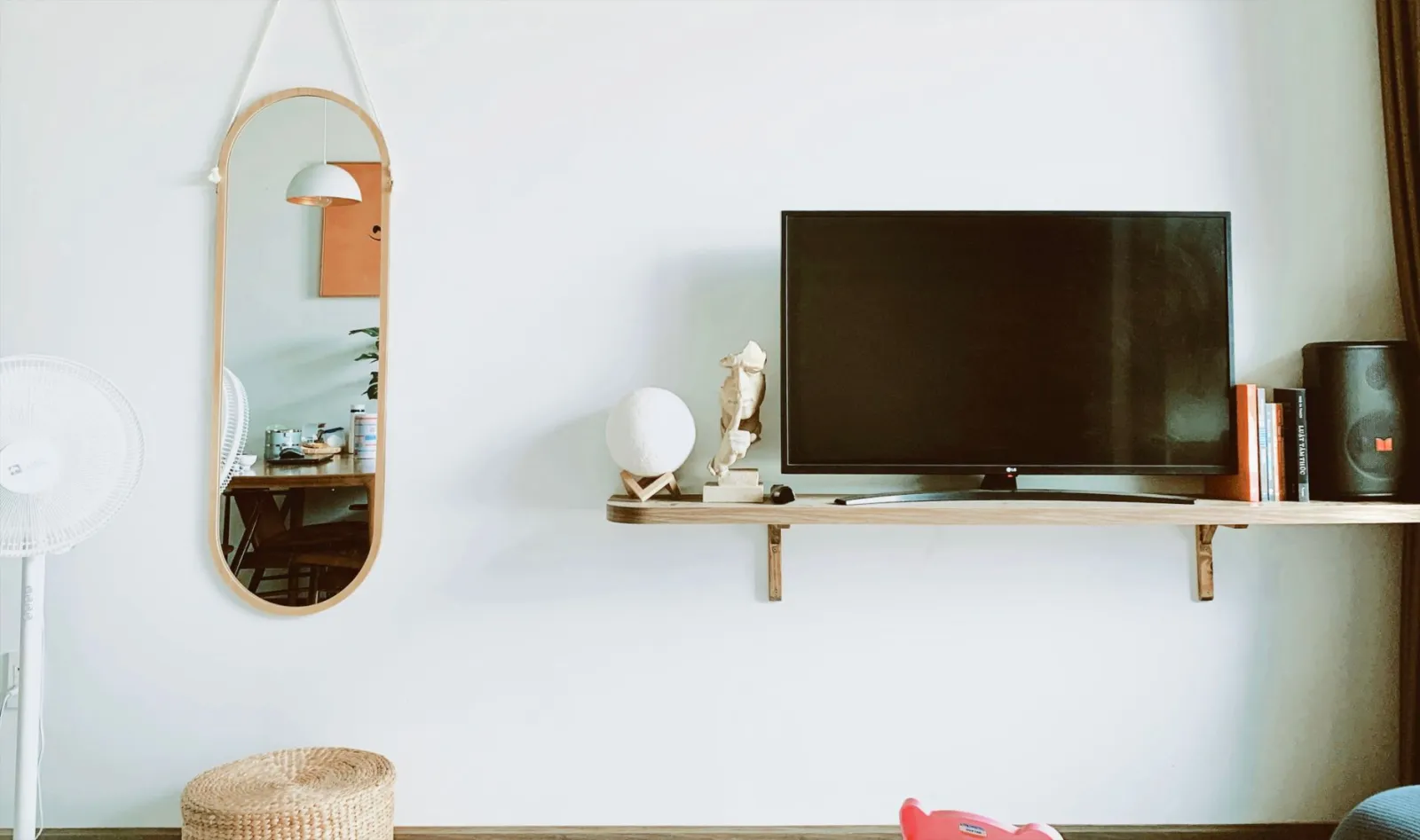
In living rooms, floating shelves win because they keep the wall calm. Nothing interrupts the line of the board, so books, plants, and framed prints read as a single composition. A concrete example: a narrow floating shelf above a sofa, holding three framed prints and a trailing plant, looks deliberate because the shelf is invisible. The same objects on a bracket shelf would feel busier, because the brackets add visual noise at eye level.
Bedrooms usually want the opposite: compact, high-mounted shelves beside the bed for a lamp, a book, and a glass of water. A short floating shelf at head height works well here, provided it is fixed into a solid fixing point. Picture ledges are a smart bedroom choice too — they hold books face-out, which makes a small room feel curated rather than cluttered.
Kitchen and bathroom: function first
Kitchen wall shelves earn their place when they hold things you reach for daily: jars, mugs, spice tins, a small herb pot. Bracket-supported shelves handle more weight and let you see what is stored, which matters in a working kitchen. Keep them at least 45–50 cm above the worktop so you can still use the surface below.
Bathrooms are the hardest environment. Steam, splashes, and humidity punish cheap materials. Choose a shelf rated for damp rooms, and mount it away from the direct spray zone of the shower. A small floating shelf above the sink, holding soap and a folded towel, is a realistic use case; a long shelf packed with bottles directly over the bath is not.
Judge the wall before you judge the shelf
Every shelf decision comes down to one question: what is behind the plaster? A shelf is only as strong as its fixing.
- Solid masonry (brick, block, concrete) holds the most weight and accepts standard plugs and screws reliably.
- Timber studs behind plasterboard are strong fixing points, but you must locate them first with a stud finder.
- Hollow plasterboard without studs is the weak case. It needs specialist hollow-wall fixings, and even then it suits light loads only.
A practical example that catches people out: a floating shelf rated for 15 kg on paper, mounted into hollow plasterboard with the wrong fixings, will fail long before it reaches that figure. The shelf’s rating assumes a sound fixing. Check the wall first, then choose the shelf.
As a rough working rule, a shelf fixed into solid masonry or timber studs can carry heavier loads, while a shelf on hollow-wall fixings should stay light — a few books, a small plant, decorative objects. If you are unsure, test with a gentle hand press before loading it fully.
Get the height and spacing right
Placement is where most shelves go wrong, and it is entirely free to fix.
- Above furniture: leave roughly 20–30 cm between the top of a sofa, desk, or sideboard and the underside of the lowest shelf.
- Between shelves: 30–40 cm suits books and plants; 20–25 cm suits small objects and frames.
- Eye level matters: the most-used shelf should sit at or just below eye level, where you naturally look and reach.
- Align to the room: line the shelf up with a window head, a door frame, or a picture rail. Alignment is what makes a shelf look built in rather than added on.
Consider a real scenario: two shelves stacked 50 cm apart above a desk. The gap is too tall for books, so the top shelf ends up empty and the arrangement looks unbalanced. Drop the upper shelf to 35 cm above the lower one and the whole wall tightens up.
Compare the main shelf types at a glance
| Shelf type | Best for | Load capacity | Installation effort |
|---|---|---|---|
| Floating | Living rooms, bedrooms, clean display | Light to moderate | Moderate — needs accurate fixing |
| Bracket-supported | Kitchens, utility areas, heavier storage | Moderate to heavy | Straightforward |
| Picture ledge | Frames, books face-out, small rooms | Light | Simple |
Frequently asked questions
Can you put shelves on a wall without drilling?
Yes, within limits. Adhesive-mounted shelves and tension-pole systems exist and suit light loads — a few small objects, bathroom toiletries, or a spice rack. They rely on a clean, flat, sound surface, and they are not a substitute for screwed fixings when you need to hold books or anything heavy. For anything beyond light display, drilling into a stud or masonry is the reliable route.
How can I style a wall shelf in a way that looks good?
Work in odd numbers and vary heights. Three objects of different sizes read better than four of the same. Lean a framed print against the wall, stack two or three books flat, and add one living element such as a plant. Leave empty space — a shelf that is 70% full looks considered; one packed edge to edge looks like storage. Repeat one colour or material across the shelf to tie it together.
Is it cheaper to buy or build shelves?
It depends on tools and time rather than materials alone. Building gives you an exact fit for awkward alcoves and lets you choose the finish, but it requires cutting, sanding, and finishing, plus access to the right tools. Buying is faster and more predictable for standard sizes. If your wall is an unusual width, building often wins on fit; if it is standard, buying usually wins on effort.
The bottom line
Choosing the right wall shelf comes down to three checks: what the room needs the shelf to do, what the wall can safely hold, and where the shelf should sit on the wall. Get those right and the style almost chooses itself — floating for calm display, brackets for working storage, ledges for frames and books. Start with the wall, not the shelf, and you will avoid the most common mistakes.
This guide covers the essentials for picking a shelf that fits your space. For the wider picture — materials, finishes, maintenance, and room-by-room planning — a more complete guide to wall shelves is available on the site.