This article contains Amazon affiliate links. As an Amazon Associate we earn from qualifying purchases.
In short :
- A sofa is worth buying in 2026 if it has a kiln-dried hardwood frame, high-resilience foam around 30 kg/m³ or more, and a fabric rated for at least 30,000 Martindale cycles.
- Match the seat depth to your body, roughly 55–60 cm for most people, with a seat height around 42–45 cm.
- Test the frame in the showroom by lifting one front corner and checking that the opposite corner stays down.
- Trendy shapes and big brand names tell you nothing about quality, so always ask for frame material and foam density in writing.
- Get those four fundamentals right and the sofa will still feel solid in year ten.
What makes a sofa worth buying in 2026?
A sofa worth buying in 2026 must combine a frame that will not creak within five years, a seat depth matched to how you actually sit, and a cover fabric rated for at least 30,000 abrasion cycles (Martindale). Trendy shapes matter less than these three fundamentals.
The 2026 market is drifting in two directions at once. On one side, modular pieces with deep seats and washable covers dominate living rooms built for family life. On the other, slimmer silhouettes with exposed wooden legs are winning smaller apartments where floor space is precious. Both can be excellent — or terrible — depending on what sits underneath the fabric.
This guide walks through the criteria that actually predict how a sofa will feel in year one and year ten. No models, no prices, no shopping list. Just the checks that separate a sound purchase from an expensive mistake.
Frame construction: what should you look for?
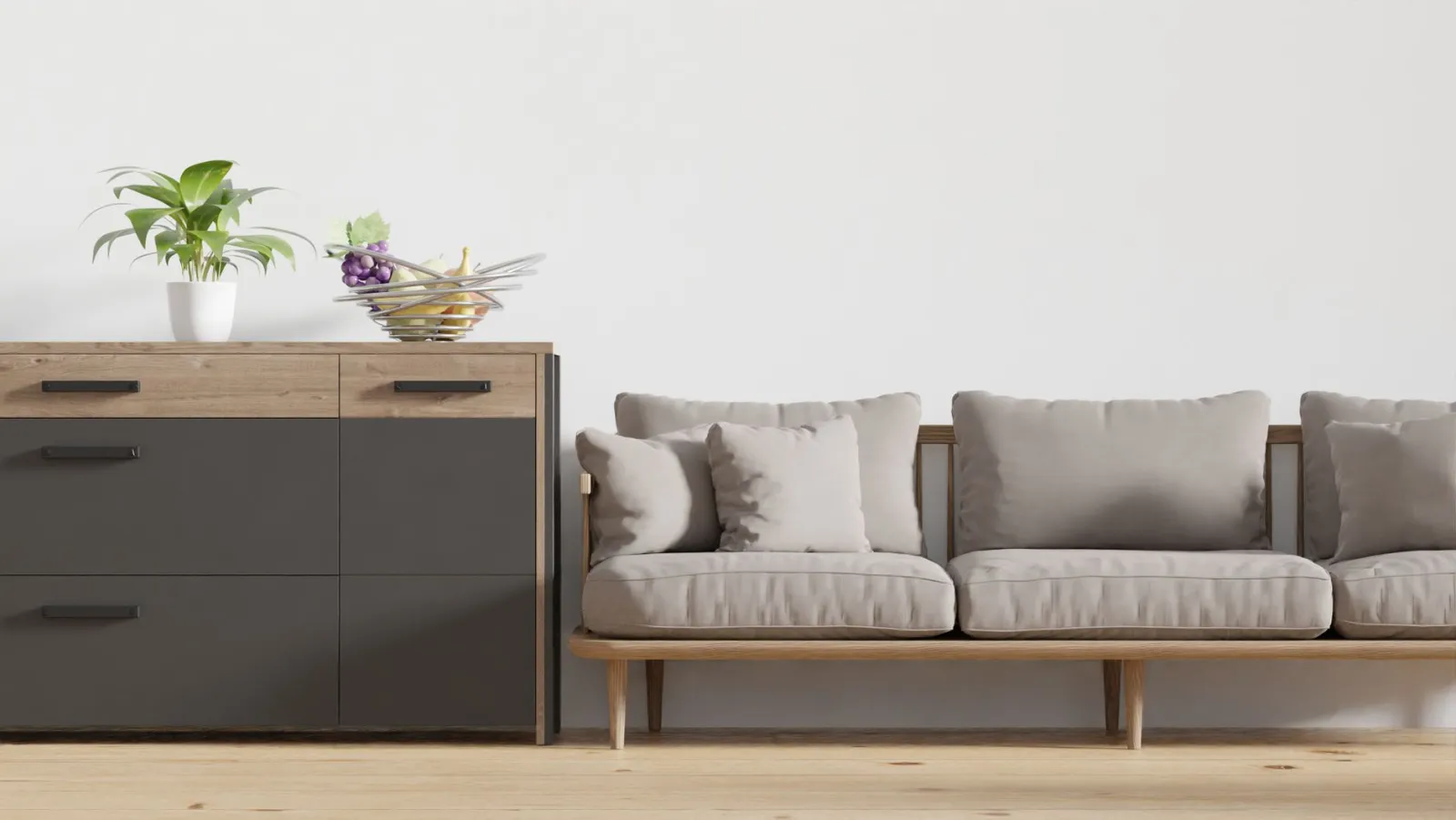
Look for a frame made of kiln-dried hardwood — beech, ash or oak — joined with dowels, screws and corner blocks rather than staples alone.
Particleboard and MDF frames are common at entry level. They can hold up in a guest room used twice a month, but they rarely survive daily family use. A simple test in the showroom: lift one front corner of the sofa about 15 cm off the floor. A solid frame keeps the opposite corner on the ground. If the whole sofa twists, the joints are loose or the wood is thin.
Ask how the frame is reinforced at the arms and the centre rail. These are the two points that fail first. A centre support leg under long sofas (three seats and above) is a small detail with a big effect on sagging.
Seat cushions: foam density and filling matter more than softness
Check the foam density: 30–35 kg/m³ is a solid baseline for everyday seating, while anything under 25 kg/m³ tends to flatten within two to three years. High-resilience (HR) foam holds its shape longer than standard foam at the same density.
Feather-and-down wraps feel luxurious for the first six months and then need daily plumping to keep their shape. A hybrid build — HR foam core with a thin fibre or down wrap — gives you the soft landing without the constant maintenance. That is the configuration I recommend for anyone who does not want to fluff cushions every evening.
In the showroom, press the seat cushion flat with your palm for five seconds and release. It should spring back almost immediately. A slow, hesitant recovery signals low-density foam. Also sit for a full ten minutes, not ten seconds — comfort that disappears after a quarter of an hour is not comfort.
Seat depth and height: matching the sofa to your body
A seat depth of 55–60 cm suits most people who sit upright; 65 cm and beyond invites you to recline but leaves shorter sitters with their feet dangling. Seat height between 42 and 45 cm lets most adults place both feet flat on the floor.
Here is a practical case worth remembering. In a household where one person is 1.60 m and the other 1.90 m, a deep lounge sofa often works for one and not the other. The fix is either a shallower model with a footstool, or a modular sofa where seat depth can be adjusted per module.
Test it at home before committing: sit on your current sofa with a tape measure and note where the seat edge hits your leg. If it presses behind the knee, the depth is too great for your height. Bring that number with you.
Upholstery fabric: which cover suits your household?
Check the Martindale abrasion rating: 20,000 cycles suits light use, 30,000–40,000 handles family living, and 50,000+ is aimed at heavy daily traffic. This is the single most useful number on a fabric label.
Weave type matters as much as the rating. Tight, flat weaves resist snagging from claws and zips; loose bouclé and looped textures look wonderful but catch on everything. For homes with pets or small children, a removable, machine-washable cover is worth more than any stain-treatment claim.
Ask for a fabric sample and take it home for a week. Rub it with a damp cloth, leave it in direct sunlight, and press a coin against it. Real-world wear shows up fast on a swatch, and it costs nothing to test.
Suspension system: what holds the seat up?
Look for sinuous springs (zig-zag steel) with a high spring count, or pocket springs in premium builds; eight-way hand-tied springs remain the benchmark for longevity. Webbing and elastic straps are the weakest option and tend to sag first in the middle seat.
Press down hard on the centre of the seat and listen. A faint creak is acceptable; a metallic clang or a hollow thud suggests thin springs or a weak frame beneath. Run your hand along the front rail — you should feel even tension, not a soft dip.
Corner blocks and a protective dust cover underneath tell you the maker finished the hidden parts properly. If the underside looks like an afterthought, the rest usually is too.
Dimensions and room fit: measure the path, not just the wall
Measure the full delivery route — doorway widths, stair turns, lift dimensions — before you fall in love with a three-seater. A sofa that cannot clear the hallway is a problem no return policy solves gracefully.
Leave at least 40–50 cm of walking space in front of the sofa, and check that the sofa’s height does not block windows or radiators. Modular pieces help here: they arrive in sections and fit where a fixed frame cannot.
Lay out the footprint with masking tape on the floor and live with it for a few days. It sounds fussy. It is also the cheapest way to avoid a sofa that swallows the room.
How do you judge build quality without a specification sheet?
Turn the sofa over and read the underside: a stapled dust cover, visible corner blocks and a centre leg are honest signals of how the piece was assembled. Lift one corner, press the cushions, and check whether the arms flex under your weight.
Ask two direct questions: what is the frame made of, and what is the foam density? A seller who answers without hesitation knows the product. Vague answers about “premium materials” tell you plenty too.
The same logic applies wherever you shop — the checks do not change across markets, which is why the criteria for the highest quality sofas in the UK are identical to those anywhere else. Construction is construction.
Frequently asked questions
What are the trendy sofas for 2026?
Deep modular sofas with washable covers, curved silhouettes, and low-profile designs on exposed wooden legs. Earthy tones and textured weaves are widespread. Trend is a styling signal, not a quality one — check the frame and foam before the shape.
Which sofa is the most comfortable in 2026?
Comfort is personal, but the documented formula is a seat depth matched to your height (55–60 cm for most), a seat height around 42–45 cm, and medium-firm HR foam. Sit for ten minutes before deciding.
Who makes the highest quality sofas?
Quality is a construction standard, not a name: kiln-dried hardwood frames, HR foam at 30 kg/m³ or above, and suspension that holds tension. Any maker meeting those benchmarks qualifies.
Who makes the highest quality sofas in the UK?
The same criteria apply: hardwood frames, dense foam, and documented fabric ratings. Ask for frame material and foam density in writing — that answer separates serious makers from the rest.
Conclusion: how to choose well
Prioritise the frame, the foam density, the seat depth and the fabric rating, in that order. Everything else — colour, shape, trend — is adjustable taste. For a broader overview of sofa types and long-term care, a more complete guide on the general topic is available on the site.
Was this guide helpful?
Share your experience with the WiseHomeGuides community.