This article contains Amazon affiliate links. As an Amazon Associate we earn from qualifying purchases.
In short :
- There’s no single best home coffee machine — the right one matches how you actually drink coffee.
- Start with your usual drink: filter machines suit long black coffees, espresso machines with a steam wand suit espresso and milk drinks, and capsule machines cover everything in between with the least fuss.
- Be honest about your time and patience each morning, and measure your counter space before you buy.
- Skip the brand hype and pick one with local service support and easy-to-find descaling products and spare parts.
- Get your drink, time, space and cleaning tolerance right, and the machine type almost picks itself.
There is no single best home coffee machine — the right one depends on how you drink your coffee and how much effort you’ll accept each morning. A machine that suits an espresso drinker who likes a ritual will frustrate someone who just wants a large filter mug before work.
Choosing a coffee machine for home use comes down to four practical criteria: the drink you make most often, the time you’re willing to spend per cup, the counter space you can spare, and how much cleaning you’ll tolerate. Get those right and the choice becomes obvious.
What is the best coffee machine to buy at home?
The best machine for your home is the one that matches your daily drink and your patience level, not the one with the longest feature list. Start with the drink, then work backwards.
Ask yourself what fills your cup on a normal Tuesday. If it’s a long black coffee or a filter mug, a drip or filter machine delivers consistent results with almost no learning curve. If it’s espresso or milk drinks, you need pressure and a milk solution — either a steam wand or an automatic frother. If it’s something in between, like a strong long coffee, a pod or capsule machine covers it with the least fuss.
A concrete example: someone who drinks two flat whites a day and has five spare minutes each morning is well served by a manual or semi-automatic espresso machine with a steam wand. The same person buying a drip machine will end up disappointed, because drip coffee cannot produce the concentrated shot and microfoam a flat white needs. Conversely, a household that drinks four large mugs of black coffee on a weekday morning will find an espresso machine exhausting — four shots, four milk jugs, four cleanups. A filter machine with a thermal carafe handles that volume in one cycle.
Time per cup is the second filter. Roughly speaking:
- Under one minute: capsule machines and automatic bean-to-cup machines.
- Two to four minutes: drip and filter machines (including grinding and setup).
- Five to ten minutes: manual espresso, including grinding, tamping, pulling the shot and cleaning the portafilter.
Be honest about which bracket you’ll actually accept at 7 a.m. on a wet Monday. A machine you skip because it’s too slow is a machine you wasted money on.
What is a good coffee machine for home use — and how do you compare types?
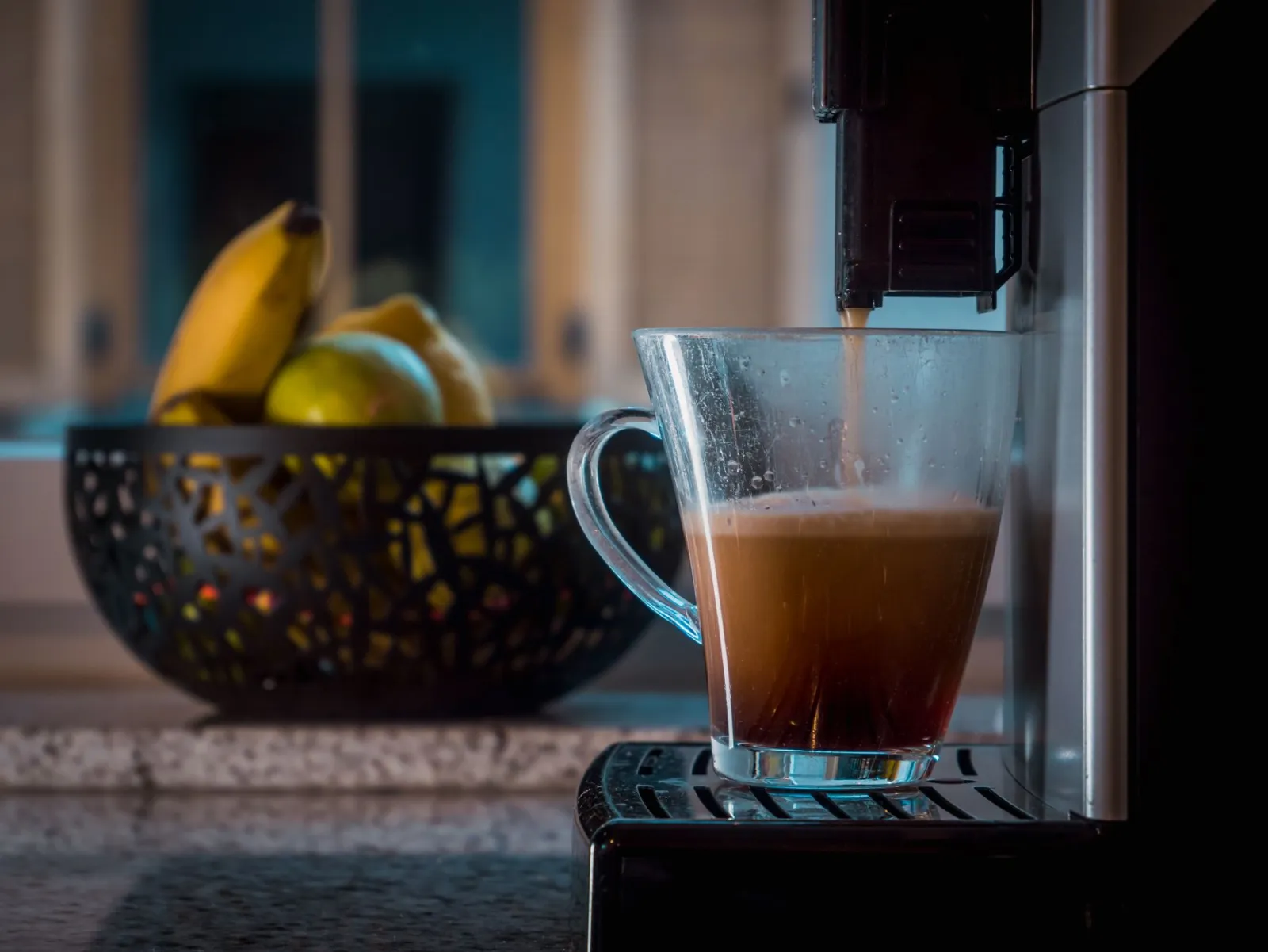
A good home machine is one that produces the drink you want, repeatably, with a cleaning routine you’ll actually follow. The comparison below sets out what each type does well and where it falls short.
| Machine type | Best for | Effort per cup | Cleaning routine | Main limitation |
|---|---|---|---|---|
| Drip / filter | Large black coffees, several cups at once | Low | Rinse carafe, descale periodically | No espresso, no milk texturing |
| Capsule / pod | Speed, single servings, variety | Very low | Empty capsule bin, descale | Locked into one capsule format |
| Automatic bean-to-cup | Espresso and milk drinks with one button | Very low | Empty grounds, rinse milk system, descale | Larger footprint, more maintenance |
| Semi-automatic espresso | Control, learning, milk-based drinks | Medium to high | Flush group head, clean portafilter, backflush | Requires a grinder and some skill |
| Moka pot / stovetop | Strong coffee on a budget, small kitchens | Medium | Rinse and dry thoroughly | Not true espresso, needs a hob |
Two details matter more than the type itself. First, a built-in grinder or a separate burr grinder changes flavour more than most upgrades — pre-ground coffee stales within days of opening, while whole beans keep their aromatics far longer. Second, check the water tank access and the drip tray clearance. A machine you have to drag out from under a wall cupboard to refill will annoy you daily. Measure your counter depth and the height under your cupboards before buying anything.
What is the best brand of coffee machine for home use?
Brand matters less than the service network, the availability of replacement parts, and whether the machine’s consumables are easy to find locally. A well-supported mid-range machine beats an orphaned premium one.
When you compare brands, look at four things you can verify before buying:
- Descaling and filter availability. Every machine needs descaling eventually, especially in hard-water areas. Confirm you can buy the descaling solution or filter cartridges locally.
- Spare parts. Carafes, seals, shower screens and milk hoses wear out. Check that replacements exist and are stocked.
- Repair access. Is there a service centre in your country, or a repair partner? A machine with no local support becomes landfill the day a pump fails.
- Water hardness settings. Better machines let you set water hardness, which directly affects how often you descale and how long the machine lasts.
Real-world example: two neighbours with identical budgets buy espresso machines. One picks a model with a service centre an hour away and a widely stocked descaling kit. The other picks a model with no local support and a proprietary filter. Eighteen months later, the first is still running after a routine seal replacement; the second sits unused because a small part couldn’t be sourced. The lesson isn’t about brands — it’s about buying into a support system, not just a box.
What is the absolute best home coffee machine?
No machine is absolutely best, because “best” depends on your drink, your space and your tolerance for maintenance. The honest answer is that the best machine is the simplest one that reliably makes the coffee you actually drink.
That sounds like a dodge, but it’s practical. Consider what “best” would need to mean for you:
- If convenience wins: a machine that makes your drink in one press, with a milk system that rinses itself.
- If taste and control win: a machine with a proper burr grinder, a stable brew temperature and a real steam wand.
- If space and simplicity win: a compact drip machine or a stovetop pot that takes up a corner of the counter.
A useful test: picture your kitchen at 7 a.m. on a rushed day. Which machine would you actually use, and which would you walk past? That mental image filters out most bad choices faster than any spec sheet. Also check the noise level — a grinder running at full volume in a small flat is a genuine daily irritation.
FAQ
What is the best brand of coffee machine for home use?
There’s no single best brand. Prioritise local service support, easy-to-find descaling products and spare parts over marketing claims. A mid-range machine from a well-supported brand usually outlasts a premium machine with no repair network.
What is the absolute best home coffee machine?
There isn’t one. The best machine for you is the one that matches your most common drink, fits your counter and has a cleaning routine you’ll follow. If you drink espresso and milk drinks, look for stable brew temperature and a steam wand; if you drink large black coffees, a filter machine is simpler and more consistent.
What is the best coffee machine to buy at home?
Match the machine to your daily drink and your patience. Capsule and bean-to-cup machines suit speed; drip machines suit volume; semi-automatic espresso suits control. Measure your counter and cupboard clearance before buying, and confirm descaling supplies are easy to find.
Conclusion
Choosing a coffee machine for home use comes down to your most common drink, your realistic time budget, your counter space and your willingness to clean. Get those four right and the type of machine almost picks itself. For a broader walkthrough of machine types, maintenance routines and setup tips, a more complete guide on the general topic is worth reading before you commit.
Was this guide helpful?
Share your experience with the WiseHomeGuides community.