This article contains Amazon affiliate links. As an Amazon Associate we earn from qualifying purchases.
In short :
- Focus on the mopping system first, since that’s where these machines differ most and where marketing gets loudest.
- Check that the mop lifts off the floor when it crosses a rug, so you don’t get damp patches and pushed-in dirt.
- Don’t chase big suction numbers — good navigation and a dock that empties itself will serve you better than raw power.
- Measure your lowest furniture gaps and note your floor mix before you buy anything.
- If you need to cut costs, keep the good navigation and sacrifice the dock automation.
What should you check before choosing a robot vacuum and mop in 2026?
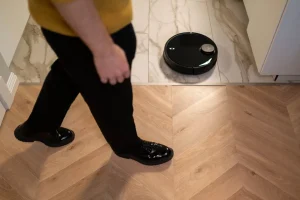
A robot vacuum and mop combines autonomous vacuuming with a wet-cleaning function, either by dragging a damp cloth or by scrubbing with rotating or roller brushes. In 2026, the useful question is not “which one is best” but “which one fits your floors, your furniture and your tolerance for maintenance.” The short answer: prioritize the mopping method, obstacle handling and dock autonomy over raw suction numbers. A machine with modest suction that navigates cleanly and empties itself will serve you better than a powerful unit you have to rescue every morning.
Below, I walk through the criteria that actually decide whether you will still be happy with the machine in two years — the same checklist I’d hand a friend before they spend real money on one.
How does the mopping system change the result on your floors?

Mopping is where these machines differ most, and where marketing gets loudest. Two families exist: a vibrating or dragging flat cloth, and a rotating or roller brush that scrubs and can rinse itself. Flat cloths are gentle and quiet but redistribute dirt once saturated. Roller systems lift grime better on tile and sealed wood, yet need a clean-water supply and a dirty-water tank to stay effective.
Check whether the mop pad or roller lifts off the floor when the robot crosses a rug. A mop that stays down on carpet leaves damp patches and pushes dirt into fibers. Look for a mechanical lift of several millimeters, or a dock that washes and dries the mop between runs — otherwise a wet cloth sits against the dock for hours and starts to smell.
- Hard floors (tile, stone, sealed wood): a scrubbing roller or dual rotating pads gives the best result.
- Mostly carpet with one kitchen corner: prioritize vacuuming and a mop that lifts clear of rugs.
- Mixed floors: test whether the machine detects the transition on its own.
Concrete case: in a flat with a tiled kitchen and a wool rug in the living room, a dragging cloth that never lifts will leave a damp line across the rug edge every single run. A lift of even a few millimeters eliminates that entirely.
What suction power actually matters, and what is marketing noise?
Suction is measured in pascals (Pa), and the numbers on the box have climbed into the tens of thousands. Beyond a certain point, the gain is marginal on hard floors and thin carpet — what matters more is the brush design and how well the machine seals against the floor. A high number paired with a weak seal underperforms a moderate number with a good one.
Instead of chasing the biggest figure, check the brush type. A rubber roller handles pet hair without tangling; a bristle brush digs deeper into carpet but wraps hair around itself. Many machines now ship with both, or with a self-combing design. If you have long hair or a shedding pet, that detail will affect your life far more than the pascal rating.
How to test at home: sprinkle a teaspoon of rice or fine sand on a hard floor and on a low-pile rug, then run the machine on its standard setting. What it leaves behind tells you more than any spec sheet.
How tall can a robot be and still clean under your furniture?
Height is the most overlooked spec and the one that causes the most regret. Most robots sit between roughly 3 and 4 inches tall, and a lidar turret on top adds to that. If your sofa or bed frame has less clearance than the machine’s height, that floor simply never gets cleaned — and you will not notice until you move the furniture.
Measure the lowest gap in your home before you buy: under the sofa, the bed, the kitchen cabinets, the bathroom vanity. Write the smallest number down. Then compare it to the machine’s height including any raised sensor. A few tenths of an inch decide whether it slides under or bumps its nose and turns away.
Real situation: a low-profile sofa with a four-inch gap looks generous until the robot’s top-mounted turret pushes the total height past it. The machine cleans around the sofa but never beneath it, and dust collects there for months.
Which navigation and obstacle avoidance do you need?
Navigation decides whether the robot cleans in sensible lines or wanders. Lidar mapping builds a floor plan and lets you set no-go zones, room-by-room schedules and virtual walls. Camera-based systems add object recognition — they can spot a cable, a shoe or a pet deposit and steer around it. The best setups combine both.
Check that the app lets you save multiple floor maps if your home has levels, and that you can draw restricted zones. Without those, you will be picking up chairs and laying down towels before every run. Obstacle avoidance quality varies widely: some machines see a charging cable, others drag it around the room.
Test it yourself: place a phone charger cable and a pair of shoes in the machine’s path on the first run. If it climbs over them or stalls, you have your answer about how much tidying you will need to do first.
How much dock autonomy do you actually need?
The dock is where convenience lives or dies. Basic docks recharge only. Better ones empty the dustbin, refill the water tank, wash the mop and dry it with warm air. Each function removes a chore from your week — but each also adds a consumable, a tank to refill or a bag to replace.
Ask yourself how often you are willing to touch the machine. A self-emptying dock can hold weeks of dust; a self-washing dock keeps the mop from souring. But a dock with a dirty-water tank still needs emptying, and a wash cycle still needs clean water. Check tank capacities and how easy they are to lift out and rinse.
Practical example: in a home with two shedding pets, a dock that empties the bin and washes the mop turns a daily chore into a weekly one. In a small flat with no pets, a simpler dock may be all you need — and less to maintain.
What running costs and maintenance should you plan for?
These machines are not maintenance-free. Expect to replace filters, mop pads or rollers, dust bags and occasionally a brush. The frequency depends on your floors and pets, but the pattern is predictable: filters clog faster with pets, mop pads wear with daily wet cleaning, and brushes tangle with long hair.
Before buying, check that consumables are easy to source and that the brush and filter can be removed without tools. A machine you can strip and rinse in two minutes gets maintained; one that needs a screwdriver gets neglected. Also confirm the app shows filter and brush wear reminders — small feature, big difference in longevity.
Common pitfall: buying a machine with a proprietary mop pad that is hard to find later. Stick to designs with standard, widely available parts.
How do you match the machine to your home layout and thresholds?
Climbing ability matters more than people expect. A robot needs to cross door thresholds, rug edges and small steps between rooms. Most handle thresholds up to roughly half an inch; taller lips stop them cold. If your home has a step down to a sunken living room or a raised bathroom sill, check the climbing spec.
Also consider the layout: a single open floor plan suits almost any machine, while a home with many small rooms and narrow passages rewards good navigation and a compact body. Doorway widths, furniture legs and cable clutter all affect how much of your floor actually gets covered.
Test: place a thin book or a rug edge in the machine’s path and see whether it climbs or retreats. That single trial predicts whether it will clean your whole home or just the easy parts.
Frequently asked questions
What is the highest rated robot vacuum and mop combo?
Ratings vary by source and by what is being measured — mopping, carpet pickup, navigation or value. The honest answer is that no single machine tops every category. The highest-rated combo for your home is the one that matches your floor mix, your furniture clearance and your willingness to maintain it. Use the criteria above to shortlist, then compare reviews that test the same things you care about.
Which robot vacuum cleaner and mop is the best?
“Best” depends on your priority. If mopping hard floors matters most, look for a scrubbing roller or rotating pads with a self-washing dock. If carpet and pet hair dominate, prioritize a rubber brush and strong sealing. If you have low furniture, height wins. There is no universal winner — only the right fit for your floors.
What is the newest robot vacuum expected in 2026?
New models keep arriving with higher suction figures, slimmer bodies, self-washing mop docks and better obstacle recognition. Rather than chasing the newest release, check whether the new features solve a problem you actually have. A slightly older machine with the right mopping system and dock will often serve you better than the latest one with features you will never use.
What is the best affordable robot vacuum in 2026?
Affordable models increasingly include mapping and app control, but often skip self-emptying or self-washing docks. If you are willing to empty the bin and rinse the mop yourself, a mid-range machine with good navigation covers most homes well. Spend your budget on navigation and brush design first; dock automation is the feature to sacrifice if you must cut costs.
Practical conclusion
Choosing a robot vacuum and mop in 2026 comes down to matching the machine to your floors, your furniture clearance and your tolerance for maintenance — not to the biggest number on the box. Measure your lowest gaps, note your floor mix, decide how often you want to touch the machine, and check that consumables are easy to find and replace. Do that, and you will pick a machine you are still happy with in two years. For a broader look at the category as a whole, a more complete guide on the general topic is available on the site.
Go further : Robot vacuum for carpet
Was this guide helpful?
Share your experience with the WiseHomeGuides community.