In short:
- Home decor styles right now are all about texture, not shine — think linen, bouclé, and raw cotton in earthy tones.
- Skip the matching set and mix shapes instead: round, lumbar, and bolster cushions break up the sofa nicely within a broader decor style.
- Pick one accent color and keep everything else neutral so the arrangement looks intentional.
- Go for slightly overfilled cushions and chop the top edge with your hand to keep them looking full.
- Start with just one decor style on the sofa you already own, live with it for a week, then add more.
\n
\n\n
Throw cushions are the cheapest way to change a room — and the easiest to get wrong. You buy three, bring them home, and suddenly the sofa looks like a waiting room. Or worse: you play it so safe that the cushions disappear into the furniture and do nothing at all.
\n
The good news is that home decor styles have moved away from rigid rules. The current wave is softer, more personal, and surprisingly practical. It borrows from slow living, from vintage markets, from hotel styling, and from the simple realization that a cushion is not just decoration — it is the thing you actually lean on while watching a film.
\n
Below, you will find the home decor styles shaping cushions right now, why they work, and how to apply them in a real living room without turning your sofa into a showroom piece nobody dares to sit on.
\n
Style 1: Earthy, Undyed, and Imperfect Textures
\n
The glossy, satin-finish cushion is taking a back seat. What is rising instead is texture you want to touch: linen with visible slubs, bouclé with its looped surface, raw cotton, chunky wool, and jute blends. The color palette follows the material — oatmeal, clay, warm grey, olive, faded terracotta.
\n
Why does this home decor style stick? Because it hides real life. A pale bouclé cushion absorbs the look of a slightly worn sofa far better than a shiny polyester square that shows every crease and crumb. Texture also adds depth to a room without adding color, which matters if you rent and cannot repaint the walls.
\n
Here is a concrete case. Imagine a living room with a dark grey sofa, white walls, and a wooden floor. Adding three cushions in the same neutral tone but three different textures — one smooth linen, one bouclé, one knitted wool — creates visual interest with zero risk of clashing. Same color family, three surfaces, and the sofa instantly looks considered rather than bare.
\n
How to Apply It
\n
- \n
- Mix at least two textures in the same color family before introducing a new color.
- Choose cushion covers you can remove and wash — textured fabrics collect dust and pet hair.
- If you have children or pets, favor tighter weaves over loose knits that snag on claws and toys.
\n
\n
\n
\n
Style 2: Asymmetry and the End of the Matching Set
\n
Matching cushions in identical pairs are fading. The current approach treats the sofa as a small composition: one large cushion, two medium ones, one small accent, arranged off-center. Odd numbers dominate, and symmetry is deliberately broken.
\n
This is not chaos for its own sake. Asymmetry gives the eye somewhere to travel. A perfectly symmetrical row of four identical cushions reads as static — pleasant for five seconds, boring for five years. An off-balance arrangement feels alive and lets you swap one cushion later without ruining the whole scheme.
\n
Picture a two-seater sofa. Instead of four cushions split evenly, you place a large square cushion in the left corner, a rectangular lumbar cushion slightly overlapping it, and a small round cushion on the right side. The empty space on the right is intentional. It gives the arrangement breathing room and makes the seating look bigger, not emptier.
\n
How to Apply It
\n
- \n
- Start with the largest cushion in one corner, not the center.
- Overlap cushions by a few centimeters so they lean into each other.
- Leave one section of the sofa cushion-free — this is where asymmetry actually works.
\n
\n
\n
\n
Style 3: Shape Variety — Round, Lumbar, and Bolster
\n
Square cushions still exist, but they are no longer the default. Round cushions soften angular furniture. Lumbar cushions (the long, rectangular ones) support the lower back and look intentional on a bench or a narrow seat. Bolsters add a sculptural touch to a bed or a window seat.
\n
Mixing shapes solves a practical problem too. A round cushion cannot be stacked neatly, so it forces you to arrange rather than pile. And a lumbar cushion is genuinely more comfortable for reading than a square one wedged behind your spine.
\n
Consider a bedroom bench at the foot of the bed. Two square cushions there look like leftover sofa cushions. One long lumbar cushion in a textured neutral, plus one small round cushion beside it, makes the bench look designed. Same furniture, different shapes.
\n
How to Apply It
\n
- \n
- Use round cushions to break up rectangular sofas and boxy armchairs.
- Choose a lumbar cushion if you sit on a bench, a window seat, or a dining chair you use for long meals.
- Limit yourself to three shapes per seating area — more starts to look like a display shelf.
\n
\n
\n
\n
Style 4: Layered Color With One Deliberate Accent
\n
The “one accent color” rule has been relaxed, but not abandoned. The refined version is layering tones within a narrow range, then adding a single contrasting cushion as a focal point. Think three cushions in warm neutrals plus one in a deeper rust or muted teal.
\n
This works because the eye needs a resting place and a landing point. Too many accents and the sofa competes with the artwork, the rug, and the curtains. One accent and the arrangement feels intentional without shouting.
\n
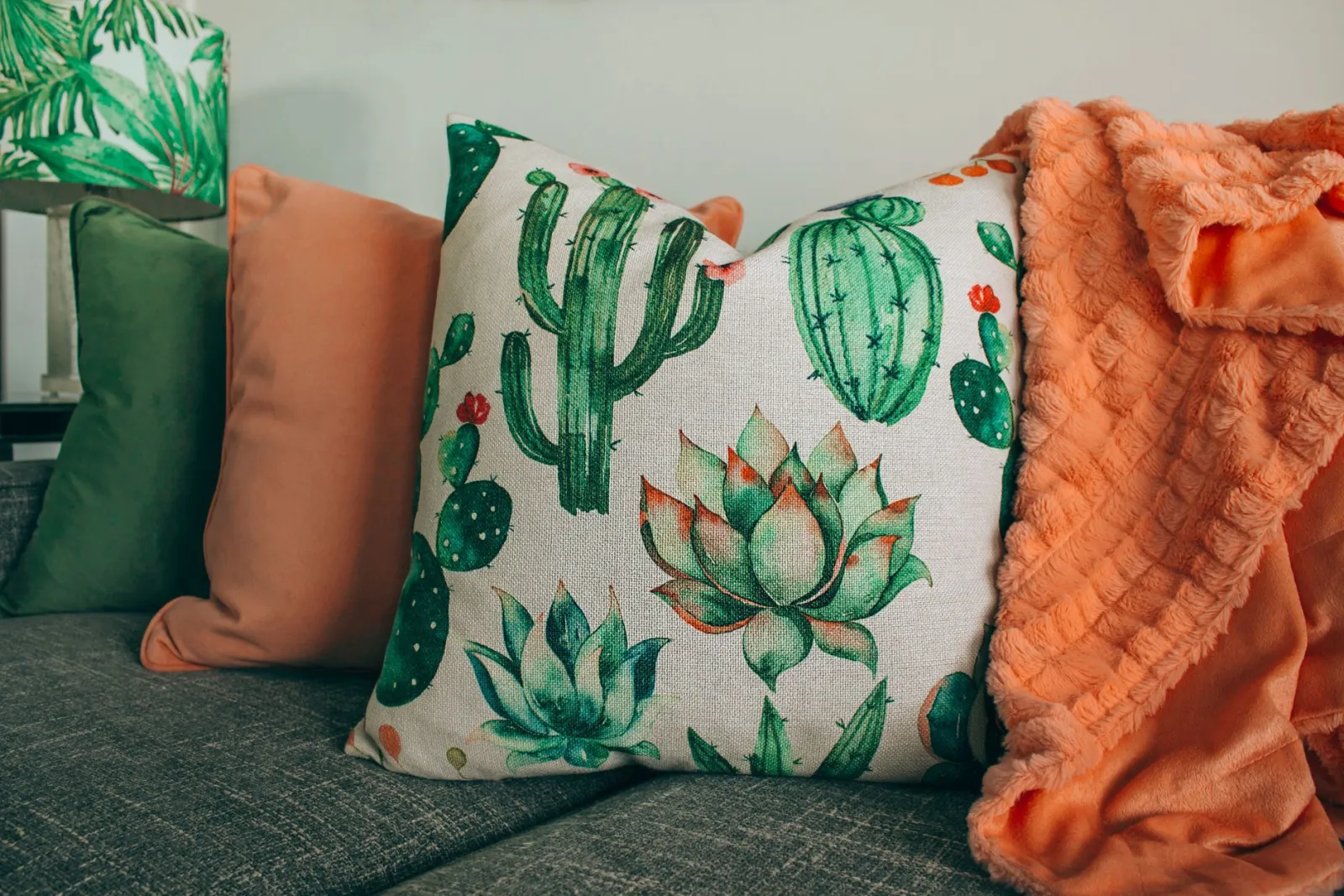
A real example: a beige sofa with cream walls and a soft grey rug. Three cushions in beige and cream tones, one in deep olive. The olive cushion becomes the visual anchor and ties into a plant in the corner. No new furniture, no repainting — just one deliberate color decision.
\n
How to Apply It
\n
- \n
- Pull your accent color from something already in the room — a book spine, a plant, a piece of art.
- Keep the accent to one cushion out of three or four.
- If you tire of the accent, rotate the cushion to another room instead of buying new ones.
\n
\n
\n
\n
Quick Comparison: Which Home Decor Style Fits Your Room?
\n
| Style | Best For | Effort Level | Main Risk |
|---|---|---|---|
| Earthy textures | Neutral rooms, rented spaces, busy households | Low | Can look flat without shape variety |
| Asymmetry | Small sofas, modern interiors | Medium | Can look messy if overdone |
| Shape variety | Benches, narrow seats, beds | Low | Round cushions can roll off |
| Single accent color | Rooms that feel too plain | Low | Accent can clash if not sourced from the room |
\n
FAQ
\n
How many cushions should I put on a sofa?
\n
There is no fixed number, but a useful starting point is three for a two-seater and five for a three-seater, arranged asymmetrically. The real test is comfort: if you have to remove a cushion before you can sit down, you have one too many. Cushions should support you, not push you forward.
\n
Can I mix patterns with these home decor styles?
\n
Yes, but keep the scale different. A large-scale abstract print next to a small geometric weave works; two medium-scale patterns in similar colors tend to blur together. If you are unsure, anchor the arrangement with two plain textured cushions and add one patterned one.
\n
How do I stop cushions from looking flat and sad?
\n
Two things help. First, choose a slightly overfilled cushion rather than an underfilled one — a cushion should hold its shape when you press it. Second, chop the top edge with your hand after arranging, a small habit that instantly makes a cushion look fuller. Rotating and plumping cushions weekly also prevents permanent flattening.
\n
The Bottom Line
\n
The latest home decor styles are less about following a look and more about layering texture, breaking symmetry, varying shapes, and using one deliberate accent color. None of these require a big budget or a redesign. Pick one style, apply it to the sofa you already own, and live with it for a week before adding more.
\n
If you want the broader picture — how cushions fit into a full room scheme, how to choose sizes, and how to build a rotation that lasts for years — a more complete guide on home textile styling is available on the blog.
\n
\n