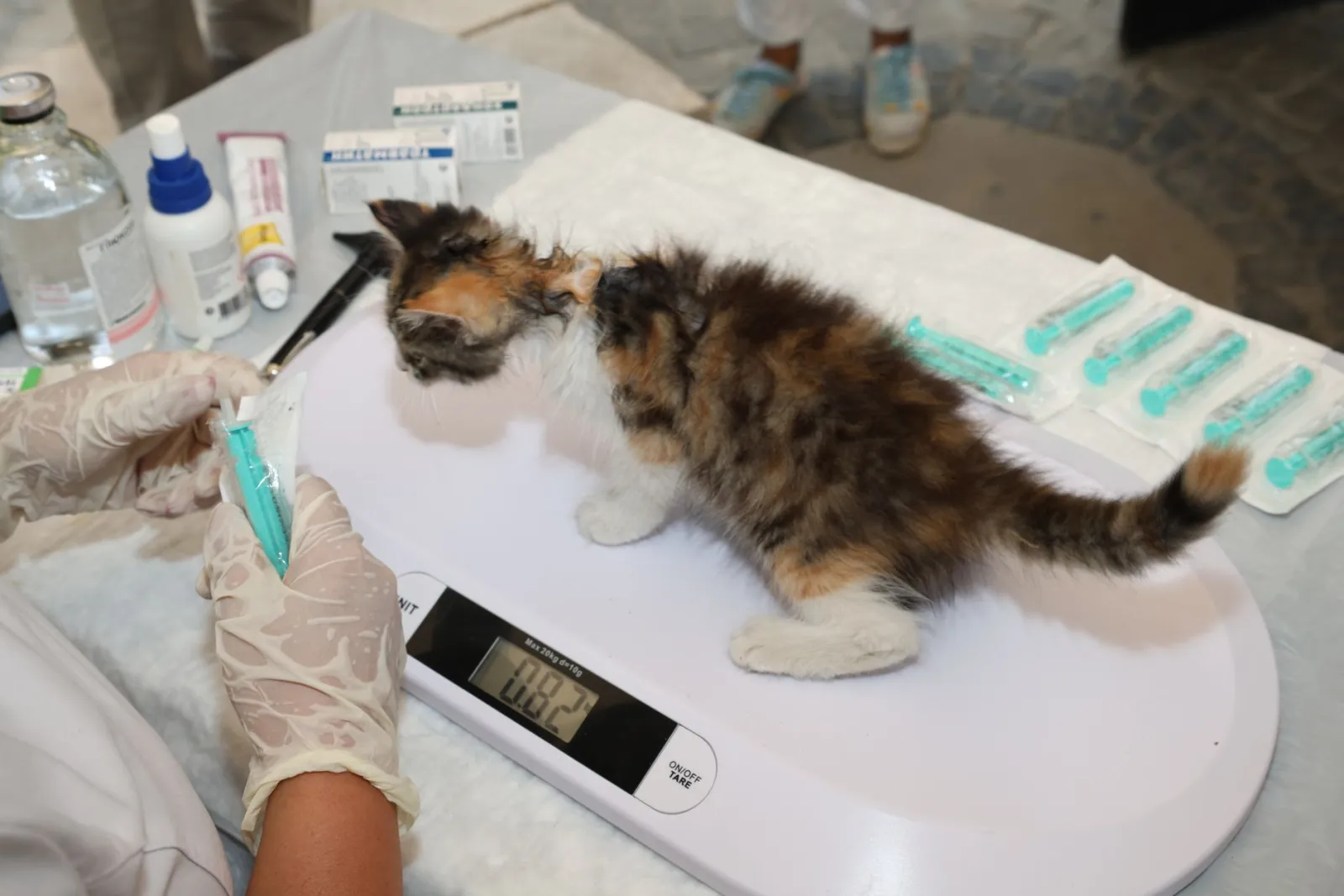
In short :
- Most adult house cats weigh 4 to 5 kg and measure about 46 cm from nose to tail base.
- That’s your baseline for a cat of unknown background, not a breed standard.
- Sex and body condition move the number more than anything else, so a 6 kg cat can be the same frame as a lean 4 kg one.
- A 4 kg cat is average, not big, and weight alone tells you little.
- Weigh each cat monthly and check body condition by hand, especially in a multi-cat home.
An average adult domestic cat weighs between 3.6 and 5.4 kg (8 to 12 lbs) and measures roughly 45 to 50 cm (18 to 20 inches) from nose to tail base, with a tail adding about 30 cm. These figures describe the everyday house cat, not a specific breed.
What is the average size of a cat?
Most healthy adult cats land in a fairly narrow window: 4 to 5 kg (8.8 to 11 lbs) in weight and about 46 cm in head-to-body length, standing 23 to 25 cm at the shoulder. That is the baseline you can reasonably expect when you bring home an adult of unknown background.
What does this look like in practice? Picture a cat that fits comfortably on a standard lap cushion, can slip under a sofa with a few centimetres to spare, and weighs about the same as a large bag of flour. That mental image is more useful than a tape measure when you are judging whether an animal is thriving.
Two things shift the number up or down. Sex is the first: a tom will often sit a kilogram above a queen of the same lineage. Body condition is the second, and it matters far more than most owners realise. A cat carrying excess fat can weigh 6 kg while being the same skeletal size as a lean 4 kg littermate. Weighing alone tells you little; you need weight paired with a body-condition check (ribs easy to feel under a thin fat layer, a visible waist from above).
In a multi-cat home, this baseline becomes a practical tool. If you feed three cats from one bowl and one of them is quietly gaining, the average tells you nothing about the individual. Weigh each cat monthly on a kitchen scale and log it.
What does cat size look like across breeds?

Breed moves the needle considerably, from miniature cats around 1.8 to 3.6 kg up to large-framed cats that regularly exceed 6 kg without being overweight. Size categories are usually grouped as small, medium, large and very large.
Small breeds sit at the bottom of the range, often 2 to 3.5 kg with a fine, slender frame. Medium cats — the majority of domestic shorthairs and longhairs — occupy the 4 to 5 kg band. Large breeds are built long and heavy-boned, commonly 5 to 8 kg, and the biggest among them can reach 8 to 10 kg.
Here is the catch that surprises many owners: a large-breed cat at 7 kg may be perfectly lean, while a medium-framed cat at 7 kg is likely obese. The number on the scale is meaningless without knowing the frame it sits on. A long-bodied cat with a deep chest has more room to carry weight than a compact, cobby one.
Consider a household with a slender, fine-boned queen and a heavy, broad-chested tom. Both can be healthy at very different weights. If you apply the same portion to both, the smaller cat gains and the larger one loses. Portion by individual, not by household average.
| Size category | Typical weight | Frame description |
|---|---|---|
| Small / miniature | 1.8 to 3.6 kg | Fine bone, compact, light build |
| Medium (most domestic cats) | 3.6 to 5.4 kg | Balanced, moderate bone |
| Large | 5 to 8 kg | Long body, heavy bone, deep chest |
| Very large | 8 to 10 kg | Substantial frame, often slow to mature |
Is a 4kg cat big?
No — a 4 kg cat is squarely average for an adult domestic cat, sitting near the middle of the 3.6 to 5.4 kg range. Whether it looks big depends entirely on the frame beneath the fur.
On a fine-boned female, 4 kg reads as a solid, well-fed cat. On a large-breed male, 4 kg would be underweight. Same number, opposite conclusions. This is why comparing cats by weight alone across a multi-cat household leads to bad feeding decisions.
Age matters too. Many cats keep filling out until around 18 months to two years, and the larger breeds mature even later. A 4 kg cat at ten months is still a growing animal; the same cat at four years is an adult at its settled weight.
Practical check: run your hands along the ribcage. You should feel the ribs like the knuckles on the back of your hand — detectable but not sharp. If you have to press to find them, the cat is carrying extra; if they stand out prominently, it is lean. Do this monthly and note the trend. A stable 4 kg with good body condition is a healthy cat, full stop.
What are the different sizes of cats?
Beyond breed, cats come in four practical size bands — small, medium, large and very large — and knowing which band your cat belongs to changes how you feed, weigh and house it.
Small cats need less food but more frequent small meals; their stomachs are genuinely smaller. Large cats need portion control because their joints carry more load, and jumping from a high shelf stresses them more. In a multi-cat home, this translates into separate feeding stations at different heights and a litter tray sized to the largest cat, not the smallest.
Height and length matter as much as weight for everyday logistics. A 25 cm shoulder height fits most standard carriers; a very large cat needs a carrier with real headroom and a door wide enough to walk through. Measure your cat’s length and height once, write it down, and use it when choosing carriers, beds and scratching posts. It saves a lot of returns.
One real-world observation: owners often underestimate how much space a large cat needs on a shelf or window perch. A perch that suits a 4 kg cat can sag or feel cramped for a 7 kg one. Buy for the biggest cat in the house and the smaller ones will simply have more room.
FAQ
What is the average size of a cat?
An average adult domestic cat weighs 3.6 to 5.4 kg (8 to 12 lbs), measures about 45 to 50 cm from nose to tail base, and stands 23 to 25 cm at the shoulder.
What does cat size look like?
Think of a cat that fits neatly on a lap, slips under low furniture, and weighs about as much as a large bag of flour. Size shows in the frame: fine-boned cats look small even at average weight, while long, deep-chested cats look substantial at the same number.
Is a 4kg cat big?
No. Four kilograms is average for an adult domestic cat. It reads as big only on a small-framed female and as underweight on a large-breed male. Judge by body condition — ribs easy to feel, visible waist — rather than weight alone.
What are the different sizes of cats?
Cats fall into four practical bands: small or miniature (1.8 to 3.6 kg), medium (3.6 to 5.4 kg, most domestic cats), large (5 to 8 kg) and very large (8 to 10 kg). Breed and sex drive most of the variation.
The takeaway
The average cat is a 4 to 5 kg animal roughly 46 cm long, and that figure is your starting point, not your answer. Weigh each cat monthly, check body condition by hand, and adjust portions per individual — especially in a multi-cat home where averages hide problems. For the wider picture on living with and caring for cats in a small space, a more complete guide covers the topic in depth.
Put it into practice : How do I pick the right bowl size for my cat’s whiskers?
Work out your own case in 30 seconds:
Methodology
This calculator produces an indicative estimate based on the parameters you enter. The ranges used reflect typical market tiers in the pets space and are neither a commercial offer nor a guarantee. Prices and availability may vary.
Was this guide helpful?
Share your experience with the WiseHomeGuides community.