In short :
- Most cats don’t actually want to wear a costume, so don’t force it.
- Go for low-contact options like a collar cover, a small bandana, or a themed scene with props.
- Keep any dress-up session short and watch your cat’s body language closely.
- If your cat freezes, hides, or fights the accessory, skip the costume entirely.
- Keep your cat indoors during Halloween week and give it a quiet room with water, a litter tray, and a hiding spot.
So you’ve seen the photos. A tabby dressed as a tiny lobster. A fluffy black cat wearing a witch’s hat, looking deeply unimpressed. And now you’re wondering: what should my cat be for Halloween?
Here’s the honest answer up front: most cats don’t want to be anything. They want to nap in the warm spot on the sofa and watch the household chaos from a safe distance. But that doesn’t mean your cat can’t join the festivities. It just means the “costume” question needs a little reframing — less about dressing up, more about keeping your cat comfortable while you enjoy the season.
This article focuses on one specific angle: how to include your cat in Halloween in a way that respects feline behaviour, stays safe, and still looks great in photos. If you want the bigger picture on Halloween safety and home setup, there’s a more complete guide on the general theme elsewhere on the site.
Do cats actually enjoy wearing costumes?
Short answer: very few do. Cats are sensitive to anything that changes how their body feels. A costume that restricts movement, covers the whiskers, or sits over the ears can trigger genuine stress — flattened ears, a twitching tail, attempts to freeze or bolt.
That said, some cats tolerate light accessories remarkably well. The difference usually comes down to the individual cat and how the item is introduced. A confident, food-motivated cat that has worn a harness before is far more likely to accept a small bow than a shy cat who hides when the doorbell rings.
A concrete example: a cat that already wears a harness calmly for vet visits has learned that “something on my body” isn’t a threat. That same cat will often accept a lightweight collar cover or a small fabric bow for a few minutes. A cat that has never worn anything and freezes when you put on a collar? Start there — not with a full costume.
Watch for these signals that a costume is a no:
- Freezing in place or walking low to the ground
- Flattened ears, dilated pupils, fast tail flicks
- Scratching at the item or trying to bite it off
- Hiding immediately after you put it on
If you see any of these, take it off. No photo is worth a stressed cat.
Costume ideas that work with a cat, not against it
The trick is to choose ideas that need minimal or no actual wearing. Think of the cat as the star of the scene, not the mannequin.
Low-contact looks
These involve a small accessory or none at all, plus a themed setup around the cat:
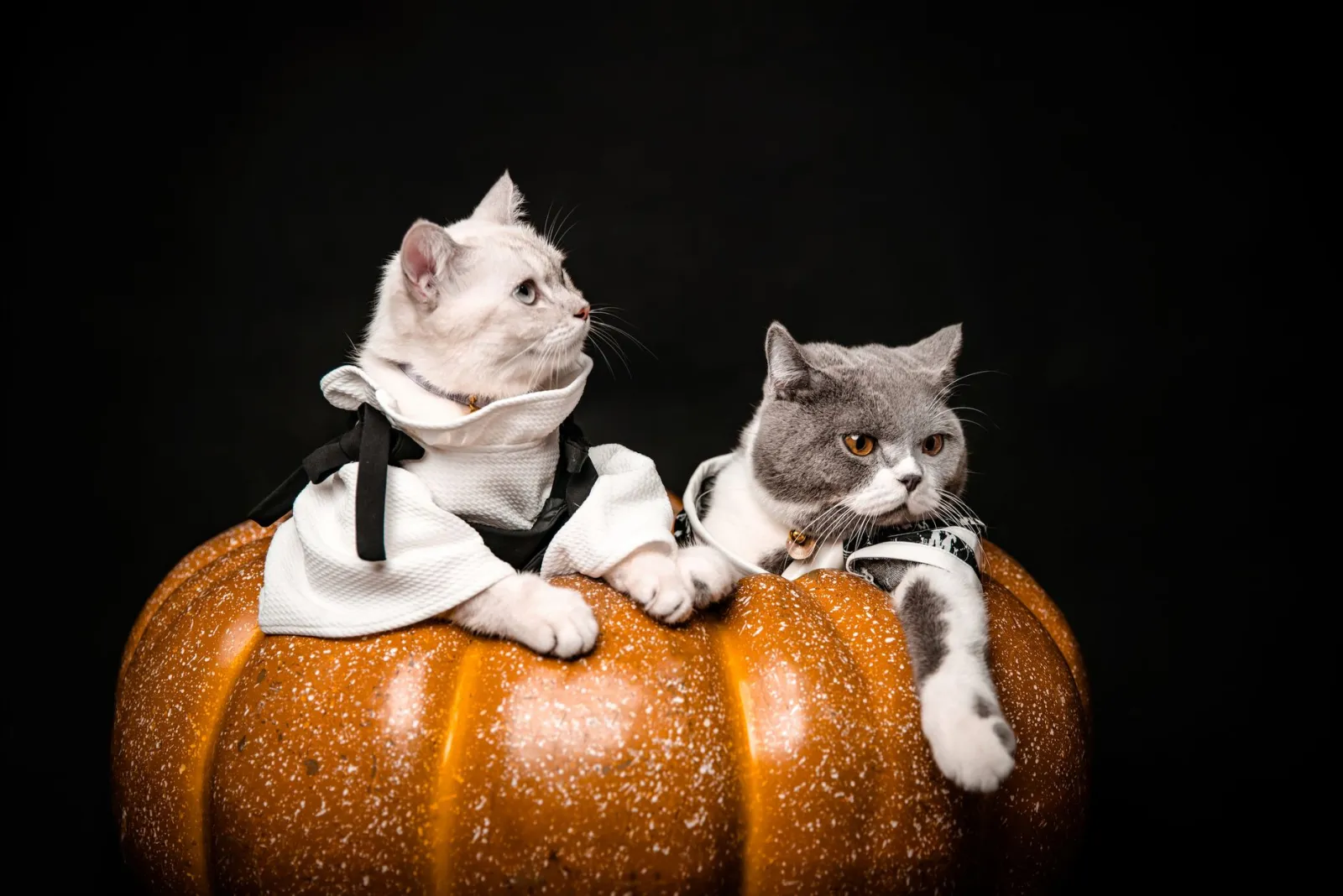
- Pumpkin in a patch: a plain orange bandana or a tiny felt hat placed nearby (not on the head) while the cat sits in a cardboard box surrounded by real or fabric pumpkins.
- Bat cat: a simple black collar cover with small felt wings attached to the collar itself — lightweight and short-worn.
- Witch’s familiar: a small bow or a star-shaped felt tag on the collar, with a broom prop beside the cat.
- Mummy: a strip of soft gauze loosely draped over a sleeping cat’s back for a two-second photo — never wrapped around the body.
What to avoid entirely
Full-body suits, hoods that cover the ears, anything with dangling pieces near the mouth, and costumes with small removable parts. Cats chew and swallow things; dangling eyes, bells, and sequins are a choking risk. Skip anything that tightens around the neck or restricts the legs.
Practical case: a household with two cats — one bold, one nervous — often finds the bold cat will wear a bandana for a photo while the nervous cat gets the “themed blanket” treatment: a festive throw on the sofa and the cat sitting on it. Same festive vibe, zero stress.
Involving your cat safely in the Halloween evening
Costume aside, the bigger question is how your cat experiences the night itself. Doorbells ringing, strangers at the door, costumes, and fireworks can turn a normally calm cat into a hiding one.
Set up a quiet room before trick-or-treating starts. Include water, a litter tray, a favourite hiding spot, and a familiar blanket. Close the door and check on your cat periodically. This single step prevents most Halloween stress.
Other practical points:
- Keep real candles out of reach — swap to battery-operated lights inside pumpkins.
- Store chocolate and sweets well away; chocolate is toxic to cats.
- Keep fake cobwebs and small decorations out of reach to avoid swallowing hazards.
- Keep cats indoors during Halloween week, especially black cats.
Real situation: a cat that normally greets visitors at the door may bolt outside when a group of costumed strangers arrives. A quiet room with the door closed removes that risk entirely.
Comparison: costume options at a glance
| Option | Contact level | Best for | Watch out for |
|---|---|---|---|
| Collar cover or small bow | Minimal | Confident cats used to collars | Check it’s breakaway and lightweight |
| Bandana | Low | Short photo sessions | Not too tight around the neck |
| Themed scene (props only) | None | Any cat, especially shy ones | Keep props small and chew-safe |
| Full costume | High | Rarely suitable | Restriction, stress, choking parts |
FAQ
What is the Halloween cat called?
There’s no single official name, but the most common term is the “Halloween cat” or “witch’s familiar.” In folklore, black cats were linked to witches, which is why the black cat became the classic Halloween symbol. Colloquially, people also call the arched-back, spooky silhouette the “Halloween cat pose.”
What should my cat be for Halloween?
Choose something that requires little or no wearing. A collar cover, a small bandana, or a themed scene with props around a relaxed cat all work well. The best “costume” is one your cat barely notices — and if your cat shows stress signals, skip the costume and use festive props instead.
Should you let cats out on Halloween?
No. Keep cats indoors during Halloween week. Fireworks, roaming hazards, and the risk of cruelty — particularly toward black cats — make the outdoors unsafe. Set up a quiet indoor room with water, a litter tray, and a hiding spot instead.
What is the traditional Halloween cat?
The traditional Halloween cat is the black cat, tied to centuries-old folklore linking black cats with witches and the supernatural. That association is why black cats appear on decorations, cards, and costumes — and why they deserve extra care and indoor safety on Halloween night.
Conclusion
So, what should your cat be for Halloween? Probably a cat — just a festive one. Pick a low-contact option like a collar cover or a themed scene, keep the session short, and watch your cat’s body language. If your cat freezes, hides, or fights the accessory, that’s your answer: no costume. A calm cat in a pumpkin-filled cardboard box makes a better photo than a stressed cat in a full suit, every time.
For the broader picture on Halloween safety, decorations, and household setup, a more complete article on the general theme is available on the site.