This article contains Amazon affiliate links. As an Amazon Associate we earn from qualifying purchases.
How do you choose a dog harness that actually fits
A well-fitting dog harness spreads pulling force across the chest instead of the throat, and it stays put without rubbing. To choose one, measure the chest girth and neck, check that the front strap clears the shoulder joints, count the adjustment points, then match the attachment position to how your dog walks. Fit beats features every time.
Most harness problems start before the dog leaves the house. A strap sitting a centimetre too low, a front ring that drags the chest sideways, a buckle that creeps loose on the third walk — these are fit issues, not training issues. And every one of them can be spotted before you commit to anything.
The guide below walks through seven criteria, in the order you’d realistically use them. Work through them one at a time and you’ll end up with a harness your dog forgets it’s wearing.
Table of contents
- How do you measure a dog for a harness
- Does the shape of the front strap affect how your dog moves
- How many adjustment points should a harness have
- Which attachment point should you choose: back or front
- What should you check in the materials, padding and hardware
- How do you test a harness fit at home before you commit
- How do coat, climate and care affect the choice
- Frequently asked questions
- Putting it all together
How do you measure a dog for a harness
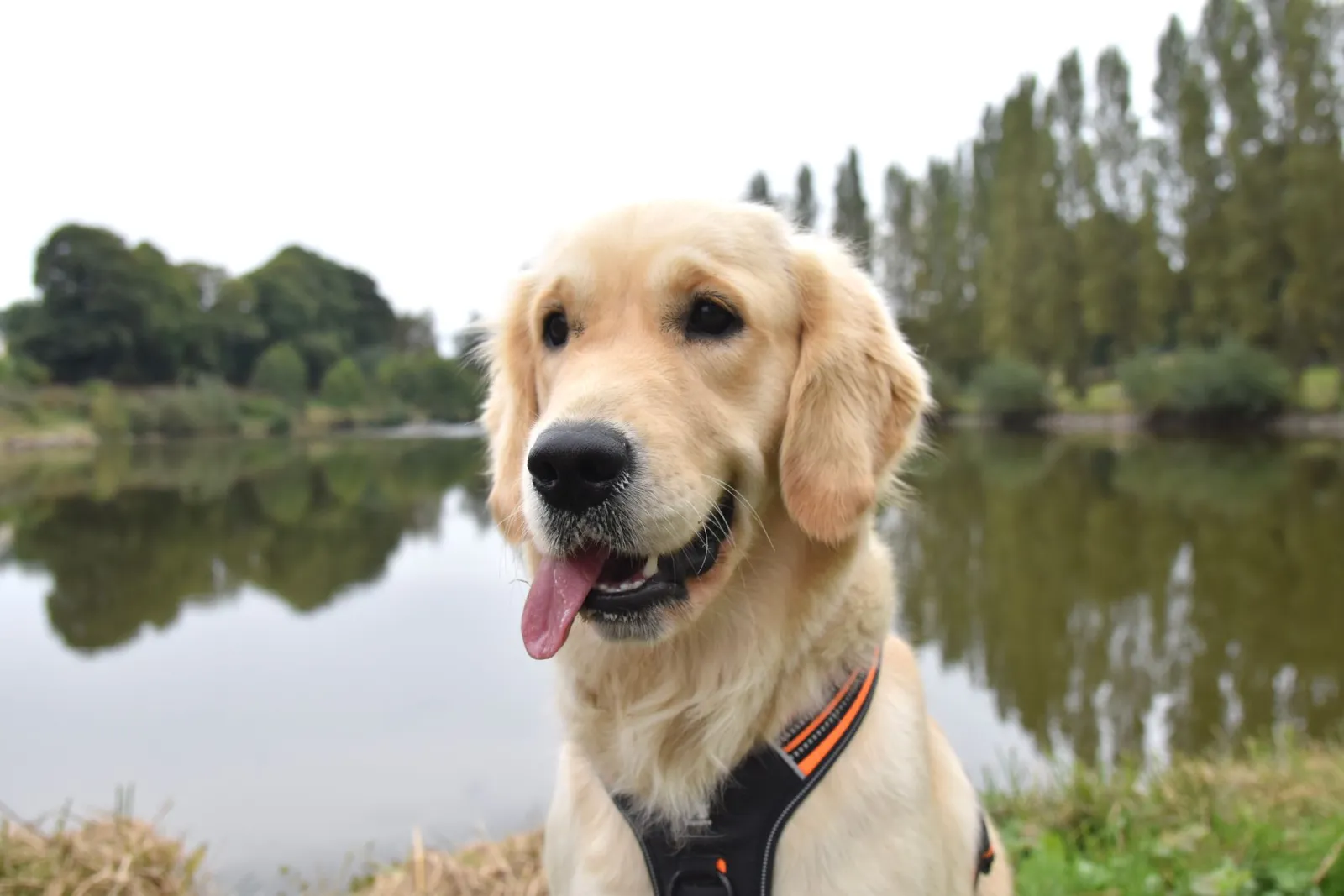
You measure two things — the chest girth at the widest point just behind the front legs, and the neck circumference at the base of the neck — then match those numbers to the maker’s own chart rather than to your dog’s weight or breed.
Use a soft cloth tape, not a metal one. Stand the dog square on all fours on a flat floor and hold a treat at nose height so it doesn’t sit or crouch; a sitting dog reads smaller at the chest. Slide the tape around the ribcage at the deepest point, usually one hand’s width behind the elbows. Snug against the fur, not compressing it. Write the number down, then do it again — the two readings should agree within a centimetre. A few makers also ask for the distance between the front legs, so note that too while the dog is standing.
Weight is a poor substitute. Two dogs of identical weight can differ by several centimetres of girth depending on build — a deep-chested sighthound and a broad, barrel-chested type are nothing alike around the ribcage. Young dogs are a moving target as well: re-measure every three to four weeks until growth plateaus, and don’t buy for the adult you expect.
Here’s the trap that catches most people. A dog measuring 72 cm around the chest might land near the top of one maker’s medium and near the bottom of another’s large. If your number sits within two or three centimetres of the upper limit of a size range, that harness has almost no room left to adjust — go up, provided the smaller size doesn’t still leave slack. And measure over the coat you’ll actually walk in. A winter-ready harness fitted in July over a summer coat will not close in January.
Does the shape of the front strap affect how your dog moves
Yes, and it’s the single most overlooked criterion. A front strap that forms a Y and passes either side of the shoulder joint lets the shoulder blade rotate freely; a straight horizontal strap crossing the joint can shorten the stride and rub behind the elbow.
Picture the shoulder blade as a paddle that swings back and forth under the skin with every step. The joint itself sits at the point of shoulder, roughly where the front leg meets the body. Anything crossing that point interferes with the swing. That’s why a Y-shaped front — two straps angling down from the neck to meet below the chest — is the shape most often recommended for dogs in regular exercise, from a morning walk to hill days.
How do you check without a vet and a slow-motion camera Put the harness on, walk the dog away from you on a loose leash, then toward you. Watch the elbows: the front leg should reach forward without the strap digging in at the top of the stride. Then look at the skin behind the elbow after ten minutes — a pink line or flattened fur means the strap is riding on the joint. One reliable observation: a dog that trots with a visibly shortened front reach on the way to the park but strides out normally off-leash is telling you something about the harness, not about its enthusiasm.
The pitfall here is fit, not just shape. A Y-front fitted too wide will slide forward and rub; fitted too narrow it pinches the chest. The Y should sit clear of the joint by roughly a finger’s width on each side, and stay there when the dog shakes.
How many adjustment points should a harness have
Four adjustable points — two at the neck, two at the chest — are the practical minimum for a stable fit on most dogs, and a fifth strap under the belly helps considerably on narrow-chested or deep-chested shapes.
Adjust in a set order: neck first, then chest, then walk away and come back. For the neck, you want the strap snug enough that it cannot be pulled over the head — the classic escape route — but with room to slide a finger underneath against slight resistance. Free-sliding fingers usually mean too loose. For the chest straps, check that no leg can slip through the opening when the dog turns sharply.
Then recheck after the first proper walk. New webbing settles and shifts by a centimetre or two in the first half hour, and a harness that felt right in the hallway often doesn’t after a kilometre. That second adjustment is the one most people skip.
More straps isn’t automatically better. Each additional buckle is another thing to get wrong on a dark morning and another potential failure point. Step-in designs, comfortable as they are to put on, often adjust only at the chest, which makes them hard to fit precisely on a dog with an unusual chest-to-neck ratio. Concrete case: a dog that backs out of its harness when a cyclist passes is almost always escaping through an over-wide neck opening — tightening the chest straps won’t fix it.
Which attachment point should you choose: back or front
A back attachment suits steady walkers, hiking, long-line work and any dog that already walks on a loose leash. A front attachment helps with dogs that lunge forward, because the leash turns them sideways instead of letting them lean into the pressure.
Mechanically, the difference is simple. A back ring gives the dog something to pull against in line with its body — the same principle that lets sled dogs work. A front ring redirects force sideways, so forward momentum breaks and the dog’s body swings round. That’s useful on a narrow pavement when another dog appears and you need half a second to redirect. It isn’t a training substitute: a front attachment works best with a loose leash and, often, two hands.
Two things to check before choosing. On a short-legged, long-bodied dog, a low front ring can catch the legs on a downhill slope — watch the clearance at the elbow. And a front attachment used with constant tension will twist the whole harness around the chest, so the panels end up where they weren’t designed to sit. Dual-attachment harnesses give you both options and are worth considering if your walks vary between busy streets and open ground.
| Harness style | Where it helps most | Main limitation | What to check at home |
|---|---|---|---|
| Y-front, back attachment | Everyday walks, hiking, long-line work | Gives a committed puller something to lean into | Shoulder clearance; no rotation when the dog shakes |
| Y-front, front attachment | Dogs that lunge or forge ahead | Can twist the harness under constant tension | Ring height above the elbow; strap stays flat |
| Dual attachment | Mixed environments, changing needs | More hardware and more straps to set correctly | Both rings loaded separately; balance stays centred |
| Straight-front or step-in | Calm dogs, quick on-and-off | Strap may cross the shoulder joint | Front reach while trotting; skin behind the elbow |
What should you check in the materials, padding and hardware
Check three failure points — the stitching, the buckles and the ring — and then check that padding sits where load is actually carried, not where it looks generous.
Start with the webbing. Twist a strap between your fingers; good webbing springs back flat, cheap webbing stays kinked and softens over months. Look at the cut ends: sealed, clean edges resist fraying, while loose fibres start unravelling from the first week. Then run a thumb along the stitching at every load point — the ring attachment, the buckle anchors, the junction where the front straps meet. Dense, even, multi-pass stitching is what you’re after; a single line of loose stitches at the D-ring is the first thing to go.
Padding deserves more suspicion than it gets. A thick, pillowy panel in the armpit area will chafe, because it traps heat and rubs on every stride. Padding belongs over the chest plate and sternum, where the load is spread, and it should be breathable rather than bulky. On a dog with a thin coat, a hairless breed or a senior with less muscle over the ribs, a smooth, low-profile lining matters more than thickness.
Hardware: metal versus plastic is the wrong question. The right questions are whether the ring is smooth and generously radiused, whether buckles click positively and stay clicked, and whether the adjusters hold their position under load. Practical test — clip a leash on, load the harness by hand with steady pressure in each direction, and watch whether anything slips or bows. A side-release buckle that pops open when a dog hits the end of a long line usually announces itself this way long before it happens outdoors. Reflective trim is a small detail that pays off from October onward.
How do you test a harness fit at home before you commit
Do a five-minute indoor session, a fifteen-minute walk, then a full body check — hands under every strap, looking for redness, hair displacement and slipping.
The indoor session covers three quick tests. The pull test: with the harness on and the leash attached, apply gentle steady backward pressure and see whether the harness rotates or lifts off the chest. The twist test: hold the harness at the ring and rotate it gently — a well-fitted harness resists, a loose one spins. The escape test: step back while the dog stands, or have someone knock at the door; a harness that slides forward over the shoulders under surprise is too big at the neck.
Then walk. Fifteen minutes on your normal route, on a loose leash where possible, with a couple of turns and one good sniff stop. Afterwards, run your fingers under every strap, all the way round, feeling for warmth, dampness or a raised line. Part the fur at the shoulder and behind the elbow. A red line after twenty minutes isn’t a padding problem — it means a strap is sitting on a joint that needs to move.
Finally, repeat the check with the dog wet. Webbing shifts when soaked, and a harness that fits perfectly dry can slide forward after a swim or a bath. If you’re between two sizes and only the wet test reveals the problem, you’ve found your answer.
How do coat, climate and care affect the choice
A harness that works in July may not fit in January — a thick winter coat adds real girth — and wet webbing behaves differently from dry, so the harness needs enough adjustment range to cover both seasons.
Coat type drives comfort more than climate does. Double-coated dogs trap heat under wide, padded panels; look for open, ventilated designs and check the armpits after summer walks. Short-coated and hairless dogs have less cushioning, so smooth linings and clean stitching matter. Woolly coats collect burrs and sand in exposed webbing — a harness with fewer exposed loops is easier to keep clean.
For wet work, quick-drying webbing and removable padding are worth the extra fuss. Rinse after salt water or muddy walks, because sand works its way into the weave and abrades the stitching from the inside. Air-dry flat, away from direct heat, and skip fabric softener entirely — it coats the fibres and reduces their grip in the adjusters.
Give the harness a two-minute inspection once a month: stitching at the ring, the buckle springs, the webbing where it bends through the adjusters. Retire it when the ring shows visible wear grooves, when the webbing at the ring softens or frays, or when a buckle no longer clicks firmly. A harness used daily at the beach may reach that point far sooner than one used for weekend walks — rinsing in fresh water after each trip is the simplest way to extend the useful life.
Frequently asked questions
Can a harness make my dog pull harder
Yes, in one specific situation: a back-attachment harness gives a determined puller a solid anchor point in line with its body, which is exactly how pulling sports work. If your dog leans into pressure, a front attachment or a change in handling does more for you than a different back-clip design.
How tight should a harness actually be
Snug enough that it cannot rotate or be pulled over the head, loose enough that a finger slides under each strap with slight resistance. The neck opening is the critical one — most escapes happen there, not at the chest.
My dog is between two sizes. Which way should I go
Pick the size where your measurement sits at least two or three centimetres inside the range, which usually means sizing up. Size down only if the larger option leaves the neck opening so wide that escape becomes possible.
Can a dog wear a harness all day
For walks, car trips and outings, yes. For long stretches at home, take it off so the skin under the straps can breathe and you can check for rubbing. A harness also isn’t a replacement for a collar and identification tag.
Does a harness damage a dog’s shoulders
Not when the front strap clears the joint. Problems come from two sources: a straight strap crossing the point of shoulder, and a harness loose enough to slide and chafe with every stride. Both are visible within twenty minutes of wear if you look for them.
Putting it all together
The order matters more than the features list. Measure the chest girth and neck with a cloth tape while the dog stands square, and keep those two numbers with you. Check that the front strap forms a Y and clears the shoulder joint by about a finger’s width. Count four adjustment points as your baseline, and recheck them after the first real walk. Match the attachment to the walk you actually do — back for steady plodders and hill days, front for the dogs that tow you toward every lamppost. Then test properly: five minutes indoors, fifteen minutes out, and a hands-on skin check afterwards.
Two habits keep a good harness good. Re-measure before each season change, since winter coats and summer coats are not the same dog. And inspect the ring, stitching and buckles monthly — most failures are visible weeks before they happen.
If you want to go further, the natural next steps are loose-leash handling on a front attachment, choosing a long line for open-ground walks, and checking how a harness interacts with car restraint. Senior dogs and dogs with reduced mobility deserve their own look too, since a harness that spreads load across the chest can make a real difference to a dog that struggles with stairs.
Work out your own case in 30 seconds:
Methodology
This calculator produces an indicative estimate based on the parameters you enter. The ranges used reflect typical market tiers in the pets space and are neither a commercial offer nor a guarantee. Prices and availability may vary.
Read next :Best Dishwasher Pods: A Practical Guide for a Cleaner Kitchen
Read next :Solar Panel Price Guide for Homeowners and Pet Owners
Read next :Dogs Xmas Jumpers: A Practical Buying and Care Guide
Read next :Watering System for Garden: A Complete Guide to Keeping Plants Hydrated
Read next :How Much Dog Insurance Really Costs and Why
Full guide :Pets
More from this guide :
Was this guide helpful?
Share your experience with the WiseHomeGuides community.