This article contains Amazon affiliate links. As an Amazon Associate we earn from qualifying purchases.
In short :
- Measure your TV first, then pick a stand at least as wide as the screen, ideally 10 to 20 cm wider on each side.
- Get the height right so your eyes rest at the middle of the screen when you sit down.
- Check the weight capacity, cable routes, materials, airflow, and how hard it is to assemble before you buy.
- Do those things and the stand fades into the background, which is exactly what you want.
A television stand looks like a simple piece of furniture. It holds a screen, hides a few cables, and blends into the room. In practice, it is one of the trickiest things to get right in a living room. Buy one that is too small and the TV seems to float above it, wobbling every time someone walks past. Buy one that is too tall and you spend the evening looking up at the screen like you are in the front row of a cinema. Buy one that is too shallow and the soundbar hangs off the front edge.
The good news is that choosing well does not require any special talent. It requires a tape measure, a little honesty about how you actually use the room, and a clear idea of the criteria that matter. This guide walks through each of those criteria one by one, so you can judge any stand you come across — in a shop, in a catalogue, or second-hand — with confidence.
Size and proportions: matching the stand to the screen
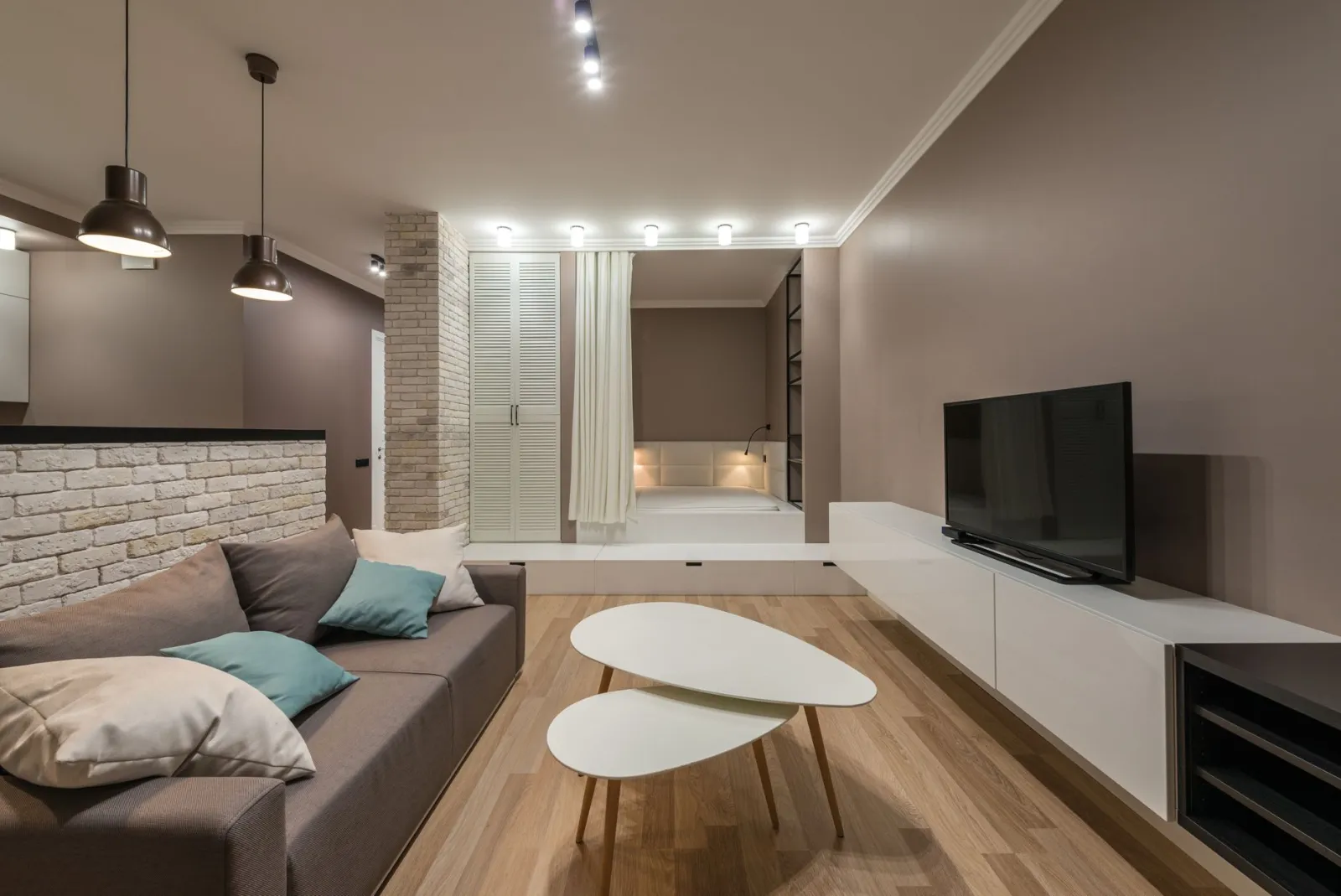
The single most common mistake is buying a stand that is narrower than the television. As a rule of thumb, the furniture should be at least as wide as the TV, and ideally a little wider so the screen does not overhang the edges. A stand that is 10 to 20 cm wider than the screen on each side looks balanced and gives you room for a speaker, a plant, or a remote-control tray.
Depth matters just as much as width. Most modern flat screens sit on a central foot or two small legs rather than a wide pedestal, but that foot still needs a stable surface. Check that the top surface is deep enough for the base and for anything you plan to place in front of it. If you own a soundbar, measure its depth too — a stand that is 35 cm deep may leave a soundbar perched precariously at the front.
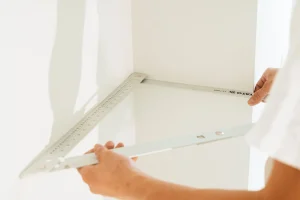
Here is a quick way to test proportions before you buy. Cut a rectangle of cardboard to the exact footprint of the stand you are considering and lay it on the floor where the furniture would go. Step back three metres. If the rectangle looks small and lost against the wall, the stand will too. If it crowds the doorway or blocks a walkway, you have your answer.
Height: the eye-line rule that saves your neck
Where you sit determines how high the stand should be. The comfortable viewing rule is simple: when you are seated normally, your eyes should land somewhere between the middle and the top third of the screen. Too low and you slouch forward. Too high and you crane your neck — a problem that shows up as tension headaches after a long film.
For most sofas, a stand between 40 and 55 cm tall, combined with the height of the TV’s own base, puts the screen in roughly the right place. If you have a very low modern sofa, aim for the lower end. If you have a tall armchair or a high-backed sofa, you may need the upper end or even a wall mount instead.
A practical test: sit where you normally sit, close one eye, and point at the centre of where the screen would be. If your finger points at the ceiling or the floor, the height is wrong. People rarely do this before buying, and it is the reason so many living rooms end up with a television that feels slightly off without anyone being able to say why.
Stability and weight capacity: the invisible safety criterion
A stand that wobbles is not just annoying — it is a genuine risk, especially in homes with children, pets, or a vacuum cleaner that bumps into furniture. Stability comes from three things: the weight the stand is rated to hold, the width of its base relative to its height, and the quality of its construction.
Always check the stated weight capacity and compare it with the weight of your television plus anything else you plan to put on top. A comfortable margin is worth having: if your TV weighs 15 kg, a stand rated for 30 kg or more will feel far more solid than one rated for 18 kg. Look at the base too. A stand with a wide, low footprint resists tipping far better than a tall, narrow one.
At home, the test is easy. Once assembled and loaded, give the top a gentle nudge from the side. It should shift a millimetre or two and settle. If it rocks, the floor is uneven or the frame is twisting — both fixable with adjustable feet or a firmer assembly, but worth knowing before the TV goes on.
Storage and cable management: planning for the mess you cannot see
Every television comes with a small colony of cables: power, HDMI, perhaps an aerial, a games console, a streaming stick. A stand without any cable management turns that colony into a visible tangle within a week. Open shelves look airy but expose every wire. Closed cabinets hide them but can trap heat around devices that run warm.
The middle ground works best for most people: at least one open shelf for a device that needs airflow, plus a route — a hole, a gap, or a channel — for cables to pass through the back. Measure the internal shelf height against your tallest device. Games consoles and receivers are often taller than people expect, and a shelf that is 2 cm too short is useless.
Think about what you actually keep near the TV. A typical living room setup includes a streaming device, a router, maybe a console, and a couple of controllers. If you count four items and the stand has two shelves, you will be stacking things on top of each other. Draw a quick list before you shop and match it to the storage on offer.
Materials and finish: what survives real life
The material affects how the stand ages, how much it weighs, and how well it hides fingerprints and dust. Solid wood is durable and repairable but heavy. Engineered wood with a veneer is lighter and often more affordable, though edges can chip if knocked. Metal frames are strong and slim, which suits modern rooms, but can scratch floors without protective pads. Glass looks elegant but shows every smudge and is unforgiving if something heavy lands on it.
Consider the room, not just the catalogue photo. In a house with young children, a light-coloured high-gloss finish will show sticky fingerprints within a day. In a room with strong sunlight, some finishes fade or yellow over time. A matte finish in a mid-tone tends to be the most forgiving in everyday use.
If you can, touch the surface before buying. Run a fingernail lightly along an edge — if it catches or lifts, that edge will not survive a move. Check the underside too; a well-made stand usually looks tidy where nobody is supposed to look.
Ventilation and airflow: protecting the electronics inside
Devices enclosed in a closed cabinet generate heat, and heat shortens the life of electronics. A stand with a solid back and tight-fitting doors can turn a shelf into a small oven, particularly during a long film or a gaming session. Look for ventilation slots, a partially open back, or a design where air can move from bottom to top.
As a general guide, leave a few centimetres of clearance around any device that has its own fan or vents. If the stand has a closed compartment, check whether the back panel has cut-outs. If it does not, you can often remove or drill the panel — but only if the structure allows it without weakening the frame.
A simple home check: after an hour of use, feel the shelf surface around your devices. Warm is normal. Hot to the touch means the enclosure is trapping too much air, and you should either open it up or move the device elsewhere.
Assembly, moving, and long-term practicality
A stand is not just furniture — it is a small construction project followed by a piece of furniture you will live with for years. Check how many parts it arrives in, whether the fixings are metal or plastic, and whether the instructions assume two people. Flat-pack stands with dozens of small cam locks take longer than they look, and a wobbly result usually traces back to one fixing that was not tightened fully.
Think about the future too. If you might move house, a heavy solid unit is harder to shift than a modular one. If you might upgrade to a larger screen, a stand with a little spare width will absorb the change. Adjustable feet are a small feature that makes a big difference on uneven floors.
Before assembly, lay out every part and check nothing is missing. Assemble on a soft surface to avoid scratches. Tighten fixings in the order the instructions suggest, then go around once more at the end — this final pass catches the loose screw that causes the wobble.
Frequently asked questions
What is the current minimum wage in the UK?
This question is about employment law, not furniture, so it sits outside the scope of this guide. For the current figure, the official government source is the only reliable reference — rates are updated regularly and vary by age band and apprentice status.
What will be the difference between the minimum wage and the Living Wage in 2026?
Again, this concerns pay policy rather than television stands. The two figures are set by different bodies and change annually, so any comparison should be checked against the official announcements for that year.
What are the reviews like for the movie “Living” with Bill Nighy?
This is a question about film, not furniture. Reviews of any film vary widely by critic and publication, so it is best to read a range of sources rather than a single summary.
Is there a movie with Bill Nighy called “Living”?
Yes, there is a film titled Living featuring Bill Nighy. It is unrelated to television stands, but the title is a helpful reminder that a stand should help you live comfortably with your screen, not fight it.
Conclusion: the stand that fits your room and your habits
Choosing a television stand comes down to matching it to your screen, your seating, and your daily reality. Get the width and depth right so the TV sits securely. Get the height right so your neck relaxes. Check the weight capacity, the cable routes, the materials, the airflow, and the assembly before you commit. Do those things and the stand disappears into the background — which is exactly what good furniture should do.
For a broader look at living room furniture, room layout, and how the pieces work together, a more complete guide is available on the general theme. Start with the criteria above, measure twice, and buy once.