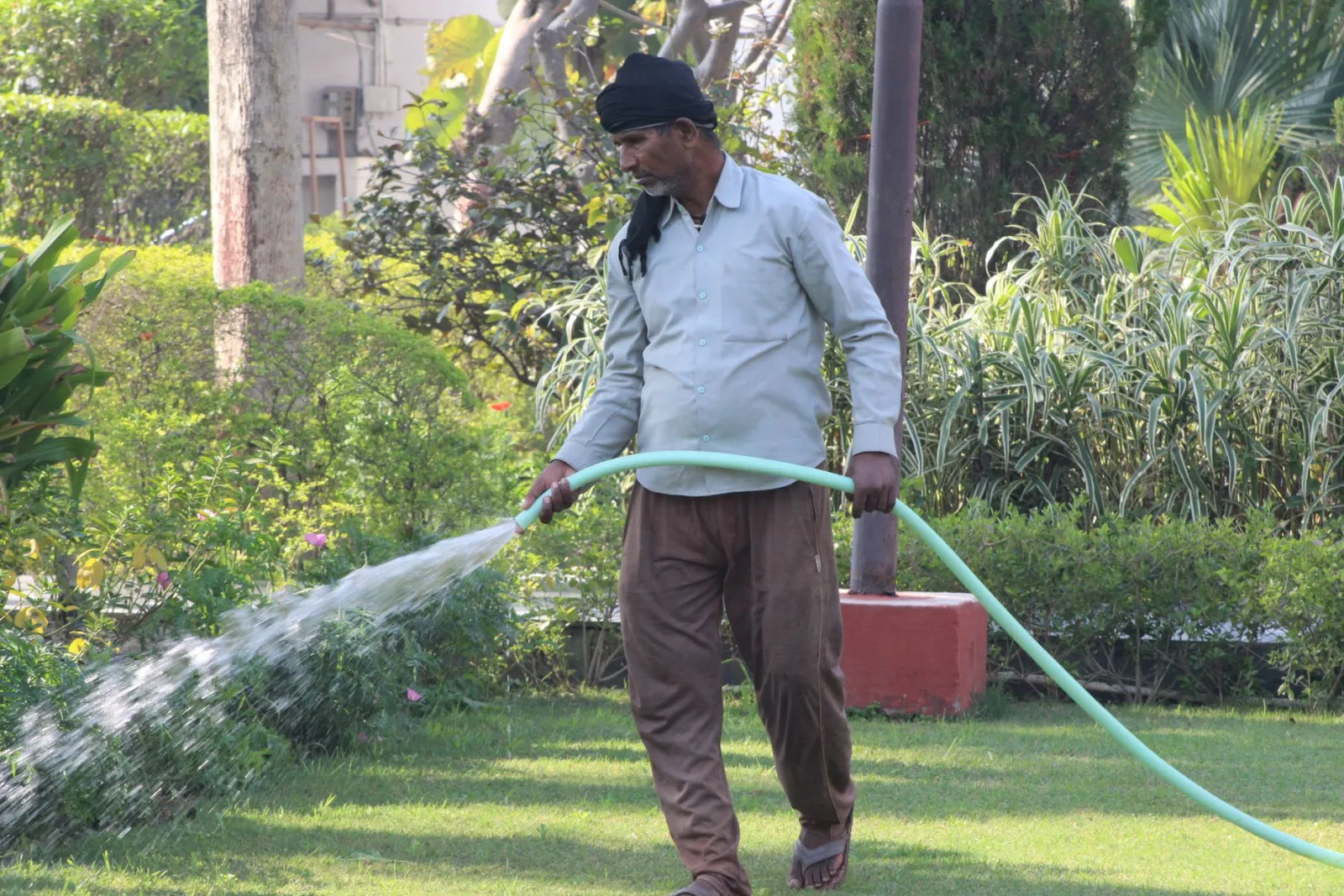
Short answer : A garden watering system delivers water directly to plant roots, either through drip lines, soaker hoses, or sprinklers, so you can keep beds hydrated without standing outside with a hose. The right choice depends on your garden size, the plants you grow, and how much time you want to spend on maintenance. Drip and soaker systems suit vegetable beds and borders because they water slowly at soil level, while sprinklers cover lawns and larger open areas. Pair any system with a timer and a rain sensor to avoid overwatering, and check emitters and connections regularly so nothing clogs or leaks.
In short
- Drip irrigation targets roots with low-flow emitters, reducing evaporation and water waste compared with overhead spraying.
- Soaker hoses are a simple, low-cost option for long, straight beds and work well under mulch.
- Sprinkler systems cover lawns and wide areas but wet foliage, so water early in the day to limit disease.
- A timer or smart controller automates watering schedules and a rain sensor skips cycles after rainfall.
- Check emitters, filters, and connections monthly, and flush lines at the start of the season to prevent clogs.
Why a Reliable Watering System Matters for Your Garden
A garden’s health depends far more on consistent watering than on almost any other single factor. Plants can recover from poor soil, a missed feeding, or a season of neglect, but they rarely recover from prolonged drought stress or from roots left sitting in waterlogged ground. A reliable watering system is what closes the gap between what the weather delivers and what your plants actually need, and it does so without depending on your memory or your free time.
The core problem is variability. Rainfall is unpredictable in timing and volume, and hand-watering is equally uneven: it is easy to soak a bed one week and skip it the next, or to give shallow daily sprinklings that only wet the surface. Shallow watering encourages roots to stay near the top of the soil, where they dry out fastest, while deep, infrequent watering pushes roots downward and builds a more resilient plant. A proper system, whether drip lines, soakers, or timed sprinklers, delivers water slowly and deeply at the root zone, which is exactly the pattern most vegetables, perennials, shrubs, and lawns respond to best.
Different parts of a garden have different demands, and this is where a system earns its keep. Raised beds and containers dry out much faster than open ground because they hold less soil volume and drain freely, so they need more frequent, targeted delivery. Newly planted trees and shrubs need steady moisture through their first seasons while their roots establish. Lawns, meanwhile, prefer a good soak less often rather than light daily misting. A well-designed system lets you match delivery to each zone instead of treating the whole garden the same way.
Consistency also protects against the two failure modes that do the most damage. Underwatering shows up as wilting, leaf scorch, dropped blossoms, and stalled growth, and it hits hardest during hot, windy spells when evaporation spikes. Overwatering and poor drainage are just as harmful, suffocating roots and encouraging rot, which is why controlled delivery, with the ability to adjust flow and timing, matters as much as simply supplying water. A system that runs on a schedule and can be tuned to the season keeps you out of both extremes.
Finally, there is the practical case. Watering by hand takes time every day in peak summer, and that time is exactly when gardens need the most attention. Automating delivery frees you to focus on planting, pruning, and harvesting, and it keeps plants stable through weekends away or busy weeks. The result is a garden that grows evenly rather than lurching between stress and recovery, and plants that reward the steady conditions with stronger growth and better yields.
Types of Garden Watering Systems Explained
Garden watering systems fall into a few broad families, and the right choice depends on how much area you need to cover, how often you can tend to the garden, and whether you want water delivered at the soil surface or to the foliage. Understanding how each type behaves in practice makes the decision far easier than comparing product features alone.
Hand watering with a watering can or hose remains the simplest option and suits small beds, containers, and newly planted areas that need close attention. It gives you full control over how much water each plant receives and lets you direct moisture precisely to the root zone. The trade-off is time and consistency: it is labor-intensive, easy to under- or over-water, and impractical once a garden grows beyond a modest size or when you are away for several days.
Sprinklers and hose-end sprayers cover larger areas quickly by throwing water through the air. They work well for lawns and broad, evenly planted beds, and they are inexpensive to set up. Their weakness is waste and unevenness: wind drifts the spray, evaporation claims a share before the water lands, and foliage stays wet, which is not ideal for plants that prefer dry leaves. They also tend to overwater some spots while leaving others dry, so they reward a little observation and adjustment.
Drip irrigation and soaker hoses deliver water slowly and directly at or near soil level, which minimizes evaporation and keeps foliage dry. Drip lines with emitters release water at a controlled rate, while soaker hoses weep along their length; both are well suited to vegetable beds, rows, and shrub borders. They are efficient and easy to automate, but emitters can clog and the tubing needs occasional checking, and the initial layout takes more planning than simply dragging out a hose.
Automated systems built around timers, and in larger gardens around buried pipes and pop-up heads or zoned drip lines, take the consistency problem out of watering. Timers let you water early in the morning on a regular schedule, which is when losses to evaporation are lowest, and zoned designs let different parts of the garden receive different amounts. These systems demand the most upfront cost and installation effort, and they still need seasonal adjustment and winter preparation, so they make most sense for larger or more demanding gardens.
Drip Irrigation: Efficient Watering for Beds and Borders
Drip irrigation delivers water slowly and directly to the root zone through a network of tubing and emitters, rather than spraying it across the foliage and surrounding soil. For garden beds and borders, this makes it one of the most water-efficient approaches available: because water drips at a controlled rate near the base of each plant, far less is lost to evaporation, wind drift, or runoff onto paths and paving. The result is that a greater share of the water you supply actually reaches the roots, and the soil surface between plants stays comparatively dry, which discourages weed germination.
The system typically consists of a main supply line laid along the bed, with either inline emitters built into the tubing at fixed intervals or individual emitters punched into blank tubing where each plant sits. Inline drip tubing suits uniform plantings such as a row of shrubs or a dense border, where evenly spaced outlets match the planting rhythm. Individual emitters give more flexibility in mixed borders, where a large specimen may need a higher-flow emitter while delicate perennials nearby need only a trickle. A pressure regulator and a filter at the connection point are worth including, since emitters are narrow and vulnerable to clogging from debris and to uneven output if pressure is too high.
Drip is particularly well suited to beds and borders for several practical reasons. It keeps foliage dry, which is helpful for plants prone to fungal problems when leaves stay wet. It works well on slopes and in long, narrow borders where sprinklers would waste water on surrounding ground. It also allows different zones to be watered according to their needs, so a thirsty vegetable bed and a drought-tolerant shrub border can run on separate lines and schedules rather than being forced into one compromise.
Layout matters as much as the hardware. Emitters should be placed within the spread of each plant’s root zone rather than tight against the stem, and spacing should reflect soil type: water spreads sideways more readily in loam than in sandy soil, where it tends to move downward, so closer emitter spacing is generally needed on light soils. Running the tubing in loops or parallel lines through a wide border helps cover the root area evenly instead of leaving dry gaps between rows.
Maintenance is modest but not optional. Checking emitters periodically for clogs, flushing the lines at the start of the season, and adjusting placement as plants establish and spread will keep the system performing. Used with a simple timer, drip irrigation turns a border into a consistently watered bed with little ongoing effort, making it a strong default choice wherever water efficiency and healthy foliage matter.
Soaker Hoses: Simple Watering for Vegetable Patches
A soaker hose is one of the least expensive ways to water a vegetable patch, and it suits gardeners who want reliable moisture without installing a full drip system with emitters and fittings. The hose itself is a length of porous rubber or recycled material that sweats water along its entire length, releasing it slowly into the soil rather than spraying it into the air. Because the water seeps out at low pressure and lands directly on the ground, very little is lost to evaporation and the foliage stays dry, which helps reduce the conditions that favor leaf diseases. It is not a precision tool, but for a row of tomatoes, a block of beans, or a bed of leafy greens, it covers the basics well.
The main appeal is simplicity. You lay the hose along the base of your plants, stake or weight it so it stays put, and connect one end to a tap or a length of standard garden hose. A pressure reducer is often worth adding, since household water pressure is usually higher than a soaker hose needs and can cause uneven weeping or split seams. Once running, the hose delivers water along its whole length, so you are watering a strip of soil rather than individual plants. That makes it a natural fit for closely spaced crops and for raised beds where the hose can be looped back and forth to cover the surface.
Performance depends heavily on soil type and length. In sandy soil, water spreads mostly downward, so the wetted band stays narrow and you may need hoses spaced closer together. In loam or clay, moisture spreads sideways more readily and a wider band of soil is moistened. Long runs of soaker hose tend to lose pressure toward the far end, so the last stretch may weep noticeably less than the first; keeping individual runs moderate in length and splitting long beds into two shorter runs gives more even delivery. Burying the hose lightly under a layer of mulch or a thin skim of soil slows surface evaporation further and hides the rubber from view.
Soaker hoses work best on a timer or with a simple manual routine, because the flow is slow and easy to underestimate. A common approach is to run the hose for a longer block of time a few times a week rather than a short daily burst, letting the water soak down to the root zone. Checking is straightforward: push a finger into the soil beside the hose after a run and see how deep the moisture reaches. If only the top inch is damp, extend the run time; if water is pooling on the surface, shorten it or reduce the pressure.
The limitations are worth knowing before you commit. Soaker hoses are less uniform than drip lines with individual emitters, they can clog over time in hard water areas, and they do not adapt well to widely spaced plants that each need their own delivery point. They also degrade with sun exposure and seasonal freezing if left out. For a vegetable patch with rows or blocks of similar crops, though, they remain a practical, low-cost choice that keeps water where roots can use it.
Sprinkler Systems for Lawns and Large Garden Areas
Sprinkler systems are the practical choice when a lawn or a broad planting bed is too large to water by hand and too valuable to leave to chance. Rather than delivering water to the base of individual plants, they spread it across the surface, which suits turf and dense groundcover far better than drip lines. The main decision is between fixed spray heads, which throw water in a set pattern from a permanently placed position, and rotary or gear-driven heads, which sweep a stream back and forth or in a circle. Fixed sprays cover a smaller radius but apply water quickly, making them useful for small, irregular lawns and tight corners. Rotary heads throw farther and apply water more slowly, so they suit open, uninterrupted lawns where even coverage over a wide area matters more than speed.
Coverage and overlap are the criteria that decide whether a layout works. Sprinkler heads are designed to be spaced so their patterns overlap, typically head-to-head, because the outer edge of a spray throws less water than the center. A system laid out with gaps between patterns will produce dry strips and lush patches in the same lawn. When planning, match the throw radius of the chosen head to the spacing, and expect to use more heads than a simple area calculation suggests. For long, narrow strips along a fence or driveway, a row of matched heads along one edge usually beats a scattered arrangement.
Water pressure and flow determine what a zone can support. Spray and rotary heads have different demands, and running too many heads on one zone drops pressure until the patterns collapse and coverage becomes uneven. Splitting a large lawn into several zones, each controlled by its own valve and run in sequence, keeps pressure steady and lets you tailor run times to sun exposure and soil. Slopes and compacted areas benefit from shorter, repeated run cycles so water soaks in rather than running off.
Sprinklers are the right tool for established turf, playing fields, and large beds of similar plants, but they are a poor fit for mixed borders, vegetable patches, and containers, where foliage stays wet and water lands where it is not needed. In those areas, drip or soaker lines deliver water to the root zone with less waste and less leaf disease. Many gardens work best with a hybrid: sprinklers for the lawn, drip for beds and pots.
Finally, match the system to how the garden is used and maintained. Pop-up heads that retract below the mowing height avoid damage from mowers and foot traffic, while fixed above-ground sprinklers are simpler to move and adjust but must be relocated before mowing. A timer or controller turns any of these into a reliable schedule, and a rain sensor prevents watering during or just after rainfall. Choose the head type for the shape and size of the area, zone the system to protect pressure, and keep sprinklers where their broad spray is an advantage rather than a liability.
Hose Timers and Controllers for Automated Watering
A hose timer sits between your outdoor tap and your hose or drip line, and its job is simple: open the water at a set time and close it again after a set duration. That single function removes the most common cause of plant loss during hot spells, which is inconsistent watering rather than outright neglect. Timers range from basic mechanical dials that run on tap pressure to electronic units with digital scheduling, and the right choice depends on how much control you want and how reliable your water pressure is.
Electronic timers offer the most flexibility. Most let you set a start time, a run duration, and a frequency such as every day, every second day, or specific days of the week. Some support multiple start times per day, which suits containers and newly planted beds that need short, frequent cycles rather than one long soak. Look for a timer with a manual override so you can water on demand without reprogramming the schedule, and check whether it has a rain-delay function that pauses watering for a day or more after wet weather. A clear display and simple button layout matter more than extra features, because a timer you find confusing is one you will stop adjusting.
Mechanical timers are cheaper and need no batteries, but they are less precise. They work well for a single hose run on a lawn or a row of established shrubs where exact timing is not critical. The trade-off is that flow rate and pressure affect how accurately they switch, and very low pressure can prevent them from advancing properly. If your tap feeds a long drip line with many emitters, confirm the timer is rated for low-flow operation, since some units assume a minimum flow to function.
Battery-powered electronic timers are the practical middle ground for most gardens. They handle drip irrigation and soaker hoses well, and they let you water early in the morning when evaporation is lowest and pressure is often more stable. As a rule of thumb, a deep soak two or three times a week beats a light daily sprinkle for established beds, while pots and raised beds usually need shorter, more frequent cycles. Match the run time to your emitters: a drip line delivering a slow trickle needs a longer window than a sprinkler covering the same area.
Whichever type you choose, place the timer where it stays dry and accessible, and check the connection for leaks after fitting. A timer is only as good as the fittings around it, so use a filter to keep grit out of the mechanism and inspect the unit at the start of each season. Think of the timer as the scheduling brain of your watering system, working alongside the hose, drip line, or sprinkler that actually delivers the water.
Rain Barrels and Water Collection for Garden Use
Rain barrels turn roof runoff into a free, chlorine-free supply for garden beds, and they earn their place most clearly in climates with distinct wet and dry seasons or on properties where a hose bib sits far from thirsty plantings. The basic setup is a downspout diverter that routes water into a covered barrel, a screen or filter at the inlet to keep out leaves and debris, and an overflow that directs excess water away from the foundation. Because a single downspout can deliver a surprising volume during a short, heavy shower, sizing the barrel and planning the overflow matter more than most beginners expect. A rain barrel that fills and then dumps the rest against the house defeats much of its purpose.
Capacity and placement are the two decisions that shape how useful a collection system becomes. A modest barrel suits hand-watering a few containers and a small bed, while a linked set of barrels or a larger cistern makes sense for raised beds, newly planted trees, or a greenhouse. Place barrels on level, stable ground close to where the water will be used, since a full barrel is heavy and awkward to move. Elevating the outlet even slightly gives you gravity flow for a watering can or a soaker hose, though you should not expect strong pressure from a simple gravity setup. For drip irrigation or a sprinkler, a small pump is usually needed.
Water quality is a practical concern worth planning for. Roof runoff can carry grit, pollen, and bird droppings, so keep the inlet screened and empty or flush the barrel periodically. Water collected from an asphalt-shingled roof is generally reserved for ornamental beds, lawns, and established shrubs rather than delicate seedlings or edibles, and many gardeners prefer to use it on soil rather than foliage. A lid keeps out mosquitoes and algae, and an opaque barrel slows algae growth compared with a translucent one.
The best use cases are straightforward: irrigating ornamental borders during dry spells, topping up a rain garden or swale, filling watering cans for pots on a patio, and supplying soaker hoses along a hedge. Collection pairs naturally with mulch and drip lines, because stored water stretches further when it soaks slowly into the root zone instead of running off. In winter, drain and store barrels in cold climates to avoid cracking, and disconnect diverters so ice and debris do not back up.
Think of rain barrels as a supplement rather than a replacement for a full irrigation system. They buffer short dry periods, reduce demand on the mains supply, and give you a convenient water source near the garden, but their stored volume is limited and depends on rainfall. Combining collection with a timed drip system and good soil preparation gives the most reliable results across the season.
Choosing the Right Watering System for Your Garden Size
The size of your garden is the single most practical filter for narrowing down watering options, because it determines how much time, effort, and infrastructure each approach demands. A small plot of a few raised beds or a cluster of containers can be handled comfortably with a watering can, a hose with a spray nozzle, or a simple drip kit connected to an outdoor tap. At this scale, hand watering gives you direct control and lets you spot problems early, and the volume of water needed stays modest enough that carrying it is not a burden. The main trade-off is consistency: small gardens dry out quickly, especially in containers, so you need to commit to regular checks rather than relying on occasional deep soaks.
As the garden grows to a medium size, roughly the footprint of a full vegetable patch or several borders, hand watering starts to eat into your time and becomes uneven in coverage. This is where a hose-end drip line or a soaker hose laid along rows and beds earns its place. These systems deliver water slowly at the base of plants, which suits established vegetables, shrubs, and perennials, and they can be run from a tap with a timer to remove the daily decision-making. The practical threshold is effort per session: once a single watering round takes longer than you are willing to repeat several times a week in summer, a semi-automated drip or soaker setup pays off.
For larger gardens, an allotment-scale plot, or multiple distinct growing areas, a more structured system becomes worthwhile. A network of drip lines divided into zones, each controlled by a timer or a set of valves, lets you water different areas on different schedules, so thirsty vegetables and drought-tolerant borders are not forced onto the same regime. Zonal design also means a single failure, such as a blocked emitter or a split line, affects only one section rather than the whole garden. At this scale, planning the layout around your tap position and water pressure matters as much as the choice of hardware.
Lawns and large ornamental areas follow a different logic from beds and borders. Sprinklers and pop-up systems cover wide areas efficiently, but they wet foliage and waste water on paths and bare ground, so they suit turf and broad plantings better than mixed borders. If your garden is mostly lawn with island beds, a sprinkler on a timer for the lawn plus drip lines for the beds is a sensible split. If it is mostly densely planted borders, drip and soaker lines should dominate.
Finally, weigh your available time and attention against the size of the space. Small gardens reward hands-on watering with close observation; large gardens reward automation that runs reliably without you. Match the system to the area you can realistically maintain, and choose the simplest setup that covers your largest or thirstiest zone first, expanding from there as needed.
Installing and Maintaining Your Garden Watering System
Installing a garden watering system well matters as much as choosing the right one, because most performance problems trace back to placement and setup rather than the equipment itself. Before you bury a single line or mount a dripper, map your garden by plant type and sun exposure. Thirsty vegetables, newly planted shrubs, and established perennials have very different needs, and grouping them onto separate zones or lines lets you water each appropriately instead of overwatering some plants to reach others. A simple sketch showing beds, slopes, and the location of your water source will save considerable guesswork later.
For drip systems, spacing emitters according to the spread of each plant’s root zone rather than at fixed intervals along the tubing gives more even results. On slopes, run lines along the contour where possible and use pressure-compensating emitters so that plants at the bottom of the slope don’t receive far more water than those at the top. For sprinkler systems, position heads so their spray patterns overlap slightly at the edges; this “head-to-head” coverage avoids the dry pockets that appear between sprinklers when coverage is only just adequate. Keep sprinkler spray off walls, fences, and paths to reduce waste, and angle heads away from anything that blocks the pattern.
Commissioning the system is a step worth doing slowly. Run each zone and walk the garden while it operates, checking that every emitter drips, every sprinkler reaches its intended area, and no fittings leak. Adjust or replace anything that misbehaves before backfilling trenches or anchoring lines. Once everything runs correctly, set your timer or controller conservatively at first, then adjust based on how the soil and plants respond over the following weeks rather than trusting a default schedule.
Maintenance is mostly about small, regular checks. Inspect emitters and sprinkler heads periodically for clogs from grit, mineral deposits, or debris, and clean or replace them as needed. Flush the lines at the start of each season to clear sediment, and check filters if your system has them. In colder climates, drain and winterize the system before the first hard freeze to prevent cracked pipes and fittings. After winter, walk the lines again, since frost heave and rodent activity can shift or damage buried components.
Finally, watch the garden itself as your best diagnostic tool. Yellowing, wilting in odd patches, or persistently soggy soil around certain plants usually signals a blocked emitter, a misdirected head, or a zone running too long. Adjusting run times with the seasons, and reacting to what the plants show rather than sticking rigidly to a schedule, keeps the system efficient and your garden healthy.
Water-Saving Tips for a Healthier, Greener Garden
Water-saving in the garden starts with watering the soil, not the plant. A system that delivers water slowly and close to the root zone loses far less to evaporation and runoff than a sprinkler throwing water into the air. Drip lines, soaker hoses, and targeted emitters all share this principle: the water arrives where roots can take it up, and the foliage stays dry, which also reduces the conditions that favor leaf disease. Before adjusting anything else, check that your emitters are placed over the root zone rather than between plants, since water landing on bare soil between widely spaced plants is wasted.
Timing matters as much as delivery. Early morning watering gives plants a chance to absorb moisture before the heat of the day, and it lets foliage dry before evening, which is healthier for the canopy. Watering in the evening is the next best option, but it leaves leaves wet overnight. Midday watering is the least efficient: a large share of the water evaporates before it reaches the soil, and shallow puddles may form faster than the ground can absorb them. Pairing a timer with your system removes the guesswork and keeps the schedule consistent.
Match the water volume to the plant and the soil. Established shrubs and perennials generally need deep, infrequent watering that encourages roots to grow downward, while seedlings and newly transplanted starts need smaller amounts more often until they establish. Sandy soils drain quickly and hold little water, so they benefit from shorter, more frequent cycles; clay soils absorb slowly and reward slow delivery that prevents runoff. A simple check is to push a finger or a trowel into the soil after watering: if it is dry a short depth down, the water did not penetrate far enough, and a longer, slower cycle is needed.
Mulch is one of the most effective water-saving tools available. A layer of organic mulch over the soil surface slows evaporation, keeps the soil temperature steadier, and suppresses weeds that would otherwise compete for moisture. Keep mulch a little away from stems and trunks to avoid trapping dampness against plant tissue. In beds with drip irrigation, mulch also hides and protects the lines. Combined with a functioning system, mulch can noticeably reduce how often you need to run the water.
Finally, maintain the system itself. Clogged emitters, leaky connections, and misaligned drip lines waste water quietly. Flush lines at the start of the season, check emitters for even output, and adjust placement as plants grow. Group plants with similar water needs on the same zone so you are not overwatering thirsty plants to satisfy drought-tolerant ones. These habits, taken together, keep the garden healthier while using less water.
Frequently asked questions
What is the best watering system for a small garden?
For a small garden, a drip irrigation kit or a soaker hose attached to an outdoor tap is usually the most practical choice. Drip lines deliver water slowly to the root zone with little waste, and soaker hoses are inexpensive and easy to lay between rows or around beds. Both suit compact plots because they run at low pressure and can be moved or shortened as plantings change. Choose drip emitters for individual plants and soaker hoses for dense beds.
How often should I run my garden watering system?
Run the system based on soil moisture rather than a fixed calendar. Check the soil a few inches down with your finger or a trowel; water when it feels dry at that depth. In hot, windy weather you will run it more often, and in cool or rainy periods less. Deep, less frequent watering encourages roots to grow downward. Early morning is generally the best time, as it reduces evaporation and leaf wetness.
Can I connect a drip irrigation system to a rain barrel?
Yes, but you need gravity pressure, since a rain barrel provides very little. Elevate the barrel on a sturdy stand so the outlet sits above the drip lines, and use a filter and a pressure-compensating drip kit designed for low-pressure gravity feed. Standard drip systems built for household tap pressure may not work well. Keep the barrel covered to limit debris and mosquito breeding, and flush the lines periodically.
Do I need a timer for my garden watering system?
A timer is not essential, but it makes watering more consistent and saves time. Battery-operated tap timers are simple to fit between the faucet and the hose or drip line, and they let you water early in the morning even when you are busy. Timers also help avoid overwatering by keeping run times steady. If you prefer to check soil moisture yourself, manual watering works fine for small gardens.
How do I winterize my garden watering system?
Before freezing weather, shut off the supply and drain the system completely. Disconnect hoses, timers, and filters, empty them, and store them indoors. Open the ends of drip lines and soaker hoses and let them drain, then coil them loosely. If you have buried pipes, blow them out with compressed air or drain them at the lowest point. Remove and store the rain barrel or drain it so ice does not crack it.
What is the difference between drip irrigation and soaker hoses?
Drip irrigation uses tubing with individual emitters or built-in drip line that releases water at controlled points, so you can target each plant precisely. Soaker hoses are porous tubes that weep water along their entire length, which suits dense beds and rows. Drip systems are more adjustable and can be fitted with different emitters; soaker hoses are simpler and cheaper but less precise. Both deliver water slowly at the soil level.
How much water does a garden watering system use?
Water use depends on the length of the lines, the emitter flow rates, and how long you run the system, so there is no single figure. Drip and soaker systems generally use less water than sprinklers because they deliver it slowly to the root zone and lose little to evaporation or runoff. To track use, read your water meter before and after a watering cycle, or place a container under an emitter to measure output.
Can I install a garden watering system myself?
Yes, most drip and soaker hose kits are designed for do-it-yourself installation. You connect a timer or filter to the outdoor tap, run the main tubing along the garden, and attach emitters or soaker hose to each bed. Basic tools such as a hole punch and tubing cutter are usually included or inexpensive. Plan the layout first, keep runs short enough to maintain pressure, and test the system before burying or covering lines.
Read next :Compostable Food Waste Bags: A Practical Buying Guide · Best Lawn Mower Robot: A Complete Buying Guide for Homeowners · Lawn Mower Service Near Me: A Homeowner’s Guide to Finding Local Care · Best Dog Walks Near Me: A Home and Pet Guide · What duvet cover size do I need? 140×200 or 240×220 compared
Put it into practice : How do I set up a garden bed?
Work out your own case in 30 seconds:
Methodology
This calculator produces an indicative estimate based on the parameters you enter. The ranges used reflect typical market tiers in the gardening space and are neither a commercial offer nor a guarantee. Prices and availability may vary.
Read next :How Much Dog Insurance Really Costs and Why
Full guide :Garden & Balcony
More from this guide :
Was this guide helpful?
Share your experience with the WiseHomeGuides community.