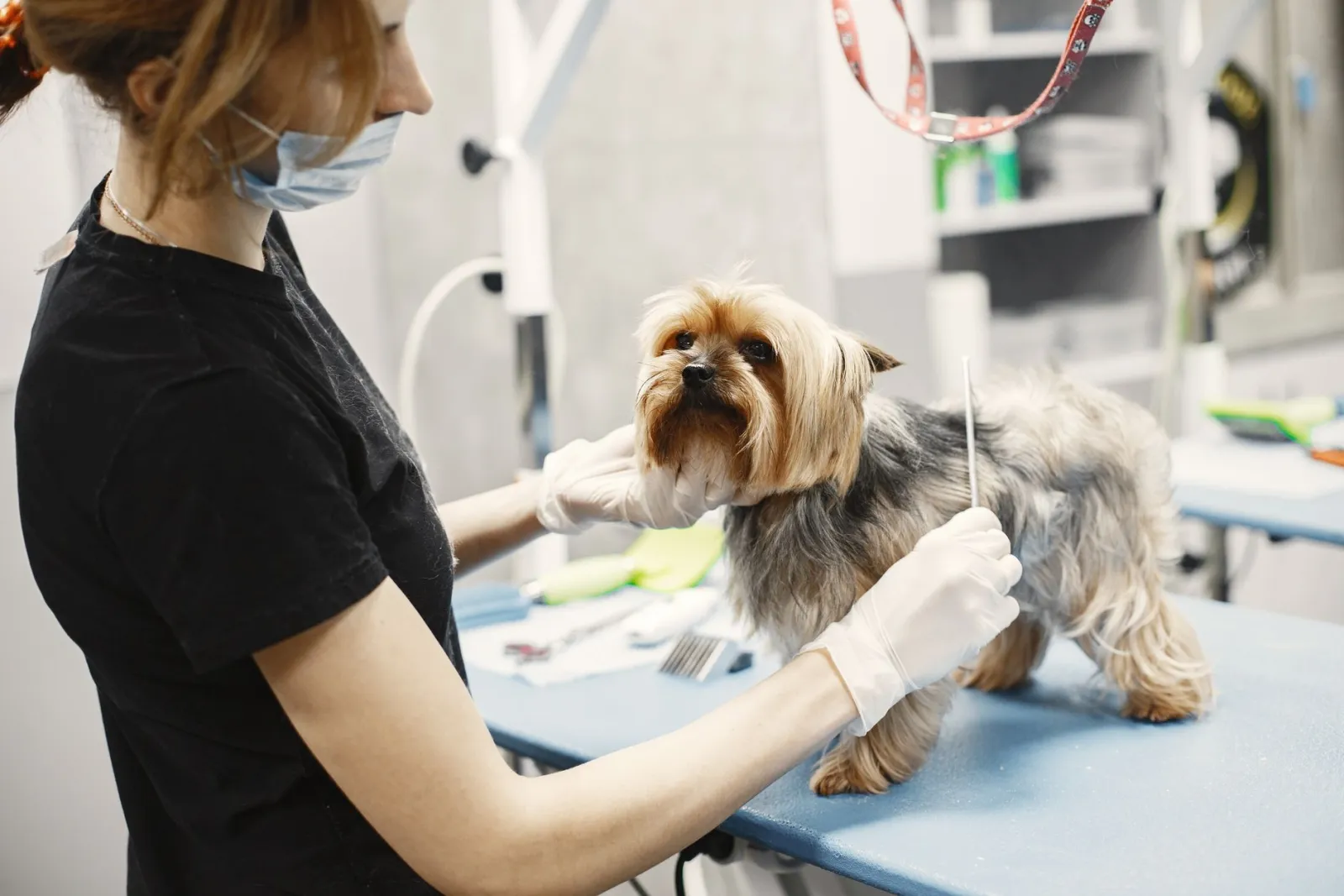
You can find dog groomers near you by running a map search for “dog groomer” plus your postcode or suburb, then cross-checking every result against your vet’s referral list, local breed-club recommendations and recent reviews. Shortlist three, phone each one, and ask to see the workspace before you book a first appointment.
Search results all look the same at first glance: a pin on a map, four or five stars, a photo of a freshly trimmed dog on a grooming table. What they don’t tell you is how the groomer handles a nervous animal, whether the dryers run unattended, or what happens when a coat is too matted to brush out. That is the information that decides whether your dog comes home relaxed or rattled — and it’s information you have to go and collect yourself.
What’s in this guide?
- How do you find dog groomers near you in the first place?
- What should you check before you book a groomer?
- Which setting suits your dog: salon, mobile unit, or home visit?
- How do you prepare your dog for the first appointment?
- What actually happens during a grooming appointment, and how long does it take?
- How do you read reviews and spot the red flags?
- How often does your dog need a professional groom?
- What else do owners ask about finding a local groomer?
How do you find dog groomers near you in the first place?
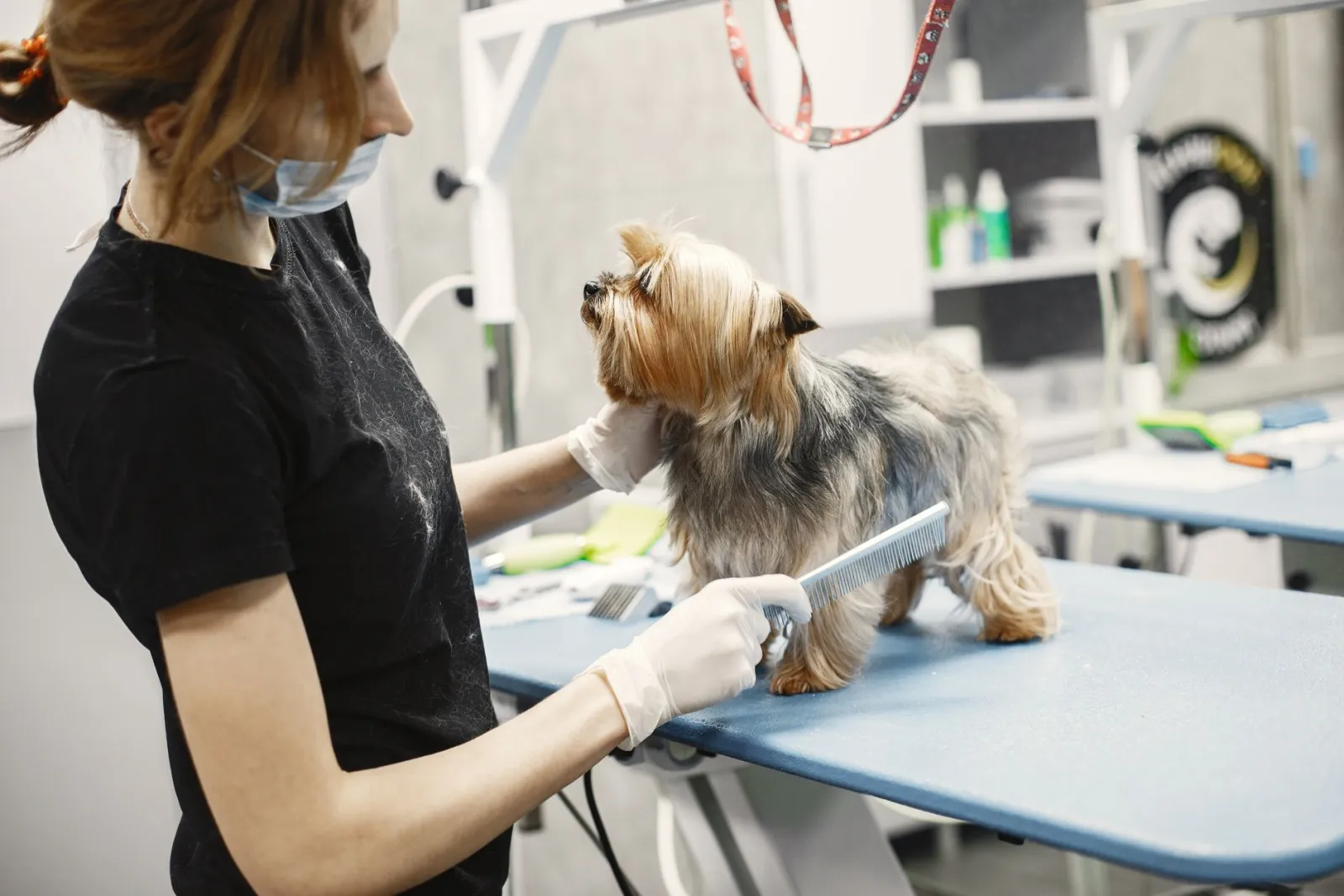
You find them by stacking three independent sources: a map search, a referral from your vet practice, and word-of-mouth from people who handle dogs professionally. Any one source on its own will either miss good groomers or quietly hide the bad ones.
The map search is where most people start, and it’s easy to do badly. Run “dog groomer”, “dog grooming” and “pet grooming salon” as three separate searches — the different phrases surface different businesses in the same town, because listings are categorised inconsistently. Then repeat the search using the names of neighbouring suburbs and the nearest larger town. Small salons often sit just outside the radius you’d naturally type, and if you live rurally, a twenty- or thirty-minute drive to someone who genuinely knows your breed’s coat is time well spent. Check whether a listing shows a street address and photos of the actual workspace; a map pin with neither deserves a second look before you go further.
Your vet practice is the second source, and the most underused. Ask directly who they’d send their own dog to. In ninety seconds you’ll usually get two or three trusted names and, if you’re lucky, a hint about who to avoid. That conversation is worth more than an hour of scrolling.
Then there’s word of mouth, which works best when you ask a narrow question. Dog walkers, trainers and puppy-class instructors see dozens of coats a week and hear the follow-up stories. “Who locally do you trust with a double coat?” gets a real answer; “Do you know a good groomer?” gets a shrug. Breed clubs are excellent for coated breeds, and grooming academies that train students sometimes run supervised appointments — longer sessions, more hands on the dog, and a useful option when you want to test the water.
A concrete case: a household adopts a rescue dog with a coat matted flat to the skin. Instead of booking the closest salon on the map, they call the vet first. The practice names two groomers who will shave a coat down humanely under sedation-free conditions rather than spend three hours tugging at it. No review site would ever have surfaced that detail.
What should you check before you book a groomer?
Check four things before you commit: the licence or registration your region requires, public liability insurance, how the salon dries dogs, and its policy on matted coats. Then ask to walk through the workspace — a groomer who won’t let you see where the dog will be handled is telling you something.
Most of this can be settled in one phone call. Ask:
- Are you licensed or registered, and are you insured?
- How do you dry dogs — hand-held forced air, stand dryer, or a drying kennel?
- Is a dog ever left in a drying cage without someone in the room?
- What’s your policy when a coat is matted beyond brushing?
- How many dogs are in the building at once, and how do you keep them apart?
- How do you restrain a dog that won’t stand still?
- Can I bring my dog in for a short bath-and-brush first?
Answers matter more than tone. On drying: forced-air drying with a person present is slower but far safer than a heated cage left to run. On matting: a groomer who says plainly “if it’s matted, I shave it — I won’t torture a dog to save the coat” is being honest, not lazy. On restraint: grooming loops and table straps are normal equipment; a groomer who describes hanging a dog in a sling to trim nails is describing something you should walk away from.
The tour tells you what the phone can’t. Does it smell of shampoo rather than urine? Are waiting dogs in clean kennels with water, or stacked in crates in a corridor? Is the table wiped between dogs? Watch how staff approach a nervous dog that’s already there — do they crouch and wait, or grab a collar and lift? You’re looking for calm competence, not a showroom.
An example worth copying: an owner books a full groom for a first visit, and the dog — a nervous two-year-old — ends up in the building for four hours. Book a bath and brush instead. Thirty to forty-five minutes, no clippers, and you learn exactly how your dog comes out before you commit to anything longer.
Which setting suits your dog: salon, mobile unit, or home visit?
A salon suits sociable dogs and heavy coats, a mobile unit suits dogs who travel badly, and a home visit suits older dogs or multi-dog households where an unfamiliar building is the main stressor. The right answer depends on your dog’s temperament first, its coat second.
| Setting | Works well for | What to check | Typical appointment |
|---|---|---|---|
| Salon | Sociable dogs, double coats, full scissor work, breeds needing specialist trimming | Drying method, number of dogs at once, whether you can tour the back room | 1.5 to 4 hours depending on coat |
| Mobile unit | Dogs who stress in the car, anxious rescues, one-to-one handling | Water and power supply, unit size against your dog’s size, parking access at your home | 1 to 3 hours, usually one dog per slot |
| Home visit | Senior dogs, multi-dog homes, dogs who shut down in strange places | Space to set up a table, access to water and electricity, equipment the groomer brings | 1 to 3 hours, longer for several dogs |
Mobile units are the middle ground, and their limits are practical rather than philosophical. A van carries a finite water tank and runs off a generator or hook-up, so a giant breed with a dense undercoat may genuinely not fit the workflow. Ask about the unit’s size against your dog’s size before booking, and check where it can park — a narrow lane with no driveway access rules out the whole option.
Home visits work beautifully for a dog that panics in the car. The trade-off is that your kitchen becomes the salon: you’ll need floor space for a table, a nearby socket, and somewhere to hose down afterwards. Ask what equipment arrives with the groomer, because a home setup without a proper high-velocity dryer means a longer, damper session.
Here’s the case that decides it for most families with an older dog. A twelve-year-old labrador with hip stiffness can still be lifted into a car, but the trip, the strange smells and the wait are what leave him flat for two days. A mobile unit in the driveway removes three of those four stressors at once. Same groomer skill, completely different experience for the dog.
How do you prepare your dog for the first appointment?
Prepare by gathering vaccination records, being honest about matting, walking the dog before drop-off, and keeping your own goodbye short. The first appointment is as much about building your dog’s confidence as about the haircut.
Bring the vaccination card if your region or the salon requires it, and confirm flea and tick treatment status beforehand — many groomers will turn away a dog with live fleas, and rightly so, because it shuts the salon down for a day. Write a short note on your phone or a scrap of paper covering the things a groomer can’t see: a lump on the ribs, a hot spot behind the ear, an old scar, sensitive ears, a fear of the nail clipper, allergies, a history of seizures, or a bad experience with a dryer.
Don’t bathe your dog the morning of the appointment. Wet matting tightens as it dries, and a coat that was brushable at 8am can be felted by 10. Brush out what you can reach, but never cut mats out with household scissors — the skin tents up inside a mat and it’s remarkably easy to slice. If the coat is beyond you, say so on the phone. Groomers deal with it every week; what they can’t deal with is discovering it after the dog is on the table.
On the day: a decent walk, a toilet break, and a calm handover. Arrive ten minutes early rather than twenty, because a nervous dog waiting in a reception area works itself up. Hand over the lead, give your phone number, ask what time to collect, and go. Hovering by the door makes some dogs worse, and most groomers will tell you the dog settles within minutes of the owner leaving.
A small example that saves trouble: a labrador arrives with a raw hot spot behind one ear. The owner mentions it at check-in and asks the groomer to work around it. The ear gets a wide berth, the spot isn’t shampooed, and the dog goes home without a scabbed, irritated patch that would have taken a fortnight to settle.
What actually happens during a grooming appointment, and how long does it take?
A standard appointment runs through check-in, coat assessment, bath, drying, clipping and finishing. Expect anywhere from 45 minutes for a small smooth-coated dog to three or four hours for a large double coat or a first visit.
The sequence is fairly consistent from salon to salon:
- Check-in. Health questions, vaccination check, notes on lumps, skin and behaviour.
- Coat assessment. The groomer runs hands and a comb through the coat to find mats and decide on clippers versus scissors.
- Pre-bath prep. Nails, ears and a rough clip of any heavy coat, done before water makes everything harder to handle.
- Bath. Two washes and a rinse, with a shampoo matched to skin condition rather than coat colour.
- Drying. The longest stage by far. High-velocity drying blows water out of the undercoat before any heat is used.
- Clipping and scissoring. Body work, then the fiddly parts — feet, face, sanitary areas, tail.
- Finishing. Nails checked again, ears cleaned, a final look-over.
- Handover. A good groomer tells you what they found and what to brush at home.
Timing is driven by coat and temperament, not by size alone. A small curly coat can take longer than a big smooth one because every inch needs scissor work. Rough guide: short smooth coats, 45 minutes to 1.5 hours; medium coats, 1.5 to 2.5 hours; heavy double coats and full hand-strip breeds, 2 to 4 hours. Add half an hour for a first visit, and add time again if the dog is anxious or elderly and needs breaks.
Drying is where the clock really goes. A labrador that has just swum will hold a startling amount of water in its undercoat, and blowing that out takes longer than the actual clipping. This is also why a groomer who rushes the dry stage is a problem: a coat that goes under the clippers damp will be uneven, and a dog left damp in a cool room stays cold for hours.
How do you read reviews and spot the red flags?
Read for patterns, not scores. Three or four detailed reviews describing the same problem tell you far more than fifty five-star ratings, and a listing with no address, no workspace photos, or a refusal to let you visit is a red flag on its own.
Useful reviews are specific. Someone writing “my cockapoo came home with an even trim and the groomer rang me halfway through to ask about a sore patch” is describing a process. So is “booked a 9am slot, collected at 11.30, dog was relaxed”. Generic five-star lines — “great service, lovely staff” — tell you almost nothing about handling, and are the easiest thing in the world to solicit.
Scroll to the middle of the ratings rather than the top. Three-star reviews tend to be written by people with a genuine mixed experience, and they often mention the details that matter: a wait that ran long, a coat that was cut shorter than asked, a dog that seemed unsettled afterwards. One bad review is noise. Four reviews over two years mentioning the same rushed dry or the same unfriendly handover is a pattern.
Then apply the red flags that reviews can’t cover:
- No physical address, or a mobile number and nothing else.
- A policy that owners wait outside and never see the grooming area.
- No questions at booking about health, vaccination, age or behaviour.
- Claims of turning around a large, coated dog in under an hour.
- Pressure to book a full groom before a trial visit.
- Photos on the page that don’t match the building you drive past.
A real-world example: a salon with hundreds of glowing reviews turns out, on a phone call, to have no street address on its listing and no interest in letting a new client look around. The reviews were probably genuine. They still don’t answer the only question that matters — what happens in the room when the door closes.
How often does your dog need a professional groom?
Most short-coated dogs need a professional bath, deshed and nail trim every eight to twelve weeks. Curly and continuously growing coats need a full groom every four to six weeks, and double coats need help at both seasonal blow-outs.
Between those visits, home maintenance does most of the heavy lifting. A five-minute brush three times a week prevents most of the matting that turns into a shaved dog, and it gives you a running check on lumps, ticks and skin irritation. Curly coats need combing right down to the skin, not just over the surface — a slicker brush that never reaches the undercoat is how a coat felts into a solid shell while still looking fluffy on top.
Nails are their own schedule: roughly every three to four weeks for most dogs, whether that’s at the groomer, at the vet, or at home if you’re confident with the clippers. Ears on floppy-eared breeds need checking weekly and cleaning when waxy. Double-coated dogs shouldn’t be shaved for summer — the coat insulates against heat as well as cold, and shaving it can leave the regrowth patchy and the skin exposed.
The spring case every labrador owner recognises: the undercoat starts coming out in handfuls on the sofa, in the car, in the food bowl. Book a deshedding appointment early in the blow-out rather than late, and brush daily for a fortnight around it. The professional bath and high-velocity dry pulls far more loose coat than home brushing alone, and doing it at the right moment cuts the shedding window noticeably.
Once you’ve found a groomer you trust, book the next two appointments before you leave. Good groomers fill their diaries weeks ahead, and a recurring slot means your dog arrives on a settled routine instead of being squeezed in whenever there’s a gap.
What else do owners ask about finding a local groomer?
Do groomers need my dog’s vaccination records?
Many do, and some require proof of the core vaccines before a first appointment — a salon is a shared space, and an unvaccinated dog is a risk to every other dog in the building. Bring the record to the first visit, and confirm the policy when you book so you’re not turned away at the door.
Can I stay and watch while my dog is groomed?
Some salons allow it, many don’t, and the reason is usually practical: dogs behave differently when an owner is visible, and a dog that keeps checking over its shoulder is harder to handle safely with clippers. A reasonable middle ground is a short tour before booking and a groomer who is happy to send a message partway through. A flat refusal to let you see the workspace at all is a different matter.
What happens if my dog’s coat is badly matted?
Expect the groomer to shave it rather than attempt a dematt. Brushing out a tight mat is painful, takes hours, and can leave bruising or clipper burn underneath. A short coat that grows back healthy beats a damaged one, and most groomers will talk you through a brushing routine to stop it recurring.
How far ahead should I book?
Two to four weeks is typical for a first appointment with a groomer people recommend, and longer in the run-up to holidays and the spring shed. If your dog is elderly, anxious, or needs a specialist coat trim, ask about lead time when you call — those slots are scarcer than a standard bath and tidy.
Is a mobile groomer better for an anxious dog?
Often, yes — no car journey, no waiting room, no other dogs in earshot, and the whole appointment happens in your driveway. It isn’t automatic, though. Some dogs find a van’s unfamiliar interior and generator noise more unsettling than a busy salon, and a mobile unit can’t always handle a giant breed or a heavy, matted coat. Try a short bath-and-brush first and judge by how your dog walks back through the front door.
What’s the simplest way to get this right?
Find three names from three different sources — a map search, your vet, and someone who handles dogs for a living. Phone each one with the same short list of questions about drying, matting and restraint, and visit at least one workspace in person. Then book a short bath-and-brush before you commit to a full groom, and stay for the handover so you hear what the groomer found.
That process takes about a week and saves months of guesswork. The dog that comes home relaxed, with even feet and clean ears, and a groomer who rings you about a sore patch before cutting into it — that’s the outcome you’re shopping for, and it has almost nothing to do with how close the salon is.
For the between-visit work, the companion guides on at-home brushing routines, safe nail trimming, and choosing a boarding kennel for the holidays cover the next layer down. Get the local groomer right first; everything else is easier once you have someone who knows your dog’s coat by name.
Put it into practice : How do I groom my dog at home?
Work out your own case in 30 seconds:
Methodology
This calculator produces an indicative estimate based on the parameters you enter. The ranges used reflect typical market tiers in the pets space and are neither a commercial offer nor a guarantee. Prices and availability may vary.
Full guide :Pets
More from this guide :
Was this guide helpful?
Share your experience with the WiseHomeGuides community.