In short :
- Powder-coated aluminium, dense hardwoods like teak and acacia, and solution-dyed HDPE or quality coated mesh are the ones that truly hold up in strong sun.
- Skip standard resin, untreated softwoods, natural rattan, and surface-dyed fabrics if your furniture sits in full sun all day.
- Remember that “UV-resistant” doesn’t mean forever — pigments fade first, then the material itself goes brittle.
- A few simple habits, like covering or storing your set, will stretch its life by years instead of seasons.
- Faded wood can be sanded and re-oiled, but chalky plastic is gone for good.
You know the scene. You step onto the terrace in July, and your once-dark grey chairs have turned a chalky, faded white. The cushions look like they’ve been through a washing machine on the wrong cycle. A plastic table feels brittle, almost sandy to the touch. This isn’t neglect — it’s sunlight doing what sunlight does. Ultraviolet radiation breaks down the chemical bonds in many materials, and garden furniture sits directly in the firing line for months on end.
The good news: some materials handle this far better than others. The less good news: “UV-resistant” on a label doesn’t mean “UV-proof forever.” Understanding which materials genuinely hold up, and why, will save you from replacing a whole set every two or three summers. Below, I’ll walk through the materials that resist UV best, the ones that quietly fail, and the practical habits that stretch any furniture’s life in strong sun.
Why sunlight destroys furniture in the first place
UV radiation is invisible, but its effects are not. It attacks two things in particular: pigments and polymer chains. Pigments fade first, which is why a red cushion turns pink before it turns grey. Then the structural molecules themselves start to break, which is when plastic goes brittle and fabric tears at the seams.
Heat accelerates all of this. A surface in direct summer sun can run 20 to 30 degrees hotter than the air around it, and that thermal stress works alongside the UV damage. Add rain, chlorine from a nearby pool, or salt air, and the breakdown speeds up further.
Here’s a concrete example you’ve probably seen. A cheap resin chair left on a south-facing balcony for two summers often develops a fine white powder on its surface. That powder is the material itself degrading. Once it starts, no cleaner will bring the colour back — the pigment is gone, not dirty.
The practical takeaway: you’re not looking for furniture that never ages. You’re looking for furniture whose ageing is slow, predictable, and mostly cosmetic rather than structural.
The materials that genuinely hold up
Not all materials are equal, and the differences are large enough to matter over a five-year horizon.
Powder-coated aluminium
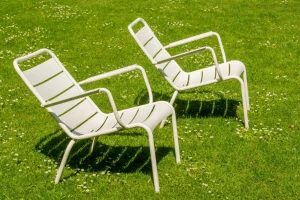
Aluminium doesn’t rust and doesn’t care much about UV. The weak point is the finish. A powder-coated frame — where dry paint particles are baked onto the metal — resists chipping and fading far better than a wet-painted one. If you tap a frame and it sounds hollow and light, that’s usually a good sign for sun exposure. Look at the joints: welded or reinforced corners survive heat expansion better than glued or clipped ones.
Teak, acacia, and other dense hardwoods
Untreated teak is one of the most sun-tolerant natural options. It greys over time, which many people actually like, but it doesn’t crack or splinter the way softer woods do. Acacia behaves similarly at a lower cost. The catch: oils and pigments in the wood protect it, so a yearly application of a UV-filtering oil keeps the colour and slows surface checking. Skip it for three years and you’ll see fine cracks along the grain.
High-density polyethylene (HDPE) and solution-dyed synthetics
This is the material family behind most modern woven furniture and outdoor rugs. The key phrase is solution-dyed. Colour is added to the plastic before it’s formed, not painted on afterwards, so it can’t flake off. HDPE is also naturally UV-stabilised. A woven HDPE chair left out year-round typically shows minimal change after five years, while a painted or surface-dyed imitation can look tired after one.
Textilene and coated mesh
These are the taut, breathable fabrics used on many sling chairs. Quality versions are PVC-coated polyester with UV inhibitors built into the coating. They stay cool to sit on and drain instantly. Lower-grade versions stiffen and crack at the fold lines within two seasons.
Materials that fade, crack, or crumble
Knowing what to avoid is just as useful as knowing what to buy.
- Untreated softwoods — pine and similar woods dry out, crack, and grey quickly without protection.
- Standard polypropylene or cheap resin — fine for a season or two, then chalky and brittle.
- Surface-dyed fabrics — the colour sits on top and disappears fast.
- Natural rattan and wicker — beautiful, but sun and rain destroy it; it belongs under cover.
- Uncoated steel — rust is the bigger enemy here, but heat and UV speed up paint failure.
One real-world observation worth noting: two identical-looking dining sets can sit side by side on a terrace, and one will look new after three years while the other looks ten years old. The difference is almost always the material grade, not the price tag or the design.
Quick comparison at a glance
| Material | UV resistance | Maintenance | Best for |
|---|---|---|---|
| Powder-coated aluminium | Excellent | Low — wipe down | Frames, exposed terraces |
| Teak / acacia | Very good | Yearly oiling | Classic look, heavy use |
| Solution-dyed HDPE | Excellent | Very low | Woven chairs, rugs |
| Textilene mesh | Very good | Low | Sling seating |
| Standard resin | Poor | None possible | Short-term, shaded spots |
| Natural rattan | Poor | High | Covered areas only |
Practical habits that extend any furniture’s life
Even the best material benefits from a few simple routines.
- Shift what you can. Moving chairs into shade during peak midday hours — roughly 11am to 4pm — cuts UV exposure dramatically.
- Use covers, but let things breathe. A breathable cover beats a plastic tarp, which traps condensation and can cause mould.
- Store cushions indoors. Cushion foam and stitching are usually the first to fail, even when the outer fabric is UV-rated.
- Clean before storing. Dirt and pollen hold moisture against surfaces and speed up degradation.
- Re-oil wood annually. A thin coat in spring, before the strongest sun arrives, makes a visible difference.
Consider a simple example. A woven chair stored under a breathable cover through the hottest weeks, and wiped down monthly, will often outlast an identical uncovered chair by several seasons. The material is the same; the exposure isn’t.
Frequently asked questions
Does UV-resistant mean the colour will never fade?
No. It means fading is slowed considerably, not stopped. Solution-dyed plastics and powder-coated metals fade very slowly, often imperceptibly over several years. Surface-dyed or painted finishes can lose noticeable colour within one or two summers. Think of UV resistance as a rate, not a guarantee.
Is metal or wood better in strong sun?
Both work well if treated properly. Powder-coated aluminium stays cooler to the touch and needs almost no upkeep. Dense hardwoods like teak handle sun beautifully but need annual oiling to keep their colour and prevent surface cracks. The choice usually comes down to the look you want and how much maintenance you’ll realistically do.
Can faded furniture be restored?
Sometimes, but only to a point. Faded wood can be sanded and re-oiled. Chalky plastic cannot be brought back — the pigment is gone. Powder-coated metal that’s merely dull can often be cleaned and waxed. If the surface feels powdery or cracks when pressed, restoration isn’t realistic.
The bottom line
So, which garden furniture resists UV in hot sun? Powder-coated aluminium frames, dense hardwoods like teak and acacia, and solution-dyed HDPE or high-quality coated mesh are the standout performers. Standard resin, untreated softwoods, natural rattan, and surface-dyed fabrics are the ones to avoid in full sun. Match the material to your exposure, add a few simple habits, and your furniture will look good for years rather than seasons.
If you want to go further — covering frame construction, cushion fabrics, storage, and how to plan a whole outdoor setup for a sunny climate — a more complete guide on choosing garden furniture is available on the site.