This article contains Amazon affiliate links. As an Amazon Associate we earn from qualifying purchases.
Short answer :The best dog toys match a dog’s size, chewing style, and energy level rather than following a single universal pick. Durable rubber chew toys suit strong chewers, while plush toys and rope toys work well for gentle play and interactive games like fetch or tug. Rotating a small selection of toys by type—chew, fetch, puzzle, and comfort—keeps play interesting and helps direct chewing toward appropriate objects instead of household items. Supervise play and remove toys that become torn or worn, since damaged toys can pose a swallowing risk.
In short
- Match toy size to your dog’s breed and jaw strength to prevent choking or rapid destruction.
- Keep separate toy types for chewing, fetching, tugging, and comfort so each purpose stays clear.
- Rotate toys weekly to maintain novelty and reduce boredom-driven chewing on furniture.
- Choose washable, non-toxic materials and inspect seams and squeakers regularly for damage.
- Use puzzle and treat-dispensing toys to add mental stimulation during quiet indoor time.
Why the Right Dog Toy Matters for Your Home and Your Dog
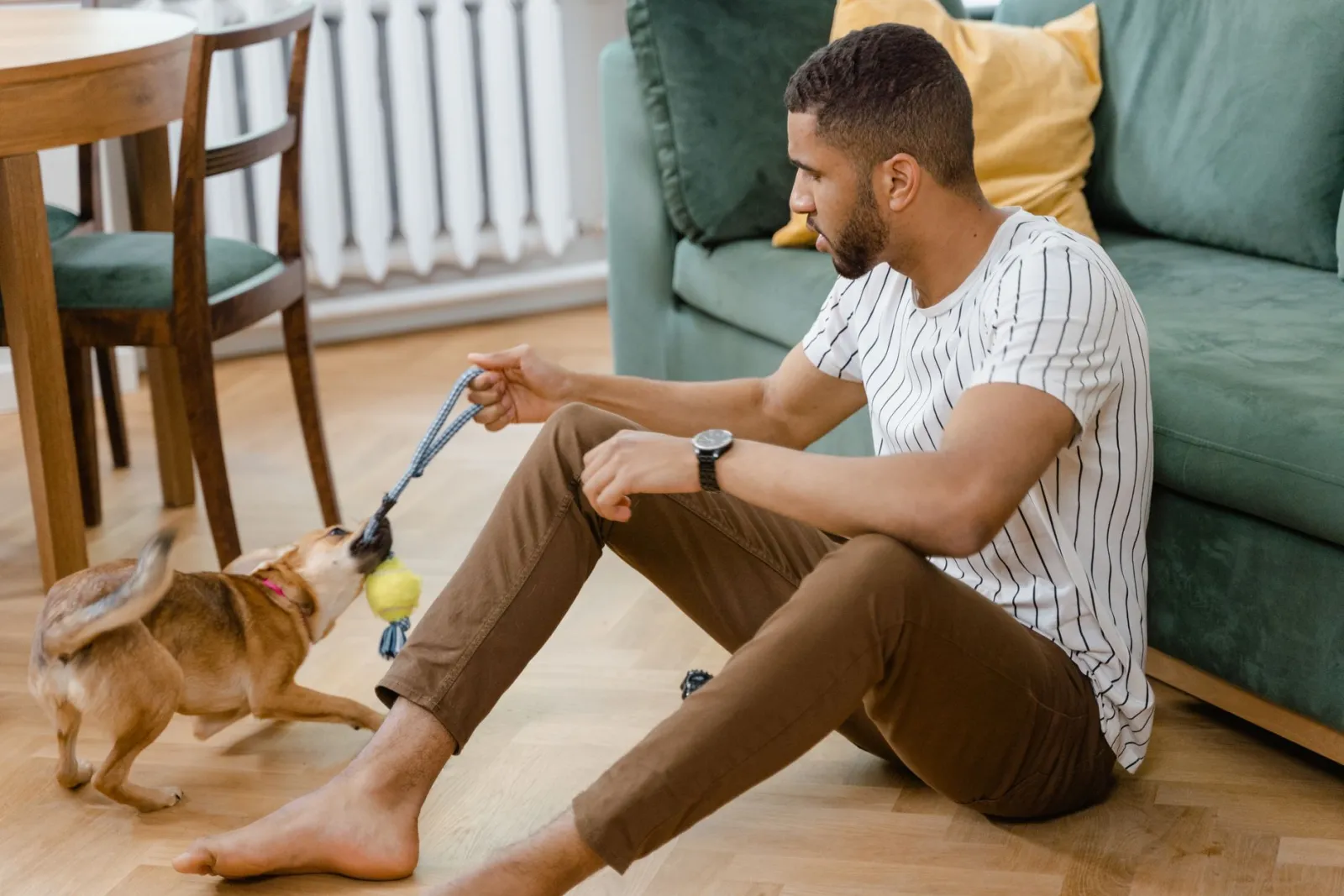
A dog toy is never just a toy. It is the object that absorbs a burst of energy before it lands on your sofa cushions, the distraction that keeps a young dog from redecorating your baseboards, and the shared focus that turns a restless evening into a calm one. Choosing well matters because the wrong toy fails quietly: it gets ignored, it gets shredded in minutes, or it encourages exactly the behavior you were trying to discourage. The right toy, by contrast, earns its place in the daily rhythm of your home.
Think about how your dog actually plays, because play styles vary enormously. Some dogs are chasers and tuggers who want a partner and a moving target; others are problem-solvers who stay engaged with a puzzle long after the humans have lost interest; still others are chewers who simply need a safe outlet for their jaws. A toy that suits a tugger will often bore a chewer, and a puzzle that delights one dog can frustrate another into giving up. Matching the toy to the play style is the single most reliable way to get value from it, and it explains why a toy loved by one dog in a household can sit untouched by another.
Durability is the practical filter. A toy that comes apart easily creates two problems at once: it stops being entertaining, and its pieces become something to swallow. Look at construction honestly — stitching, seams, how firmly appendages are attached, whether the material gives under pressure or tears — and match the toughness of the toy to the intensity of the dog. A gentle lap dog and a determined power-chewer should not be handed the same object. Toys that survive regular use also save money over time, since replacing a cheap toy every week costs more than buying one that lasts.
Toys also do quiet behavioral work in the home. A dog with nothing to occupy it will often find its own entertainment, and that entertainment is rarely convenient. A toy that can be stuffed, frozen, or otherwise made to release a reward slowly turns a stretch of alone time or a rainy afternoon into a project. This is where toys earn their keep in households with young dogs, dogs left alone during the workday, or dogs recovering from an exciting walk and needing to settle. The toy becomes a routine cue: this object means calm, focused activity.
Finally, consider the fit for your space and your household. Toys that are easy to clean suit muddy gardens and slobbery indoors; toys that roll or bounce suit hallways and yards but not rooms full of fragile objects; toys small enough to be carried are also small enough to be a hazard around very small dogs, while oversized toys can be awkward for a petite breed to grip. A practical toy box holds a small rotation — something to chase, something to chew, something to solve — rather than a pile of near-identical objects. Rotating a few good toys keeps them novel and keeps your floors clearer.
How to Match Toys to Your Dog’s Size and Chewing Style
Matching a toy to your dog starts with two simple observations: how big the dog is, and how it uses its mouth. Size is the easier of the two to judge, but it is also where most toy mistakes happen. A toy that is too small for a large dog becomes a swallowing risk, while a toy that is too large for a small dog is awkward to carry and often gets ignored. As a rough guide, a toy should be big enough that the dog cannot close its mouth around the whole object and swallow it, yet small enough to grip comfortably. For a small breed, that usually means toys in the palm-sized range; for a large breed, look for toys that need two hands to hold. A useful test is to compare the toy to the dog’s muzzle: if the toy disappears entirely inside the mouth, it is too small.
Chewing style is the second half of the equation, and it matters just as much. Some dogs are gentle mouth-ers who nibble and carry a toy around for comfort; others are determined chewers who work a single spot until something gives. A soft plush toy suits the first dog and is destroyed within minutes by the second. For gentle chewers, fabric, rope, and softer rubber are fine and give the dog something satisfying to mouth. For determined chewers, look for dense, solid materials with some give, thick walls, and no small protruding parts that can be torn off. The difference between “chew” and “destroy” is often just the firmness of the material relative to the dog’s jaw strength.
Consider the dog’s age and mouth condition as part of chewing style. Puppies explore with their mouths and have softer, less powerful jaws, so they do better with flexible toys that give under pressure. Adult dogs in their prime tend to chew hardest, and this is the group that needs the most durable options. Older dogs may have less interest in hard chewing and often prefer softer textures they can mouth without effort. None of this requires special equipment to judge; watch how the dog treats a new toy in the first few minutes and adjust from there.
The way a dog plays also points to the right toy shape. A dog that likes to shake and “kill” toys does well with something it can grab and whip around, while a dog that likes to carry and settle prefers a toy it can hold comfortably in its mouth. Dogs that like to chase and retrieve need toys that are easy to spot and pick up, and dogs that like to dissect need toys without loose stuffing or small parts. Matching shape to play style keeps the toy interesting and reduces the chance it gets abandoned.
Finally, match the toy to the setting. Indoor toys should be softer and quieter, while outdoor toys can be tougher and more visible in grass. Rotating a few toys that fit the dog’s size and chewing style, rather than leaving one out all the time, keeps interest high and spreads wear across the collection. The goal is not the toughest toy on the shelf but the one that fits this particular dog’s mouth and habits.
Durable Chew Toys for Heavy Chewers
Heavy chewers treat toys as a problem to be solved, and the wrong pick fails in minutes. The first thing to understand is that “durable” is not a single property. A toy can resist puncturing but tear at a seam, or survive tugging but crumble under sustained gnawing. Match the material to the chewing style you actually observe: some dogs work a toy with their back molars in long, grinding sessions, while others bite down hard and shake. A toy that suits one pattern can be destroyed by the other.
Material hardness is the most useful filter. Very hard, dense rubber and nylon resist penetration and last a long time, but they offer little give, so they suit dogs that gnaw steadily rather than chomp. Softer, more flexible rubber absorbs impact and is gentler on the mouth, but a determined chewer can eventually work through it. A practical middle ground is a firm rubber with some flex: enough resistance to slow a strong jaw, enough bounce to keep the toy interesting. Avoid anything that feels brittle or that you can flex easily with light hand pressure if your dog is a serious chewer.
Construction matters as much as material. Look for toys molded as a single piece with no glued seams, no small caps, and no squeaker accessible through a thin wall. Seams are where most failures begin, because a chewer concentrates force at the joint. Hollow toys with thin walls collapse quickly; solid or thick-walled designs hold up far longer. Size should be generous relative to your dog’s mouth, so the toy cannot be swallowed or wedged behind the teeth, and shaped so the dog can grip it from several angles rather than only one.
Think about how the toy will be used. A chew toy left in the crate for quiet time should be heavy and slow to consume, giving hours of grinding without breaking apart. A toy for fetch or tug needs to survive impact and pulling, which is a different stress than gnawing. For dogs that shred, choose designs with no fabric, rope, or protruding parts they can pick at. Rotating among a few durable toys also helps: novelty keeps a chewer engaged, and spreading wear across several toys extends the life of each.
Finally, inspect chew toys regularly and retire any that show deep gouges, cracks, exposed cores, or pieces beginning to detach. Even tough toys wear down, and a chewer’s progress can be gradual until a chunk comes loose. Supervision during chewing, and removing a toy once it shows real damage, is the simplest way to keep heavy chewers both occupied and safe.
Interactive Puzzle Toys That Keep Dogs Mentally Sharp
Interactive puzzle toys turn mealtime or treat time into a problem-solving session, and that mental effort is what makes them valuable. A dog that has to nose, paw, or lift a piece to reach a reward is working through a small challenge rather than simply eating from a bowl. The appeal is not just entertainment: sustained focus on a task gives a dog a legitimate outlet for energy that would otherwise go into pacing, chewing, or barking. The best puzzle toys are the ones a dog can actually solve with effort, then solve again with slightly more confidence the next time.
The first thing to judge is the difficulty curve. A good puzzle has a clear starting point that most dogs can crack within a few attempts, then layers of complexity that reward persistence. Toys that are too easy get abandoned once the treat is gone; toys that are too hard produce frustration and a dog that walks away. Look for adjustable designs where you can make the challenge harder or easier by how you load the treats, since a single fixed difficulty rarely suits a dog for long. A puzzle your dog masters in seconds is a sign to increase the difficulty or rotate in something new.
Match the puzzle to how your dog naturally works. Some dogs are nose-driven and excel at toys that hide kibble under sliding panels or inside compartments they must nudge open. Others are paw-oriented and do better with designs that require lifting flaps, spinning discs, or pulling drawers. A dog that gives up quickly often does better with a puzzle that offers partial success early, such as one where a few treats are easy to reach and the rest are hidden. Watching how your dog approaches a new toy tells you more about the right difficulty than any label on the packaging.
Durability and safety matter as much as the puzzle logic. Check that moving parts are securely attached, that there are no small pieces a determined chewer could pry loose, and that the materials hold up to repeated nosing and pawing. Puzzle toys are not chew toys, so they work best when used with supervision and put away afterward. Size the toy to your dog so pieces are not a choking risk, and inspect it periodically for cracks or loose components. A puzzle that comes apart under pressure is a hazard, not a challenge.
Use puzzle toys as part of a routine rather than a constant fixture. Rotating two or three puzzles and bringing them out at set times keeps them novel and prevents a dog from getting bored with the same solution. They are especially useful during quiet periods, when a dog needs something to do while the household settles, or as a calmer alternative to vigorous play. A short, focused puzzle session can tire a dog mentally in a way that complements physical exercise, and the satisfaction of solving a problem is its own reward.
Fetch and Tug Toys for Active Play Indoors and Out
Fetch and tug toys earn their place in a toy rotation because they let you direct your dog’s energy rather than simply absorb it. A game of fetch gives a dog a sprint-and-return cycle with a built-in pause, while tug offers a close-range, cooperative contest that many dogs find deeply satisfying. The practical distinction matters when you are choosing toys: fetch toys need to fly straight and survive repeated retrieval, whereas tug toys need to withstand sustained pulling force and stay comfortable in both your hand and your dog’s mouth. Choosing for the wrong job is the most common reason these toys fail early.
For fetch, the governing criteria are aerodynamics, grip, and visibility. A toy that tumbles unpredictably is frustrating to chase and easy to lose under furniture, so a shape that tracks a relatively straight line pays off indoors. Texture matters on hardwood and tile: a firm rubber ball can skid and bounce off walls, while a softer, slightly tacky surface grips the floor and keeps the game contained. Size should match your dog’s mouth so the toy is carried comfortably rather than clamped awkwardly at the back of the jaw. For indoor play, favor a softer, lighter toy that will not rattle furniture or ricochet; for outdoor play, a slightly denser toy carries farther and holds up better on abrasive ground.
Tug toys are judged differently. Look for a continuous, reinforced construction along the length of the toy, since the seams and ends take the most strain, and for a handle or loop section wide enough that your hand does not bunch up under load. A toy with a little give absorbs shock better than a rigid one and is gentler on the dog’s grip during a sustained pull. Length is a practical lever: a longer tug keeps your hand farther from the dog’s teeth and gives you room to yield and release rather than yank. Rope-style and flat-strap designs suit different dogs, and some dogs strongly prefer one over the other, so it is worth offering both before committing.
Use cases shape the choice more than any single feature. A narrow hallway or a small living room rewards a low-bounce fetch toy and a short, controlled tug session. A backyard or park rewards a toy with enough mass to travel and enough durability to handle dirt and repeated landings. For a dog that needs to burn energy without a long walk, short fetch repetitions combined with brief tug exchanges create a compact, high-engagement session. For a dog still learning to release, a tug toy with a clear, easy-to-grip end makes the exchange simpler to teach than a small ball that disappears into the mouth.
Durability and safety deserve a final look. Check stitching, knots, and attachment points regularly, and retire any toy showing fraying, exposed core material, or a loosened join before it becomes a choking risk. Match toy toughness to your dog’s chewing style rather than to the label, and supervise tug play so the game stays a shared activity rather than a solo chew. Stored together and rotated, a small set of fetch and tug toys covers most active-play needs indoors and out without cluttering the house.
Plush and Comfort Toys for Anxious or Senior Dogs
For anxious or senior dogs, a plush or comfort toy often serves a different purpose than a fetch ball or a chew. These dogs tend to use toys for reassurance and settling rather than for high-energy play, so the right choice is less about durability under hard chewing and more about softness, familiarity, and predictability. A toy that stays in the dog’s bed and always feels the same can become a reliable anchor in an otherwise busy household.
Texture and construction matter more than size alone. Look for short, dense pile or a tightly woven outer fabric rather than long, loose fibers that invite plucking and swallowing. Seams should be double-stitched and turned inward, since anxious dogs frequently mouth and knead the edges rather than the body of the toy. For seniors, a lighter fill helps: an overstuffed toy is awkward for a dog with reduced mobility to carry or reposition, while an understuffed one collapses and offers little to press against. A small internal squeaker can be comforting for some dogs, but for noise-sensitive animals a silent plush is usually the safer default.
Match the toy to the dog’s habits. A dog that likes to carry something from room to room does well with a flatter, floppy shape that is easy to grip in the mouth. A dog that likes to rest its chin or paw on something benefits from a slightly firmer cushion-style toy. Dogs that lick or nuzzle repeatedly tend to favor toys with a distinct head or snout they can target. For senior dogs with reduced hearing or eyesight, a toy with a consistent shape and a familiar smell is easier to locate than a new one with an unfamiliar texture.
Practical care keeps a comfort toy useful for longer. Wash plush toys on a gentle cycle and dry them fully, since damp filling holds odor and can encourage chewing. Inspect seams and squeakers regularly, and rotate between two or three identical or near-identical toys so one is always clean and available. If a dog is destructive with plush, keep the comfort toy for supervised rest time rather than free access, and offer sturdier options during active play.
The goal is a toy the dog chooses to settle with on its own. A comfort toy that is soft, quiet, and consistently present in the dog’s resting spot does more for an anxious or older dog than a more elaborate one that changes shape, sound, or texture.
Treat-Dispensing Toys for Slower, Healthier Feeding
Treat-dispensing toys turn a meal or a handful of kibble into a task the dog has to work through, and that shift in effort is the whole point. Instead of swallowing food in a few uninterrupted gulps, the dog noses, paws, and nudges the toy to release small amounts at a time. For dogs that eat too fast, gulp air, or seem bored between walks, this changes feeding from a race into an activity. The section below covers what to look for, how different designs suit different eaters, and where treat toys fit alongside the rest of your dog’s enrichment.
The first criterion is how the food comes out. Some toys rely on gravity and a rolling motion, dropping kibble through openings as the dog pushes them around; others use a fixed maze, a sliding panel, or a series of ridges that the dog must work with its tongue or paws. Gravity toys tend to be easier and better for beginners or older dogs, while puzzle-style dispensers demand more problem-solving and suit dogs that get bored quickly. Look at the size of the openings relative to your dog’s kibble: too wide and the food pours out in seconds, too narrow and the dog gives up. A toy that releases a few pieces at a time, rather than a steady stream, is doing its job.
Match the difficulty to the dog, not to your ambitions. A confident, food-motivated dog can start on a moderately challenging dispenser and will often figure it out within a session or two. A cautious dog, a puppy, or a senior may need a simpler design where a single roll produces a reward, then graduate to something harder once the idea clicks. The common mistake is starting too hard: a dog that fails repeatedly loses interest and the toy ends up ignored in a corner. It is far better to begin easy and increase difficulty than to begin difficult and have to back off.
Consider how the toy behaves when it is empty and when it is full. A weighted base keeps a toy upright so the dog can bat at it rather than chase it under the sofa, while a rounded, rolling shape encourages movement and suits dogs that like to push things around. Washability matters too, since treat residue builds up in crevices; designs that come apart or have wide, accessible interiors are easier to keep clean. Durability should match your dog’s style: a gentle chewer can use a lighter toy, but a dog that bites down hard needs a sturdier build that will not crack under pressure.
Treat-dispensing toys work best as part of a routine rather than as a replacement for every meal. Many owners use them for part of the daily ration, for a mid-day snack, or to occupy the dog during a period when it would otherwise be restless, such as before a walk or while the household is busy. They are also useful for slowing a dog that finishes a bowl in seconds, since the same amount of food stretched over a longer period gives the digestive system a gentler pace and gives the dog something to do. Rotate a couple of different designs so the challenge stays fresh, and always supervise the first few sessions to see how your dog handles the toy.
Safety Checklist: Materials, Sizing, and Wear Signs
Before a new toy ever reaches your dog, give it a quick once-over with your hands and eyes. Materials matter most: look for sturdy, non-toxic construction with no loose pieces, exposed squeakers, or small parts that could be chewed free. Rubber and dense nylon tend to hold up well for heavy chewers, while plush and fabric toys suit gentler play but need more frequent inspection. Avoid toys with sharp edges, staples, or paint that flakes, and skip anything that smells strongly of chemicals, since a dog’s mouth will be on it constantly. If a toy has a rope or string component, check that the fibers are tightly braided and won’t unravel into long strands.
Sizing is where many well-meaning purchases go wrong. A toy should be large enough that your dog cannot swallow it whole but small enough to carry and mouth comfortably. As a rough guide, choose toys clearly bigger than your dog’s muzzle so there’s no chance of it slipping past the back of the tongue, and avoid anything that could lodge in the throat. For powerful chewers, a toy that feels solid and has some give without being rock-hard is a safer bet than something brittle that cracks into shards. Small dogs do fine with smaller toys, but never so small that they disappear in one gulp.
Wear signs are your early-warning system. Inspect toys regularly, especially after intense chew sessions, and retire anything showing cracks, deep gouges, fraying, or pieces breaking off. A squeaker that has come loose, stuffing pulled out through a seam, or a rope beginning to fray are all signals to remove the toy immediately. Rotate toys rather than leaving every one out at once; this limits constant chewing on a single item and makes wear easier to spot. Keep a simple habit of a quick check each time you hand a toy over and a fuller inspection every week or so.
Match the toy to how your dog actually plays. A dog that gnaws relentlessly needs durable, appropriately sized chew toys, while a dog that mostly chases and carries can use lighter toys with closer supervision. Supervise play with any toy that has fabric, rope, or attached parts, and put those away when play ends. Store toys where they stay clean and dry, and wash fabric ones as needed to keep them hygienic. When in doubt about a toy’s condition, err on the side of replacing it; a worn toy is not worth the risk.
Rotating Toys to Prevent Boredom and Destructive Behavior
Boredom is one of the most common reasons dogs get into trouble at home. A dog that has nothing to do will often invent a job, and that job frequently involves chewing furniture, digging at cushions, or barking at the window. Rotating toys is a simple management strategy that addresses this directly: instead of leaving every toy available all the time, you keep a portion of the collection stored away and swap the selection every few days. The novelty of a toy that has been out of sight for a while restores much of the interest that a dog loses after a week of seeing the same object on the floor.
The practical mechanics matter. A workable rotation usually means keeping roughly half to two-thirds of the toy collection in a closed bin and rotating the rest into circulation every few days, or whenever you notice interest dropping. When a toy comes back out, it should feel new again, which is why storage in a place the dog cannot reach is important. Rotating toys also lets you match the selection to the day: a puzzle feeder or a chew toy for a day when the dog will be alone longer than usual, a fetch toy or a tug toy for an active evening, and a soft comfort toy for settling.
Variety across categories does more than variety within one category. A rotation that only swaps one chew for another chew does not solve boredom as effectively as one that alternates between food-dispensing toys, chew toys of different textures, and interactive toys that require the dog to move or problem-solve. Dogs that are highly food motivated often stay engaged longest with toys that release kibble or treats slowly, while dogs that prefer chasing and carrying tend to do better with balls and plush toys rotated alongside them. Matching the rotation to the dog’s play style keeps the toys meaningful rather than simply present.
Rotation also supports supervised versus unsupervised use. Toys that involve chewing, rope, or small parts should be offered when you can keep an eye on them, while a durable chew toy or a food-stuffed toy can be a reasonable choice for independent time. Inspecting each toy as it goes back into storage, and discarding anything cracked, torn, or losing pieces, keeps the rotation safe as well as interesting. A toy that is damaged is not a boredom solution; it is a hazard.
For destructive behavior specifically, rotation works best as part of a routine rather than a standalone fix. Pairing a freshly rotated toy with a predictable period of activity, such as a walk or a training session, gives the dog an outlet before the quiet hours begin. The goal is not to flood the dog with toys but to make the available ones count, so that the dog has a clear, acceptable thing to do when the house is calm and no one is playing.
Cleaning and Storing Dog Toys in a Family Home
Toys that stay clean and reachable get used; toys that end up in a soggy heap at the bottom of a basket get ignored. In a busy family home, the difference between the two is usually a simple routine rather than a deep cleaning schedule. The first practical step is sorting toys by material, because fabric, rubber, rope, and plush items each tolerate different treatment. A rubber fetch toy can be rinsed and left to air-dry without fuss, while a plush toy with a squeaker needs more care to avoid trapping moisture inside. Keeping these categories in separate containers from the start makes every later step faster.
Frequency matters less than consistency. A quick rinse of hard toys after outdoor play, and a wash of fabric toys once they start looking grubby or smelling stale, covers most households. The warning signs are straightforward: visible dirt, a lingering odour, or a slick feel on rubber surfaces. Rope toys deserve particular attention because fibres hold moisture and food residue; letting them dry thoroughly between uses, ideally in open air rather than crammed in a box, keeps them pleasant to handle. Soft or plush toys that have been chewed open should be repaired or retired rather than washed, since loose stuffing is a hazard.
Storage is where family homes usually go wrong. A single deep basket encourages toys to pile up, hide at the bottom, and stay damp. Shallow, open containers placed in two or three locations, such as a corner of the living room and a spot near the back door, keep toys visible and easy to grab. Rotating the contents every so often restores novelty without buying anything new. For households with young children, keeping dog toys in a container the children can reach but that closes securely helps separate the dog’s things from toys that belong to the kids.
Drying deserves its own habit. After washing, spread fabric and rope toys out rather than stacking them, and place rubber toys where air can circulate around them. A damp toy pressed against others in a closed bin is the most common cause of musty smells in a toy collection. In smaller homes, a dedicated drying spot near a radiator or in a well-ventilated utility area works well.
Finally, build storage into the layout of the home rather than treating it as an afterthought. A washable liner in each container, emptied and refreshed regularly, keeps the whole system manageable. When toys have a clear place to live and a simple path back to clean, the collection stays in rotation and the house stays calmer.
Frequently asked questions
How often should I replace my dog’s toys?
Replace toys based on condition, not a fixed schedule. Check them regularly for cracks, tears, loose pieces, exposed stuffing, or worn seams, and discard anything that is breaking apart. Hard chews that develop sharp edges or splinters should go immediately. Rotate toys so wear is spread out, and inspect favorites more often since they get the most use. A toy that still holds together and has no small detachable parts can stay in rotation. When in doubt, retire it.
Are rope toys safe for dogs that swallow strings?
Rope toys are risky for dogs that tend to swallow strands, because ingested fibers can bunch up in the digestive tract. For those dogs, choose solid rubber or durable chews instead of frayed rope. If you do use rope, supervise play, replace it once it starts unraveling, and never let your dog chew off and swallow pieces. Rope works best for tugging and fetch under watch, not as an unsupervised chew. Watch for loose threads and trim them before they become a hazard.
What toy materials are safest for aggressive chewers?
For strong chewers, look for dense, solid materials: firm natural rubber, tough nylon made for chewing, and thick, durable rubber balls. Avoid thin plastic, plush fabric, and soft vinyl, which tear into swallowable pieces. Choose toys rated for power chewers and sized large enough that they cannot be swallowed. Skip anything with small squeakers or glued-on parts that can be ripped out. Inspect frequently, since even tough toys wear down, and replace any toy showing deep gouges or cracks.
Can puzzle toys help with separation anxiety?
Puzzle toys can help by giving a dog something engaging to do, especially during the early part of alone time, which can ease boredom and mild distress. They are a management tool, not a cure, and won’t resolve serious anxiety on their own. Pair puzzles with gradual alone-time practice and a predictable routine. Choose puzzles matched to your dog’s skill level so they succeed rather than get frustrated. Freeze stuffed toys for longer-lasting engagement. If anxiety is severe, seek guidance from a qualified professional.
How do I choose the right toy size for my dog?
Match toy size to your dog’s mouth and body, not just breed. The toy should be large enough that your dog cannot swallow it whole and small enough to carry and chew comfortably. Avoid toys that fit entirely behind the teeth or down the throat. For fetch, pick a ball bigger than your dog’s open mouth. For chewers, choose thicker, larger shapes. Read the size guidance on the toy and watch your dog use it; if it looks like a choking risk, size up.
Are squeaky toys bad for dogs?
Squeaky toys are not inherently bad, but they carry risks. Many dogs love the sound, which rewards continued chewing, but some become fixated and tear the toy apart to reach the squeaker. The squeaker itself is a choking hazard if exposed or swallowed, so supervise play and remove the toy once it is punctured. Avoid squeakers for heavy destroyers. For dogs that fixate, use squeaky toys for interactive play only, then put them away, and offer non-squeaky alternatives for solo chewing.
What toys are best for teething puppies?
Teething puppies need soft, flexible toys they can gnaw without hurting tender gums. Rubber chew toys with textured surfaces, freezeable rubber toys, and soft plush toys for comfort all work well. Avoid hard nylon or antler-style chews that are too tough for puppy teeth. Offer a few options at different firmness so your puppy can choose. Supervise chewing, discard toys once punctured, and rotate them to keep interest high. Always match size to your puppy so nothing can be swallowed.
How do I clean and disinfect dog toys?
Cleaning depends on the material. Wash fabric and plush toys in a washing machine on a gentle cycle with pet-safe detergent, then air dry thoroughly. Wipe rubber, nylon, and plastic toys with warm soapy water, rinse well, and let them dry completely. For disinfection, use a pet-safe cleaner and rinse thoroughly so no residue remains. Clean toys more often if your dog is a heavy chewer or if toys are shared between dogs. Discard toys that cannot be cleaned properly or that stay damp and odorous.
Read next :Christmas Jumper for Dog: Buying Guide and Tips · Indoor Plant Varieties: A Complete Guide to Choosing · What are the home decor trends for 2026? · The Complete Guide to Dog Grooming · Coffee Machines for Home Use: How to Choose the Best
Work out your own case in 30 seconds:
Methodology
This calculator produces an indicative estimate based on the parameters you enter. The ranges used reflect typical market tiers in the pets space and are neither a commercial offer nor a guarantee. Prices and availability may vary.
Full guide :Pets
More from this guide :
Was this guide helpful?
Share your experience with the WiseHomeGuides community.